Despite recent fluctuations in the price of Ethereum, accumulation seems to be holding strong, which is observed in the Spot Ethereum Exchange-Traded Funds (ETFsDespite recent fluctuations in the price of Ethereum, accumulation seems to be holding strong, which is observed in the Spot Ethereum Exchange-Traded Funds (ETFs

Ethereum Spot ETFs Stack In Silence – Here’s How Much Have Been Accumulated So Far

2025/12/12 02:00

Despite recent fluctuations in the price of Ethereum, accumulation seems to be holding strong, which is observed in the Spot Ethereum Exchange-Traded Funds (ETFs). With more ETH leaving exchanges and ETFs stacking ETH, the leading altcoin could be poised for a crucial shift in market dynamics, which may be good for its price trajectory.

Smart Money Moves Quietly Via Ethereum Spot ETFs

The broader cryptocurrency market is shifting towards a bullish state once again, and the Ethereum institutional story is subtly transitioning into a new chapter. While price action remains relatively subdued, on-chain and fund flow data show a strong undercurrent as Spot Ethereum ETFs are steadily stacking.

According to Everstake.eth, the head of the Ethereum segment at Everstake, the ETH spot ETFs have been quietly increasing, reaching unprecedented levels. This silent accumulation raises the possibility that major companies are positioning themselves well ahead of the competition, creating long-term exposure while retail attention is still dispersed.

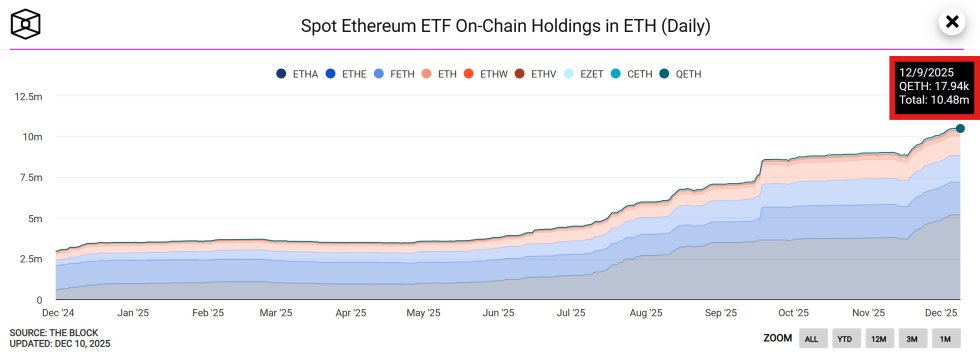
Data shared by the expert reveals that spot Ethereum ETF on-chain holdings have now reached approximately 10.48 million ETH. Everstake added that this is one of the strongest, most consistent accumulation trends ever recorded since the launch of the funds about a year ago.
Ethereum

Given the substantial growth of the funds, the expert has declared that “the future is bullish, and the future is Ethereum.” As ETF holdings rise to previously unheard-of levels, the question now is not whether smart money is going in, but rather what they anticipate.

The steady growth is not observed among other metrics, like the Funding Rates. Currently, the derivatives market for ETH is starting to cool, and funding rates are clearly reflecting this change. However, this is not entirely a bad thing for the altcoin and its price trajectory.

As reported by Sina Estavi, the Chief Executive Officer (CEO) of Bridge Capital, a declining ETH funding rate is not merely a sign of a cool market. Rather, it is the structure that typically appears on the chart prior to a sustained move.

When funding resets in the absence of aggressive shorting, it usually implies that leverage is not overcrowded, the rally is not overheated, and spot-driven demand can carry the price further. Should ETH register even a modest growth in demand, the market may have room to extend this bullish leg.

Institutional Demand For ETH Is Returning

Ethereum’s recent sideways price movements do not seem to have swayed institutions from acquiring the altcoin. Big firms such as Bitmine Immersion, a leading treasury company run by industry leader Tom Lee, are still scooping up ETH at a substantial rate and scale.

The report from Arkham shows that as of Tuesday, Bitmine has purchased over 138,452 ETH valued at approximately $431.97 million since last week. Following the purchase, the company’s crypto holdings now boost about $12.05 billion in ETH. Despite this massive holding of ETH, the firm still has $1 billion left to accumulate more of the altcoin.


Ethereum
Disclaimer: The articles reposted on this site are sourced from public platforms and are provided for informational purposes only. They do not necessarily reflect the views of MEXC. All rights remain with the original authors. If you believe any content infringes on third-party rights, please contact service@support.mexc.com for removal. MEXC makes no guarantees regarding the accuracy, completeness, or timeliness of the content and is not responsible for any actions taken based on the information provided. The content does not constitute financial, legal, or other professional advice, nor should it be considered a recommendation or endorsement by MEXC.

You May Also Like

Luxembourg adds Bitcoin to its wealth fund, but what does that mean for Europe?

Luxembourg adds Bitcoin to its wealth fund, but what does that mean for Europe?

The post Luxembourg adds Bitcoin to its wealth fund, but what does that mean for Europe? appeared on BitcoinEthereumNews.com. Key Takeaways Why does Luxembourg’s move matter? It’s the first Eurozone nation to include Bitcoin in a sovereign wealth fund. How does it fit into Europe’s bigger picture? The UK is opening crypto ETNs to retail investors, and the EU’s ESMA is expanding its oversight. Luxembourg has become the first Eurozone country to invest part of its sovereign wealth fund in Bitcoin. During the presentation of the 2026 Budget at the Chambre des Deputes, Finance Minister Gilles Roth confirmed that the Fonds Souverain Intergenerationnel du Luxembourg (FSIL) — the nation’s sovereign wealth fund — has allocated 1% of its portfolio to Bitcoin. Luxembourg’s Bitcoin play According to Bob Kieffer, Director of the Treasury, the decision reflects “the growing maturity of this new asset class” and “leadership in digital finance.” Under the FSIL’s revised investment policy, up to 15% of total assets can now be placed in alternative investments. This includes investments in private equity, real estate, and crypto assets. The Bitcoin exposure, roughly €8.5 million [around $9 million USD], is being made through ETFs to avoid custody and operational risks. Kieffer also acknowledged differing opinions about the move. He said,  “Some might argue that we’re committing too little too late; others will point out the volatility and speculative nature of the investment. Yet, given the FSIL’s mission, a 1% allocation strikes the right balance while sending a clear message about Bitcoin’s long-term potential.” A cautious, but symbolic shift The FSIL, created in 2014 to preserve wealth across generations, now manages roughly €850 million. The announcement also comes on the back of Luxembourg tightening its digital asset regulatory framework, while preparing to implement DAC8. This new move will expand tax and reporting standards for crypto service providers in 2026. If Bitcoin continues to gain acceptance among sovereign investors, Luxembourg’s decision could…
Share
BitcoinEthereumNews2025/10/10 02:02
XRP Fractal Signals $6–$7 Surge by November Amid DLT Disruption

XRP Fractal Signals $6–$7 Surge by November Amid DLT Disruption

The post XRP Fractal Signals $6–$7 Surge by November Amid DLT Disruption appeared on BitcoinEthereumNews.com. XRP Fractal Analysis Hints at $6–$7 Breakout by Mid-November According to renowned market analyst EGRAG CRYPTO, XRP may be on the verge of a significant price movement. In his latest analysis, he points to a fractal formation pattern that suggests XRP could reach the $6–$7 range by mid-November.  Source: EGRAG CRYPTO This projection has quickly caught the attention of traders and long-term investors, as XRP’s current price remains well below this target. Fractals, often used in technical analysis, are recurring chart patterns that can help predict future price action by identifying historical similarities in market behavior.  Therefore, EGRAG CRYPTO argues that XRP is currently mirroring a previous structure that led to a notable rally. If this fractal setup plays out as expected, it could mark one of the most significant price surges for the digital asset in recent years. If XRP reaches $6–$7 by mid-November, it would mark a major win for investors and a symbolic breakthrough for a token that has endured regulatory battles and market volatility, validating its resilience and cementing its relevance in the evolving digital finance ecosystem. Meanwhile, a recent cup-and-handle pattern signalled that XRP had the potential of soaring to $15 by year-end with the altcoin presently trading at $3.04 per CoinGecko data.  DLT-Based Solutions: How Ripple and Stellar are Redefining Cross-Border Banking According to crypto observer SMQKE, distributed ledger technology (DLT)-based solutions are increasingly challenging the traditional correspondent banking model.  For decades, cross-border payments have relied on a chain of intermediaries, often resulting in slow settlements, high costs, and limited transparency. But with the rise of blockchain networks such as Ripple and Stellar, the industry is experiencing a seismic shift. The correspondent banking model depends on trust and pre-funded accounts, locking up liquidity and exposing banks to counterparty risk.  Transactions often take days to…
Share
BitcoinEthereumNews2025/09/19 16:12