Quantum risk has become a recurring stress point in Bitcoin discourse, often framed as an existential threat. The claim usually follows a familiar arc: quantum Quantum risk has become a recurring stress point in Bitcoin discourse, often framed as an existential threat. The claim usually follows a familiar arc: quantum

Bitcoin And The Quantum Panic: What Developers Are Actually Doing

2025/12/15 22:00
4 min read
For feedback or concerns regarding this content, please contact us at crypto.news@mexc.com

Quantum risk has become a recurring stress point in Bitcoin discourse, often framed as an existential threat. The claim usually follows a familiar arc: quantum computing is advancing quickly, cryptography is vulnerable, and Bitcoin isn’t adapting fast enough.

Marty Bent doesn’t buy that framing. In his Dec. 14 episode, Bent acknowledged that quantum computing represents a genuine risk — not just for Bitcoin, but for any system built on modern cryptography — while pushing back on the idea that Bitcoin developers are ignoring the issue.

“Short answer is yes, it is a risk,” Bent said. “But it’s not only a risk for Bitcoin. It’s a risk for any system that depends on cryptography for security.”

What Developers Are Doing To Make Bitcoin Quantum-Safe

What tends to get lost, he argued, is the work already underway. Bent pointed to ongoing developer discussions and, more recently, a research paper published by Blockstream’s Jonas Nick and Mikhail Kutunov examining hash-based, post-quantum signature schemes tailored specifically for Bitcoin.

“I just wanted to make this video to push back on that notion,” Bent said, referring to claims that Bitcoin isn’t moving fast enough. “Because I think it’s pretty clear if you’ve been following Bitcoin development discussions over the last year, the quantum risk is certainly being taken seriously and the conversations have started.”

Nick summarized the paper in a Dec. 9 post on X, describing it as an analysis of post-quantum schemes optimized for Bitcoin’s constraints rather than generic cryptographic benchmarks. Bent described the work as a signal that research is shifting from abstract concern to concrete design space.

Nick wrote via X: “Hash-based signatures are conceptually simple and rely solely on hash functions, which is a primitive Bitcoin already trusts. While NIST has standardized SLH-DSA (SPHINCS+), we investigate alternatives that are better suited to Bitcoin’s specific needs. We explore in detail how various optimizations and parameter choices affect size and performance. Signature size can be reduced to ~3-4KB, which is comparable to lattice-based signature schemes (ML-DSA).”

The challenge, Bent emphasized, isn’t a lack of candidate solutions. It’s that Bitcoin is a globally distributed system with nearly 17 years of operational history, and changes at the protocol level come with heavy trade-offs. “Bitcoin is a globally distributed peer-to-peer system that depends on consensus protocol rules that are very hard to change,” Bent said. “And you really don’t want to change them too often.”

That reality complicates any transition to quantum-resistant signatures. Existing address types, HD wallets, multisig setups, and threshold schemes all need to be considered. And beyond compatibility, there’s the question of performance.

“One of the biggest hurdles when approaching this problem in Bitcoin is that many quantum-resistant schemes are very data intensive,” Bent said. “Yes, there are many different schemes that can be implemented. However, they come with trade-offs — particularly verification and bandwidth trade-offs.”

Larger signatures can slow block propagation and make it more expensive to run a full node, which directly impacts decentralization. The Blockstream paper focuses heavily on that tension, exploring optimizations that could reduce signature sizes to a few kilobytes while keeping verification costs manageable.

“They feel pretty confident that they’ve done the research to find signature schemes that would have a nice trade-off balance,” Bent said. “You get quantum resistance, but at the same time it remains conducive for people to download full nodes and verify transactions without needing a significant amount of bandwidth and data storage.”

Bent was careful not to frame the research as a finished solution. Instead, he described it as groundwork — mapping the problem space early so the network isn’t caught flat-footed if quantum capabilities advance faster than expected.

“This is by no means like, ‘hey, we solved the problem,’” he said. “But we are taking this problem seriously, doing research and beginning to figure out ways in which we could solve the quantum risk that may or may not manifest in the medium to long term.”

He also noted that BTC tends to be singled out in quantum discussions, even though most of the internet relies on cryptographic assumptions that would face similar pressure in a true post-quantum scenario.

“If quantum computers do come, Bitcoin is not the only thing,” Bent said. “Almost everything you touch on the internet is depending on some cryptographic security at some point.”

For now, Bent’s takeaway was measured. Quantum risk exists. Progress in quantum computing is real. But the narrative that developers are ignoring the issue doesn’t align with what’s happening in technical circles.

“Very smart developers, cryptographers more importantly, are researching the problem,” he said. “If you know where to look, it’s pretty clear that people are preparing for this.” Not solved. Not ignored. Just quietly being worked on.

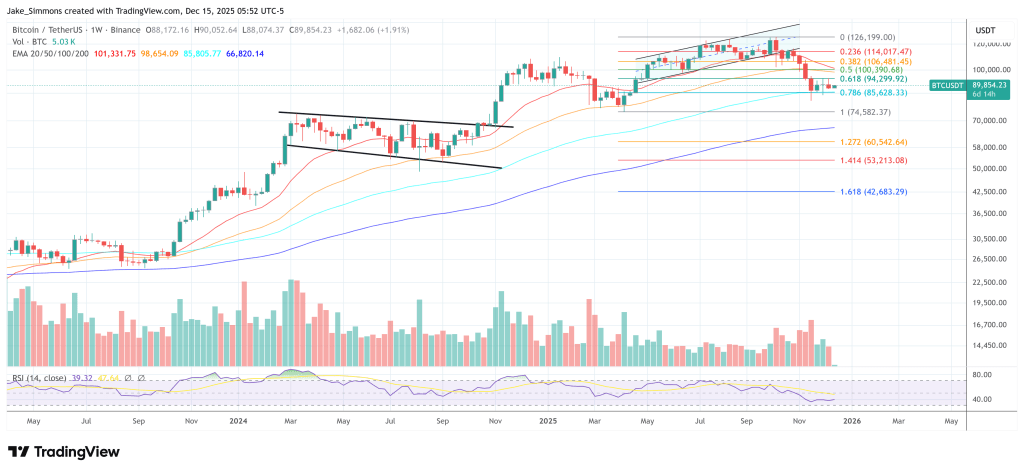
At press time, BTC traded at $89,854.
Bitcoin price
Market Opportunity
QUANTUM Logo
QUANTUM Price(QUANTUM)
$0.002727
$0.002727$0.002727
+0.77%
USD
QUANTUM (QUANTUM) Live Price Chart
Disclaimer: The articles reposted on this site are sourced from public platforms and are provided for informational purposes only. They do not necessarily reflect the views of MEXC. All rights remain with the original authors. If you believe any content infringes on third-party rights, please contact crypto.news@mexc.com for removal. MEXC makes no guarantees regarding the accuracy, completeness, or timeliness of the content and is not responsible for any actions taken based on the information provided. The content does not constitute financial, legal, or other professional advice, nor should it be considered a recommendation or endorsement by MEXC.
Tags:

You May Also Like

Why This New Trending Meme Coin Is Being Dubbed The New PEPE After Record Presale

Why This New Trending Meme Coin Is Being Dubbed The New PEPE After Record Presale

The post Why This New Trending Meme Coin Is Being Dubbed The New PEPE After Record Presale appeared on BitcoinEthereumNews.com. Crypto News 17 September 2025 | 20:13 The meme coin market is heating up once again as traders look for the next breakout token. While Shiba Inu (SHIB) continues to build its ecosystem and PEPE holds onto its viral roots, a new contender, Layer Brett (LBRETT), is gaining attention after raising more than $3.7 million in its presale. With a live staking system, fast-growing community, and real tech backing, some analysts are already calling it “the next PEPE.” Here’s the latest on the Shiba Inu price forecast, what’s going on with PEPE, and why Layer Brett is drawing in new investors fast. Shiba Inu price forecast: Ecosystem builds, but retail looks elsewhere Shiba Inu (SHIB) continues to develop its broader ecosystem with Shibarium, the project’s Layer 2 network built to improve speed and lower gas fees. While the community remains strong, the price hasn’t followed suit lately. SHIB is currently trading around $0.00001298, and while that’s a decent jump from its earlier lows, it still falls short of triggering any major excitement across the market. The project includes additional tokens like BONE and LEASH, and also has ongoing initiatives in DeFi and NFTs. However, even with all this development, many investors feel the hype that once surrounded SHIB has shifted elsewhere, particularly toward newer, more dynamic meme coins offering better entry points and incentives. PEPE: Can it rebound or is the momentum gone? PEPE saw a parabolic rise during the last meme coin surge, catching fire on social media and delivering massive short-term gains for early adopters. However, like most meme tokens driven largely by hype, it has since cooled off. PEPE is currently trading around $0.00001076, down significantly from its peak. While the token still enjoys a loyal community, analysts believe its best days may be behind it unless…
Share
BitcoinEthereumNews2025/09/18 02:50
USD/JPY Intervention: How Verbal Warnings Dramatically Slowed the Japanese Yen’s Slide

USD/JPY Intervention: How Verbal Warnings Dramatically Slowed the Japanese Yen’s Slide

BitcoinWorld USD/JPY Intervention: How Verbal Warnings Dramatically Slowed the Japanese Yen’s Slide TOKYO, March 2025 – Japanese authorities’ carefully calibrated

Share
bitcoinworld2026/03/30 23:25
Adoption Leads Traders to Snorter Token

Adoption Leads Traders to Snorter Token

The post Adoption Leads Traders to Snorter Token appeared on BitcoinEthereumNews.com. Largest Bank in Spain Launches Crypto Service: Adoption Leads Traders to Snorter Token Sign Up for Our Newsletter! For updates and exclusive offers enter your email. Leah is a British journalist with a BA in Journalism, Media, and Communications and nearly a decade of content writing experience. Over the last four years, her focus has primarily been on Web3 technologies, driven by her genuine enthusiasm for decentralization and the latest technological advancements. She has contributed to leading crypto and NFT publications – Cointelegraph, Coinbound, Crypto News, NFT Plazas, Bitcolumnist, Techreport, and NFT Lately – which has elevated her to a senior role in crypto journalism. Whether crafting breaking news or in-depth reviews, she strives to engage her readers with the latest insights and information. Her articles often span the hottest cryptos, exchanges, and evolving regulations. As part of her ploy to attract crypto newbies into Web3, she explains even the most complex topics in an easily understandable and engaging way. Further underscoring her dynamic journalism background, she has written for various sectors, including software testing (TEST Magazine), travel (Travel Off Path), and music (Mixmag). When she’s not deep into a crypto rabbit hole, she’s probably island-hopping (with the Galapagos and Hainan being her go-to’s). Or perhaps sketching chalk pencil drawings while listening to the Pixies, her all-time favorite band. This website uses cookies. By continuing to use this website you are giving consent to cookies being used. Visit our Privacy Center or Cookie Policy. I Agree Source: https://bitcoinist.com/banco-santander-and-snorter-token-crypto-services/
Share
BitcoinEthereumNews2025/09/17 23:45