Daily market key data review and trend analysis, produced by PANews.Daily market key data review and trend analysis, produced by PANews.

Trading time: Crypto market pulls back across the board, Ethereum nearly halved since the beginning of the year

2025/03/11 14:30

Trading time: Crypto market pulls back across the board, Ethereum has nearly halved since the beginning of the year

1. Market observation

Keywords: Coinbase, ETH, BTC

BTC fell below $77,000 this morning. Greeks.live briefings show that traders are generally bearish at present, with most focusing on the $74,000-76,000 area as a potential downside target, and $87,000 as a resistance level. Arthur Hayes, co-founder of BitMEX, predicts that Bitcoin may bottom out around $70,000, which is equivalent to a 36% correction from the historical high of $110,000, which is a normal adjustment in the bull market. Although Strategy did not increase its holdings of Bitcoin last week, it has submitted a new prospectus to issue $21 billion in preferred shares, which may be used to purchase Bitcoin.

In the case of Ethereum, the situation is even more serious. Its price has fallen below $1,800 this morning. An address holding 65,000 ETH is facing liquidation risk, and another whale has sold 25,800 ETH for risk aversion, with a loss of $31.75 million. Yuga Labs executives warned that if the market enters a bear market, ETH may fall below $1,500, or even reach the $200-400 range, which is consistent with the 90% maximum retracement in historical bear markets.

In the traditional financial market, the US stock market experienced a "Black Monday", with the Nasdaq falling 4%, Tesla falling 15%, and blockchain concept stocks generally falling, including Coinbase falling 17.58% and MicroStrategy falling 16.68%. In this regard, Arthur Hayes believes that the next step is to pay attention to the plunge in US stocks and the risk of bankruptcy of traditional financial institutions, and then major central banks may adopt loose policies to stimulate the economy. Cathie Wood, founder of ARK Invest, believes that the market is digesting the last stage of the recession and expects a deflationary boom in the second half of the year. However, Federal Reserve Chairman Powell recently said that the Federal Reserve is not in a hurry to cut interest rates due to the continued strength of the labor market, the uneven inflation path, and the uncertainty of the impact of Trump's trade, fiscal, immigration and regulatory policies. Goldman Sachs has lowered its forecast for US economic growth to 1.7% and raised its inflation forecast. It is worth noting that futures traders are increasingly betting that the Federal Reserve will cut interest rates in June, July and October.

Facing the current market situation, Delphi Digital researcher Minty suggested that investors should not measure investment by historical highs, but rather a target of 50-70%. He said that most altcoins may never return to their historical highs, major opportunities only appear a few times a year and are fleeting, and over-trading and lack of patience are the main reasons for profit loss.

2. Key data (as of 13:00 HKT on March 11)

  • Fear index: 24 (extreme fear)

  • 24-hour BTC long-short ratio: 0.9685
  • Average GAS: BTC 3 sat/vB, ETH 1.11 Gwei

  • Market share: BTC 61.1%, ETH 8.7%

  • Upbit 24-hour trading volume ranking: XRP, BTC, ETH

  • Sector ups and downs: DeFi sector fell 8.32%, Meme sector fell 9.19%

  • Bitcoin: $80,007.13 (-14.6% year-to-date), with a daily spot volume of $58.486 billion

  • Ethereum: $1,865.44 (-44.05% year-to-date), with a daily spot volume of $38.414 billion

  • 24-hour liquidation data: A total of 336,581 people were liquidated worldwide, with a total liquidation amount of US$956 million, including BTC liquidation of US$318 million and ETH liquidation of US$252 million.
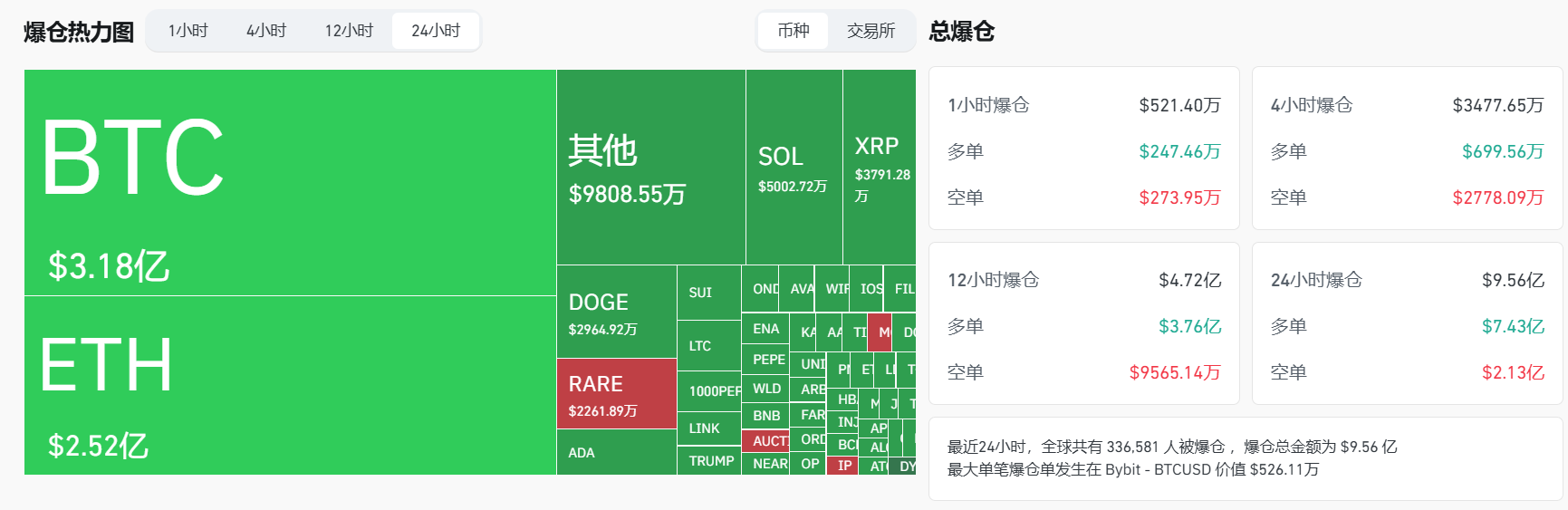
Trading time: Crypto market pulls back across the board, Ethereum has nearly halved since the beginning of the year

3. ETF flows (as of March 10 EST)

  • Bitcoin ETF: -$189 million

  • Ethereum ETF: -$34 million

4. Important Dates (Hong Kong Time)

US President Trump met with US technology leaders, including the CEOs of HP, Intel, IBM, and Qualcomm. (March 11, 2:00)

US President Trump signed an executive order. US February unadjusted CPI annual rate (March 12, 20:30)

  • Actual: None / Previous: 3% / Expected: 2.9%

U.S. February seasonally adjusted CPI monthly rate (March 12, 20:30)

  • Actual: None / Previous: 0.50% / Expected: 0.30%

Number of initial jobless claims in the United States for the week ending March 8 (10,000 people) (March 13, 20:30)

  • Actual: None / Previous: 22.1 / Expected: None

5. Hot News

El Salvador and Paraguay Sign Cryptocurrency Regulatory Agreement

Bithumb launches Elixir (ELX) Korean Won trading market

Maker will update the oracle price to $1806 at 10:00, and the whale address position of 65,000 ETH may face forced liquidation

Longling Capital transferred 21,000 ETH to Binance, about 38.81 million US dollars

Mt. Gox transfers about 11,502 BTC to unknown wallet, possibly related to creditor repayment plan

The U.S. Senate updates the stablecoin bill GENIUS Act 2025: Expanding the reciprocity clause for overseas payment stablecoins

BTC falls below $77,000, down 3.80% on the day

Solana transaction fees fall to lowest level since September 2024, on-chain activity drops sharply

Black Monday in US stocks: Nasdaq plunges 4% and Tesla falls 15%

Coinbase will launch Cookie DAO (COOKIE)

Coinbase to launch 24/7 Bitcoin and Ethereum futures contracts in the U.S.

Movement public mainnet Beta is now live

DeFi TVL has completely given up the gains since Trump was elected as the US president, falling by more than $45 billion from its previous peak

UK Treasury: No plans to introduce US-style Bitcoin reserves

MyShell: Terminated cooperation with illegal market makers and introduced new partners, and plans to repurchase SHELL

Thai regulator adds stablecoins USDC, USDT to approved cryptocurrencies

Strategy files prospectus for offering up to $21 billion in preferred stock

Crypto executives suggest that Bitcoin can be exchanged for Trump's "gold card"

Singapore Exchange plans to launch Bitcoin perpetual futures contracts in the second half of 2025

Market News: Japan's cryptocurrency reform bill will be submitted to the Diet after cabinet approval

Standard Chartered Bank: The United States can build up Bitcoin reserves by selling gold and using treasury funds

Cayman Islands’ new cryptocurrency regulatory framework introduces new licensing requirements, effective April 1

CoinShares: Last week, digital asset investment products saw a net outflow of $876 million, marking the fourth consecutive week of outflows


Disclaimer: The articles reposted on this site are sourced from public platforms and are provided for informational purposes only. They do not necessarily reflect the views of MEXC. All rights remain with the original authors. If you believe any content infringes on third-party rights, please contact service@support.mexc.com for removal. MEXC makes no guarantees regarding the accuracy, completeness, or timeliness of the content and is not responsible for any actions taken based on the information provided. The content does not constitute financial, legal, or other professional advice, nor should it be considered a recommendation or endorsement by MEXC.

You May Also Like

Shocking OpenVPP Partnership Claim Draws Urgent Scrutiny

Shocking OpenVPP Partnership Claim Draws Urgent Scrutiny

The post Shocking OpenVPP Partnership Claim Draws Urgent Scrutiny appeared on BitcoinEthereumNews.com. The cryptocurrency world is buzzing with a recent controversy surrounding a bold OpenVPP partnership claim. This week, OpenVPP (OVPP) announced what it presented as a significant collaboration with the U.S. government in the innovative field of energy tokenization. However, this claim quickly drew the sharp eye of on-chain analyst ZachXBT, who highlighted a swift and official rebuttal that has sent ripples through the digital asset community. What Sparked the OpenVPP Partnership Claim Controversy? The core of the issue revolves around OpenVPP’s assertion of a U.S. government partnership. This kind of collaboration would typically be a monumental endorsement for any private cryptocurrency project, especially given the current regulatory climate. Such a partnership could signify a new era of mainstream adoption and legitimacy for energy tokenization initiatives. OpenVPP initially claimed cooperation with the U.S. government. This alleged partnership was said to be in the domain of energy tokenization. The announcement generated considerable interest and discussion online. ZachXBT, known for his diligent on-chain investigations, was quick to flag the development. He brought attention to the fact that U.S. Securities and Exchange Commission (SEC) Commissioner Hester Peirce had directly addressed the OpenVPP partnership claim. Her response, delivered within hours, was unequivocal and starkly contradicted OpenVPP’s narrative. How Did Regulatory Authorities Respond to the OpenVPP Partnership Claim? Commissioner Hester Peirce’s statement was a crucial turning point in this unfolding story. She clearly stated that the SEC, as an agency, does not engage in partnerships with private cryptocurrency projects. This response effectively dismantled the credibility of OpenVPP’s initial announcement regarding their supposed government collaboration. Peirce’s swift clarification underscores a fundamental principle of regulatory bodies: maintaining impartiality and avoiding endorsements of private entities. Her statement serves as a vital reminder to the crypto community about the official stance of government agencies concerning private ventures. Moreover, ZachXBT’s analysis…
Share
BitcoinEthereumNews2025/09/18 02:13
The Role of Blockchain in Building Safer Web3 Gaming Ecosystems

The Role of Blockchain in Building Safer Web3 Gaming Ecosystems

The gaming industry is in the midst of a historic shift, driven by the rise of Web3. Unlike traditional games, where developers and publishers control assets and dictate in-game economies, Web3 gaming empowers players with ownership and influence. Built on blockchain technology, these ecosystems are decentralized by design, enabling true digital asset ownership, transparent economies, and a future where players help shape the games they play. However, as Web3 gaming grows, security becomes a focal point. The range of security concerns, from hacking to asset theft to vulnerabilities in smart contracts, is a significant issue that will undermine or erode trust in this ecosystem, limiting or stopping adoption. Blockchain technology could be used to create security processes around secure, transparent, and fair Web3 gaming ecosystems. We will explore how security is increasing within gaming ecosystems, which challenges are being overcome, and what the future of security looks like. Why is Security Important in Web3 Gaming? Web3 gaming differs from traditional gaming in that players engage with both the game and assets with real value attached. Players own in-game assets that exist as tokens or NFTs (Non-Fungible Tokens), and can trade and sell them. These game assets usually represent significant financial value, meaning security failure could represent real monetary loss. In essence, without security, the promises of owning “something” in Web3, decentralized economies within games, and all that comes with the term “fair” gameplay can easily be eroded by fraud, hacking, and exploitation. This is precisely why the uniqueness of blockchain should be emphasized in securing Web3 gaming. How Blockchain Ensures Security in Web3 Gaming?
  1. Immutable Ownership of Assets Blockchain records can be manipulated by anyone. If a player owns a sword, skin, or plot of land as an NFT, it is verifiably in their ownership, and it cannot be altered or deleted by the developer or even hacked. This has created a proven track record of ownership, providing control back to the players, unlike any centralised gaming platform where assets can be revoked.
  2. Decentralized Infrastructure Blockchain networks also have a distributed architecture where game data is stored in a worldwide network of nodes, making them much less susceptible to centralised points of failure and attacks. This decentralised approach makes it exponentially more difficult to hijack systems or even shut off the game’s economy.
  3. Secure Transactions with Cryptography Whether a player buys an NFT or trades their in-game tokens for other items or tokens, the transactions are enforced by cryptographic algorithms, ensuring secure, verifiable, and irreversible transactions and eliminating the risks of double-spending or fraudulent trades.
  4. Smart Contract Automation Smart contracts automate the enforcement of game rules and players’ economic exchanges for the developer, eliminating the need for intermediaries or middlemen, and trust for the developer. For example, if a player completes a quest that promises a reward, the smart contract will execute and distribute what was promised.
  5. Anti-Cheating and Fair Gameplay The naturally transparent nature of blockchain makes it extremely simple for anyone to examine a specific instance of gameplay and verify the economic outcomes from that play. Furthermore, multi-player games that enforce smart contracts on things like loot sharing or win sharing can automate and measure trustlessness and avoid cheating, manipulations, and fraud by developers.
  6. Cross-Platform Security Many Web3 games feature asset interoperability across platforms. This interoperability is made viable by blockchain, which guarantees ownership is maintained whenever assets transition from one game or marketplace to another, thereby offering protection to players who rely on transfers for security against fraud. Key Security Dangers in Web3 Gaming Although blockchain provides sound first principles of security, the Web3 gaming ecosystem is susceptible to threats. Some of the most serious threats include:
Smart Contract Vulnerabilities: Smart contracts that are poorly written or lack auditing will leave openings for exploitation and thereby result in asset loss. Phishing Attacks: Unintentionally exposing or revealing private keys or signing transactions that are not possible to reverse, under the assumption they were genuine transaction requests. Bridge Hacks: Cross-chain bridges, which allow players to move their assets between their respective blockchains, continually face hacks, requiring vigilance from players and developers. Scams and Rug Pulls: Rug pulls occur when a game project raises money and leaves, leaving player assets worthless. Regulatory Ambiguity: Global regulations remain unclear; risks exist for players and developers alike. While blockchain alone won’t resolve every issue, it remediates the responsibility of the first principles, more so when joined by processes such as auditing, education, and the right governance, which can improve their contribution to the security landscapes in game ecosystems. Real Life Examples of Blockchain Security in Web3 Gaming Axie Infinity (Ronin Hack): The Axie Infinity game and several projects suffered one of the biggest hacks thus far on its Ronin bridge; however, it demonstrated the effectiveness of multi-sig security and the effective utilization of decentralization. The industry benefited through learning and reflection, thus, as projects have implemented changes to reduce the risks of future hacks or misappropriation. Immutable X: This Ethereum scaling solution aims to ensure secure NFT transactions for gaming, allowing players to trade an asset without the burden of exorbitant fees and fears of being a victim of fraud. Enjin: Enjin is providing a trusted infrastructure for Web3 games, offering secure NFT creation and transfer while reiterating that ownership and an asset securely belong to the player. These examples indubitably illustrate that despite challenges to overcome, blockchain remains the foundational layer on which to build more secure Web3 gaming environments. Benefits of Blockchain Security for Players and Developers For Players: Confidence in true ownership of assets Transparency in in-game economies Protection against nefarious trades/scams For Developers: More trust between players and the platform Less reliance on centralized infrastructure Ability to attract wealth and players based on provable fairness By incorporating blockchain security within the mechanics of game design, developers can create and enforce resilient ecosystems where players feel reassured in investing time, money, and ownership within virtual worlds. The Future of Secure Web3 Gaming Ecosystems As the wisdom of blockchain technology and industry knowledge improves, the future for secure Web3 gaming looks bright. New growing trends include: Zero-Knowledge Proofs (ZKPs): A new wave of protocols that enable private transactions and secure smart contracts while managing user privacy with an element of transparency. Decentralized Identity Solutions (DID): Helping players control their identities and decrease account theft risks. AI-Enhanced Security: Identifying irregularities in user interactions by sampling pattern anomalies to avert hacks and fraud by time-stamping critical events. Interoperable Security Standards: Allowing secured and seamless asset transfers across blockchains and games. With these innovations, blockchain will not only secure gaming assets but also enhance the overall trust and longevity of Web3 gaming ecosystems. Conclusion Blockchain is more than a buzzword in Web3; it is the only way to host security, fairness, and transparency. With blockchain, players confirm immutable ownership of digital assets, there is a decentralized infrastructure, and finally, it supports smart contracts to automate code that protects players and developers from the challenges of digital economies. The threats, vulnerabilities, and scams that come from smart contracts still persist, but the industry is maturing with better security practices, cross-chain solutions, and increased formal cryptographic tools. In the coming years, blockchain will remain the base to digital economies and drive Web3 gaming environments that allow players to safely own, trade, and enjoy their digital experiences free from fraud and exploitation. While blockchain and gaming alone entertain, we will usher in an era of secure digital worlds where trust complements innovation. The Role of Blockchain in Building Safer Web3 Gaming Ecosystems was originally published in Coinmonks on Medium, where people are continuing the conversation by highlighting and responding to this story
Share
Medium2025/09/18 14:40
Morning Crypto Report: $3.6 XRP Dream Is Not Dead: Bollinger Bands, ‘New Cardano’ Rockets 40%, Vitalik Buterin Sells Binance Coin and Other Crypto Amid ‘Crypto Winter’

Morning Crypto Report: $3.6 XRP Dream Is Not Dead: Bollinger Bands, ‘New Cardano’ Rockets 40%, Vitalik Buterin Sells Binance Coin and Other Crypto Amid ‘Crypto Winter’

The post Morning Crypto Report: $3.6 XRP Dream Is Not Dead: Bollinger Bands, ‘New Cardano’ Rockets 40%, Vitalik Buterin Sells Binance Coin and Other Crypto Amid
Share
BitcoinEthereumNews2025/12/21 22:15