MaGGIe ensures feature temporal consistency in videos using bidirectional Conv-GRU. It uses AdamW optimization and curriculum learning on A100 GPUs for robust mattingMaGGIe ensures feature temporal consistency in videos using bidirectional Conv-GRU. It uses AdamW optimization and curriculum learning on A100 GPUs for robust matting

MaGGIe Training Setup: High-Performance Human Instance Matting with A100 GPUs

Abstract and 1. Introduction

  1. Related Works

  2. MaGGIe

    3.1. Efficient Masked Guided Instance Matting

    3.2. Feature-Matte Temporal Consistency

  3. Instance Matting Datasets

    4.1. Image Instance Matting and 4.2. Video Instance Matting

  4. Experiments

    5.1. Pre-training on image data

    5.2. Training on video data

  5. Discussion and References

\ Supplementary Material

  1. Architecture details

  2. Image matting

    8.1. Dataset generation and preparation

    8.2. Training details

    8.3. Quantitative details

    8.4. More qualitative results on natural images

  3. Video matting

    9.1. Dataset generation

    9.2. Training details

    9.3. Quantitative details

    9.4. More qualitative results

8.2. Training details

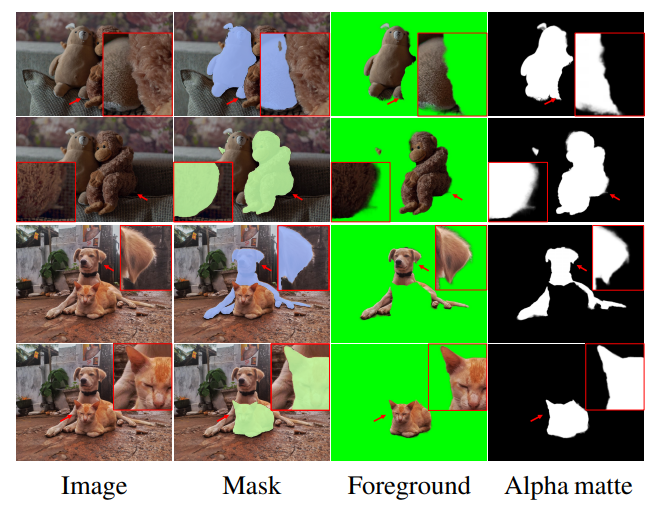
\ Figure 11. Our framework can generalize to any object. Without humans appearing in the image, our framework still performs the matting task very well to the mask-guided objects. (Best viewed in color and digital zoom).
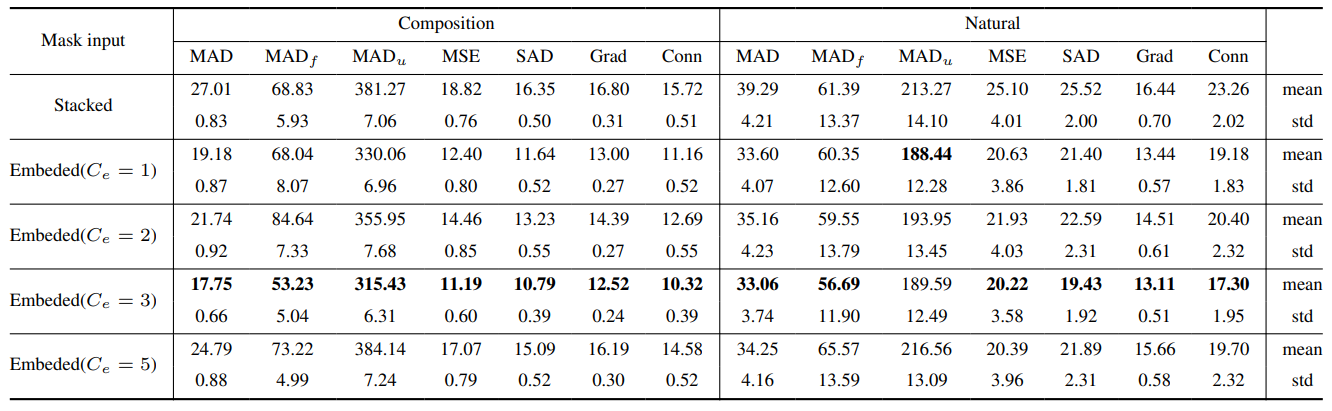
\ Table 9. Full details of different input mask setting on HIM2K+M-HIM2K. (Extension of Table 3). Bold denotes the lowest average error.

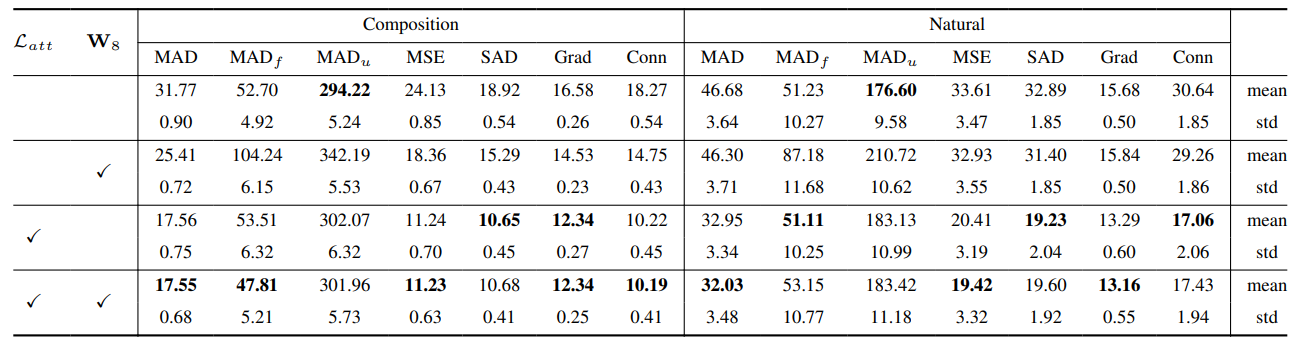
\ Table 10. Full details of different training objective components on HIM2K+M-HIM2K. (Extension of Table 4). Bold denotes the lowest average error.

\

:::info Authors:

(1) Chuong Huynh, University of Maryland, College Park (chuonghm@cs.umd.edu);

(2) Seoung Wug Oh, Adobe Research (seoh,jolee@adobe.com);

(3) Abhinav Shrivastava, University of Maryland, College Park (abhinav@cs.umd.edu);

(4) Joon-Young Lee, Adobe Research (jolee@adobe.com).

:::


:::info This paper is available on arxiv under CC by 4.0 Deed (Attribution 4.0 International) license.

:::

\

Disclaimer: The articles reposted on this site are sourced from public platforms and are provided for informational purposes only. They do not necessarily reflect the views of MEXC. All rights remain with the original authors. If you believe any content infringes on third-party rights, please contact service@support.mexc.com for removal. MEXC makes no guarantees regarding the accuracy, completeness, or timeliness of the content and is not responsible for any actions taken based on the information provided. The content does not constitute financial, legal, or other professional advice, nor should it be considered a recommendation or endorsement by MEXC.

You May Also Like

Trump’s Crypto Gains Risk Backlash Post-Presidency, Ethereum Veteran Advises Urgency

Trump’s Crypto Gains Risk Backlash Post-Presidency, Ethereum Veteran Advises Urgency

The post Trump’s Crypto Gains Risk Backlash Post-Presidency, Ethereum Veteran Advises Urgency appeared on BitcoinEthereumNews.com. President Trump’s administration
Share
BitcoinEthereumNews2025/12/21 01:29
China Blocks Nvidia’s RTX Pro 6000D as Local Chips Rise

China Blocks Nvidia’s RTX Pro 6000D as Local Chips Rise

The post China Blocks Nvidia’s RTX Pro 6000D as Local Chips Rise appeared on BitcoinEthereumNews.com. China Blocks Nvidia’s RTX Pro 6000D as Local Chips Rise China’s internet regulator has ordered the country’s biggest technology firms, including Alibaba and ByteDance, to stop purchasing Nvidia’s RTX Pro 6000D GPUs. According to the Financial Times, the move shuts down the last major channel for mass supplies of American chips to the Chinese market. Why Beijing Halted Nvidia Purchases Chinese companies had planned to buy tens of thousands of RTX Pro 6000D accelerators and had already begun testing them in servers. But regulators intervened, halting the purchases and signaling stricter controls than earlier measures placed on Nvidia’s H20 chip. Image: Nvidia An audit compared Huawei and Cambricon processors, along with chips developed by Alibaba and Baidu, against Nvidia’s export-approved products. Regulators concluded that Chinese chips had reached performance levels comparable to the restricted U.S. models. This assessment pushed authorities to advise firms to rely more heavily on domestic processors, further tightening Nvidia’s already limited position in China. China’s Drive Toward Tech Independence The decision highlights Beijing’s focus on import substitution — developing self-sufficient chip production to reduce reliance on U.S. supplies. “The signal is now clear: all attention is focused on building a domestic ecosystem,” said a representative of a leading Chinese tech company. Nvidia had unveiled the RTX Pro 6000D in July 2025 during CEO Jensen Huang’s visit to Beijing, in an attempt to keep a foothold in China after Washington restricted exports of its most advanced chips. But momentum is shifting. Industry sources told the Financial Times that Chinese manufacturers plan to triple AI chip production next year to meet growing demand. They believe “domestic supply will now be sufficient without Nvidia.” What It Means for the Future With Huawei, Cambricon, Alibaba, and Baidu stepping up, China is positioning itself for long-term technological independence. Nvidia, meanwhile, faces…
Share
BitcoinEthereumNews2025/09/18 01:37
Academic Publishing and Fairness: A Game-Theoretic Model of Peer-Review Bias

Academic Publishing and Fairness: A Game-Theoretic Model of Peer-Review Bias

Exploring how biases in the peer-review system impact researchers' choices, showing how principles of fairness relate to the production of scientific knowledge based on topic importance and hardness.
Share
Hackernoon2025/09/17 23:15