The post Crypto User Loses $50M in One Copy-Paste Mistake Address Poisoning Scam appeared first on Coinpedia Fintech News A crypto user has lost nearly $50 millionThe post Crypto User Loses $50M in One Copy-Paste Mistake Address Poisoning Scam appeared first on Coinpedia Fintech News A crypto user has lost nearly $50 million

Crypto User Loses $50M in One Copy-Paste Mistake Address Poisoning Scam

2025/12/20 14:18
3 min read
Crypto user lost millions

The post Crypto User Loses $50M in One Copy-Paste Mistake Address Poisoning Scam appeared first on Coinpedia Fintech News

A crypto user has lost nearly $50 million in USDT after falling victim to an address poisoning scam, according to on-chain analytics platform Lookonchain. The incident happened due to a simple copy-paste mistake during a large transfer and is now being described as one of the costliest errors in crypto history.

How the $50 Million Transfer Went Wrong

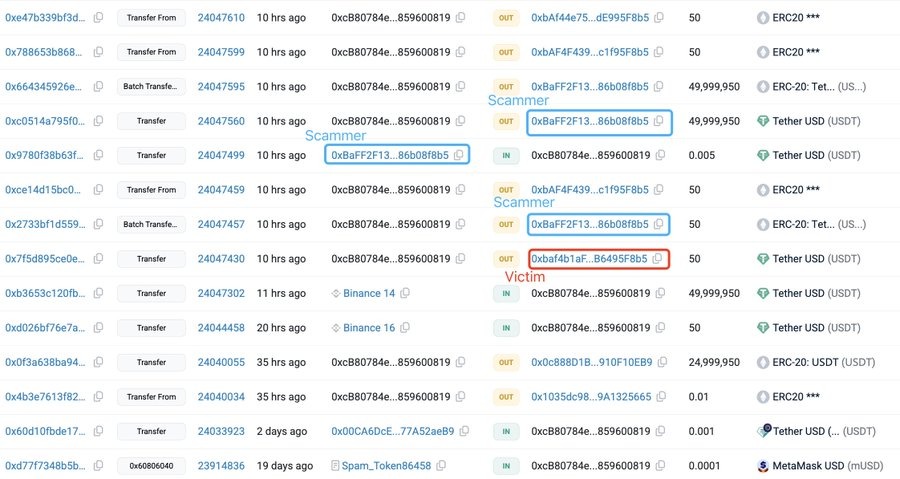
The incident began with what looked like a careful move. Before sending a large amount, the victim first transferred 50 USDT as a test transaction to their own wallet address. This is a common habit among crypto users to avoid errors.

However, scammers were closely monitoring the wallet.

Soon after the test transaction, the scammer created a fake wallet address that looked almost identical to the victim’s real address, matching the same first and last four characters. 

The scammer then sent small transactions to the victim so the fake address appeared in the transaction history. This tactic is the core of an address poisoning scam.

  • Also Read :
  •   US Senators Introduce SAFE Crypto Act to Target Rising Crypto Scams
  •   ,

The Costly Copy-Paste Error

When the victim later sent the remaining 49,999,950 USDT, they copied the address directly from their transaction history. Unfortunately, they unknowingly copied the spoofed address instead of their real one.

Within seconds, the entire amount was sent straight to the scammer’s wallet. Since blockchain transactions are irreversible, the funds were lost instantly with no recovery option.

Why Address Poisoning Scams Are So Dangerous

This type of scam, known as address poisoning, does not hack wallets or steal private keys. Instead, they exploit human habits and wallet design limitations. Many users only check the beginning and ending characters of an address, which scammers take advantage of.

Lookonchain’s shared image clearly shows how repeated small transfers were used to trick the victim into copying the wrong address.
scam chart
Never Miss a Beat in the Crypto World!

Stay ahead with breaking news, expert analysis, and real-time updates on the latest trends in Bitcoin, altcoins, DeFi, NFTs, and more.

bell icon Subscribe to News

FAQs

What is an address poisoning scam in crypto?

An address poisoning scam tricks users into sending crypto to a fake wallet by mimicking their real address.

How can I prevent address poisoning in crypto?

Always double-check full wallet addresses, avoid relying on transaction history, and test with small transfers.

Can lost crypto be recovered after a scam?

Blockchain transactions are irreversible, so once funds are sent to a scammer, they cannot be recovered.

What are the warning signs of a crypto address poisoning scam?

Look for unusual small transactions in your wallet history and addresses that closely resemble your own.

How can businesses avoid losing large crypto transfers to scams?

Use multi-step verification, test small transactions, and confirm addresses outside wallet history logs.


Market Opportunity
Scamcoin Logo
Scamcoin Price(SCAM)
$0.0003079
$0.0003079$0.0003079
-3.05%
USD
Scamcoin (SCAM) Live Price Chart
Disclaimer: The articles reposted on this site are sourced from public platforms and are provided for informational purposes only. They do not necessarily reflect the views of MEXC. All rights remain with the original authors. If you believe any content infringes on third-party rights, please contact service@support.mexc.com for removal. MEXC makes no guarantees regarding the accuracy, completeness, or timeliness of the content and is not responsible for any actions taken based on the information provided. The content does not constitute financial, legal, or other professional advice, nor should it be considered a recommendation or endorsement by MEXC.

You May Also Like

Perpetual DEX in testing with cross‑chain liquidity and ADL

Perpetual DEX in testing with cross‑chain liquidity and ADL

The post Perpetual DEX in testing with cross‑chain liquidity and ADL appeared on BitcoinEthereumNews.com. Sunperp, a new perpetual DEX being tested on the Tron blockchain, promises millisecond executions, cross-chain liquidity aggregation, and an integrated auto-deleveraging (ADL) system. Justin Sun reshared the announcement on X, inviting users to try it and highlighting dedicated incentives, while numerous economic details and operational metrics remain to be confirmed. According to the data collected by on-chain analysts and industry reports, in May 2025 TRON hosted over 75 billion USDT, with the network recording over 8.3 million daily transactions and approximately 306 million active accounts, a context that justifies the interest in USDT-collateralized derivatives. Market analysts following perpetual DEX also note that the massive availability of USDT on TRON facilitates cross-chain arbitrage operations and reduces costs for market makers. What is Sunperp and what it brings differently to Tron Sunperp is a platform perp DEX that uses USDT as collateral, with profits and losses calculated in USDT. The architecture separates matching, executed off-chain to maximize speed, from settlement, recorded on-chain to ensure transparency of trading results. In this context, the debut announcement was originally reported by Jamie Redman; the team also states that, while in the testing phase, the core contracts are non-upgradable. Main Technical Features Order types: market, limit (with FOK – Fill-or-Kill, GTC – Good-Till-Cancelled, and IOC – Immediate-or-Cancel modes), post-only orders, plan orders, trailing, and TWAP (Time-Weighted Average Price). Use of multi-source oracles to determine the mark price employed in the calculation of profits and liquidations. Primary collateral: USDT, with P&L calculated in the same currency. Core contracts declared non-upgradable in an environment still in testing. Cross-chain liquidity: less slippage and tighter spreads The protocol claims to aggregate liquidity flows from various networks in order to increase market depth and improve order execution, thereby reducing slippage and spreads in large-size trades. However, the actual effect will depend…
Share
BitcoinEthereumNews2025/09/22 17:20
Asia tackles wallet fraud; Egypt boosts digital finance

Asia tackles wallet fraud; Egypt boosts digital finance

The post Asia tackles wallet fraud; Egypt boosts digital finance appeared on BitcoinEthereumNews.com. Homepage > News > Finance > Asia tackles wallet fraud; Egypt boosts digital finance Three of Asia’s leading payment service providers have forged a partnership to improve the protection of digital wallets amid a surge of payment fraud by bad actors in the region. The alliance, dubbed Digital Wallet Guardian Partnership, comprises Singapore-based Ant International, AlipayHK, and Malaysia-based TNG eWallet. The collaboration between these three payment behemoths will leverage EasySafePay 360, an artificial intelligence (AI)-powered account protection solution. EasySafePay 360, the first phase of the partnership, will provide digital wallet service providers in the region with a plug-and-play solution to prevent account takeover by bad actors. The solution leans on an automated approval system for user verification that offers high accuracy without compromising efficiency. Furthermore, users of the EasySafePay 360 solution will have access to a money-back guarantee as an added layer of protection. Ant International disclosed that it will provide full compensation on all authorized transactions, demonstrating its faith in EasySafePay 360’s capabilities. Digital wallet service providers keen on integrating EasySafePay 360 into their operations can access customizable tools to smooth the process. After integrating the solution, consumers can make payments without being redirected to a separate browser or mobile application for payment confirmation. The trio disclosed that seamlessly eliminating the redirection requirement has the potential to improve merchant conversion rates by 10%. To achieve its objectives, the trio will also use emerging technologies, knowledge-sharing, collaboration, and stakeholder engagement. “We safeguard our 4.5 million active users with 24/ AI monitoring, customizable protections, and regular anti-fraud tips,” said AlipayHK CEO Venetia Lee. “By advancing our multi-layered security and working with partners on risk management, we’re committed to making digital payments in Hong Kong both secure and convenient.” Leading the way with digital payments Given Asia’s standing as the fastest-growing region…
Share
BitcoinEthereumNews2025/09/22 11:02
Over 260,000 Chrome users hit by 30 fake AI extensions stealing browsing & email data

Over 260,000 Chrome users hit by 30 fake AI extensions stealing browsing & email data

Tens of thousands of people have downloaded what they believed were useful AI tools for their browsers, only to give hackers a direct path into their most private
Share
Cryptopolitan2026/02/13 03:20



