The Uniswap community is on the verge of approving one of the most consequential governance decisions in the protocol’s history, with a vote to activate the longThe Uniswap community is on the verge of approving one of the most consequential governance decisions in the protocol’s history, with a vote to activate the long

Uniswap Fee Switch Set to Trigger Historic Token Burns as Vote Passes — Can UNI Reach $10?

The Uniswap community is on the verge of approving one of the most consequential governance decisions in the protocol’s history, with a vote to activate the long-debated fee switch and burn a large portion of UNI tokens set to pass later this week.

The proposal, known as “UNIfication,” has already crossed the required quorum, is backed by overwhelming support, and is set to go live following a short time-lock period.

Notably, this will set the stage for changes that would directly tie Uniswap’s protocol activity to the UNI token’s supply dynamics for the first time since launch.

Uniswap Vote Nears Finish With Overwhelming Support

As of early Monday, more than 69 million UNI tokens had been used to vote in favor of the proposal, far above the 40 million required for approval.

Voting opened on Dec. 20 and runs through Christmas Day, though opposition has been negligible. Only around 740 votes, roughly 0.001% of those cast, were against the proposal, while about 1.5 million UNI were marked as abstentions.
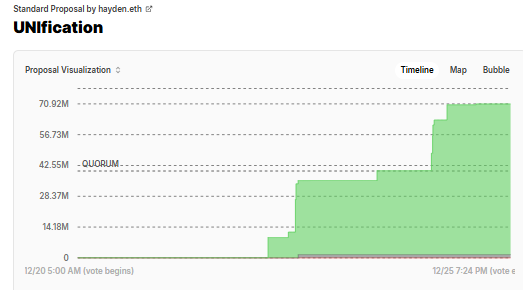
Source: Uniswap

More than 6,000 addresses have participated, with support hovering near 100% among active voters.

Uniswap Labs CEO, Hayden Adams said once the vote formally closes, the changes will be subject to a two-day time lock before implementation.

The proposal also authorizes the immediate burning of 100 million UNI from the Uniswap Foundation’s treasury.

The governance package also introduces a Protocol Fee Discount Auctions system designed to improve returns for liquidity providers while aligning Uniswap Labs, the Uniswap Foundation, and on-chain governance under a single legal structure using Wyoming’s DUNA framework.

Several influential figures in decentralized finance backed the UNIfication proposal, including Variant founder Jesse Waldren, Synthetix and Infinex founder Kain Warwick, and former Uniswap Labs engineer Ian Lapham, all of whom hold substantial voting power.

Can the Fee Switch Finally Give UNI Holders a Direct Payoff?

The vote comes amid wider debate across DeFi about sustainable token economics and long-term value capture.

Many protocols have struggled to translate heavy usage into tangible benefits for token holders, a criticism that has followed Uniswap for years despite its dominant market position.

Uniswap remains the largest decentralized exchange by volume, having processed more than $4 trillion in trades since launching in 2018, yet UNI holders have historically had limited direct exposure to protocol revenue.

Supporters of the fee switch argue that tying protocol revenue more directly to UNI supply dynamics could reshape that narrative.

The market reaction has been swift. UNI has gained roughly 25% since voting began, trading near $6.08 after recovering from a month-long slump that pushed the token to a seven-month low of $4.88.

Source: CoinGecko

Earlier signs of the proposal in November sparked an even sharper move, with UNI climbing close to 40% in a matter of days and briefly touching $9.70 on Nov. 11 before broader market weakness set in.

Can UNI Reach $10 Before the Year End?

According to CoinGecko data, UNI is currently the 38th largest cryptocurrency by market capitalization, valued at around $3.8 billion.

From a technical perspective, UNI’s price action has drawn renewed attention as the governance process nears completion.

The token recently bounced from the lower boundary of a multi-year ascending channel that has guided its recovery since the post-2021 drawdown.

Source: CAI soren/X

Analysts tracking the structure note that this zone has historically acted as strong demand, with each retest followed by higher reaction highs.

In the near term, UNI faces resistance around the $6.80 to $7.20 range, with heavier supply clustered closer to $9 and above.


Market Opportunity
TokenFi Logo
TokenFi Price(TOKEN)
$0.002509
$0.002509$0.002509
-3.01%
USD
TokenFi (TOKEN) Live Price Chart
Disclaimer: The articles reposted on this site are sourced from public platforms and are provided for informational purposes only. They do not necessarily reflect the views of MEXC. All rights remain with the original authors. If you believe any content infringes on third-party rights, please contact service@support.mexc.com for removal. MEXC makes no guarantees regarding the accuracy, completeness, or timeliness of the content and is not responsible for any actions taken based on the information provided. The content does not constitute financial, legal, or other professional advice, nor should it be considered a recommendation or endorsement by MEXC.

You May Also Like

MFS Releases Closed-End Fund Income Distribution Sources for Certain Funds

MFS Releases Closed-End Fund Income Distribution Sources for Certain Funds

BOSTON–(BUSINESS WIRE)–MFS Investment Management® (MFS®) released today the distribution income sources for five of its closed-end funds for December 2025: MFS®
Share
AI Journal2025/12/23 05:45
BlackRock boosts AI and US equity exposure in $185 billion models

BlackRock boosts AI and US equity exposure in $185 billion models

The post BlackRock boosts AI and US equity exposure in $185 billion models appeared on BitcoinEthereumNews.com. BlackRock is steering $185 billion worth of model portfolios deeper into US stocks and artificial intelligence. The decision came this week as the asset manager adjusted its entire model suite, increasing its equity allocation and dumping exposure to international developed markets. The firm now sits 2% overweight on stocks, after money moved between several of its biggest exchange-traded funds. This wasn’t a slow shuffle. Billions flowed across multiple ETFs on Tuesday as BlackRock executed the realignment. The iShares S&P 100 ETF (OEF) alone brought in $3.4 billion, the largest single-day haul in its history. The iShares Core S&P 500 ETF (IVV) collected $2.3 billion, while the iShares US Equity Factor Rotation Active ETF (DYNF) added nearly $2 billion. The rebalancing triggered swift inflows and outflows that realigned investor exposure on the back of performance data and macroeconomic outlooks. BlackRock raises equities on strong US earnings The model updates come as BlackRock backs the rally in American stocks, fueled by strong earnings and optimism around rate cuts. In an investment letter obtained by Bloomberg, the firm said US companies have delivered 11% earnings growth since the third quarter of 2024. Meanwhile, earnings across other developed markets barely touched 2%. That gap helped push the decision to drop international holdings in favor of American ones. Michael Gates, lead portfolio manager for BlackRock’s Target Allocation ETF model portfolio suite, said the US market is the only one showing consistency in sales growth, profit delivery, and revisions in analyst forecasts. “The US equity market continues to stand alone in terms of earnings delivery, sales growth and sustainable trends in analyst estimates and revisions,” Michael wrote. He added that non-US developed markets lagged far behind, especially when it came to sales. This week’s changes reflect that position. The move was made ahead of the Federal…
Share
BitcoinEthereumNews2025/09/18 01:44
Foreigner’s Lou Gramm Revisits The Band’s Classic ‘4’ Album, Now Reissued

Foreigner’s Lou Gramm Revisits The Band’s Classic ‘4’ Album, Now Reissued

The post Foreigner’s Lou Gramm Revisits The Band’s Classic ‘4’ Album, Now Reissued appeared on BitcoinEthereumNews.com. American-based rock band Foreigner performs onstage at the Rosemont Horizon, Rosemont, Illinois, November 8, 1981. Pictured are, from left, Mick Jones, on guitar, and vocalist Lou Gramm. (Photo by Paul Natkin/Getty Images) Getty Images Singer Lou Gramm has a vivid memory of recording the ballad “Waiting for a Girl Like You” at New York City’s Electric Lady Studio for his band Foreigner more than 40 years ago. Gramm was adding his vocals for the track in the control room on the other side of the glass when he noticed a beautiful woman walking through the door. “She sits on the sofa in front of the board,” he says. “She looked at me while I was singing. And every now and then, she had a little smile on her face. I’m not sure what that was, but it was driving me crazy. “And at the end of the song, when I’m singing the ad-libs and stuff like that, she gets up,” he continues. “She gives me a little smile and walks out of the room. And when the song ended, I would look up every now and then to see where Mick [Jones] and Mutt [Lange] were, and they were pushing buttons and turning knobs. They were not aware that she was even in the room. So when the song ended, I said, ‘Guys, who was that woman who walked in? She was beautiful.’ And they looked at each other, and they went, ‘What are you talking about? We didn’t see anything.’ But you know what? I think they put her up to it. Doesn’t that sound more like them?” “Waiting for a Girl Like You” became a massive hit in 1981 for Foreigner off their album 4, which peaked at number one on the Billboard chart for 10 weeks and…
Share
BitcoinEthereumNews2025/09/18 01:26