

Ether Price Surged 120% After Staking Queue Overtook Exit Queue

Ethereum’s Staking Dynamics Signal Potential Bullish Momentum
The amount of Ether queued for staking has recently surpassed the amount awaited for unstaking, a development historically correlated with significant price rallies. This shift reflects increased confidence among validators and could herald a bullish period for Ether.
Key Takeaways
- Ethereum’s validator entry queue exceeds the exit queue for the first time since June, indicating strong staking interest.
- Market sentiment suggests Ethereum could rise above $2,750, with technical analysis pointing to a possible target of $5,000 by 2026.
- The validator queue surpasses previous levels recorded in March and June, preceding substantial price increases.
- Continued increase in staked Ether and network activity may support sustained bullish momentum.
Ethereum Validator Entry Surpasses Exit
The validator entry queue for Ethereum has grown to 745,619 ETH, valued at approximately $2.2 billion, with an average wait time of 13 days. This marks the first time since June that the incoming staking volume has overtaken the amount scheduled for unstaking, which currently stands at 360,528 ETH, or roughly $1.06 billion. This shift suggests a preference among validators to hold onto their ETH rather than sell, reducing downward pressure on the price.
Data from ValidatorQueue indicates that the total number of active validators exceeds 983,371, accounting for about 29.3% of the total ETH supply, or around 35.5 million ETH. Experts note that recent protocol upgrades, such as the Pectra update, have enhanced staking usability and increased validator limits, encouraging larger balances and longer-term commitments.
Number of Ether queued for staking entry and exit. Source: Validator QueueHistorically, similar patterns in March and June have preceded Ether rallies of 90% and 126%, respectively. If history rewinds, Ethereum could potentially reach $5,000 by 2026, driven by increasing staking activity, overall network utilization, and declining transaction fees.
Technical Outlook Supports Bullish Target
Current technical indicators for Ether mirror a setup that previously ignited significant gains in late 2024. The price has been consolidating between $2,750 and $3,200, resembling a pattern observed in mid-2024. Once the asset clears the $2,750 resistance, a subsequent rally toward $4,100—up 74.5% from recent lows—becomes plausible.
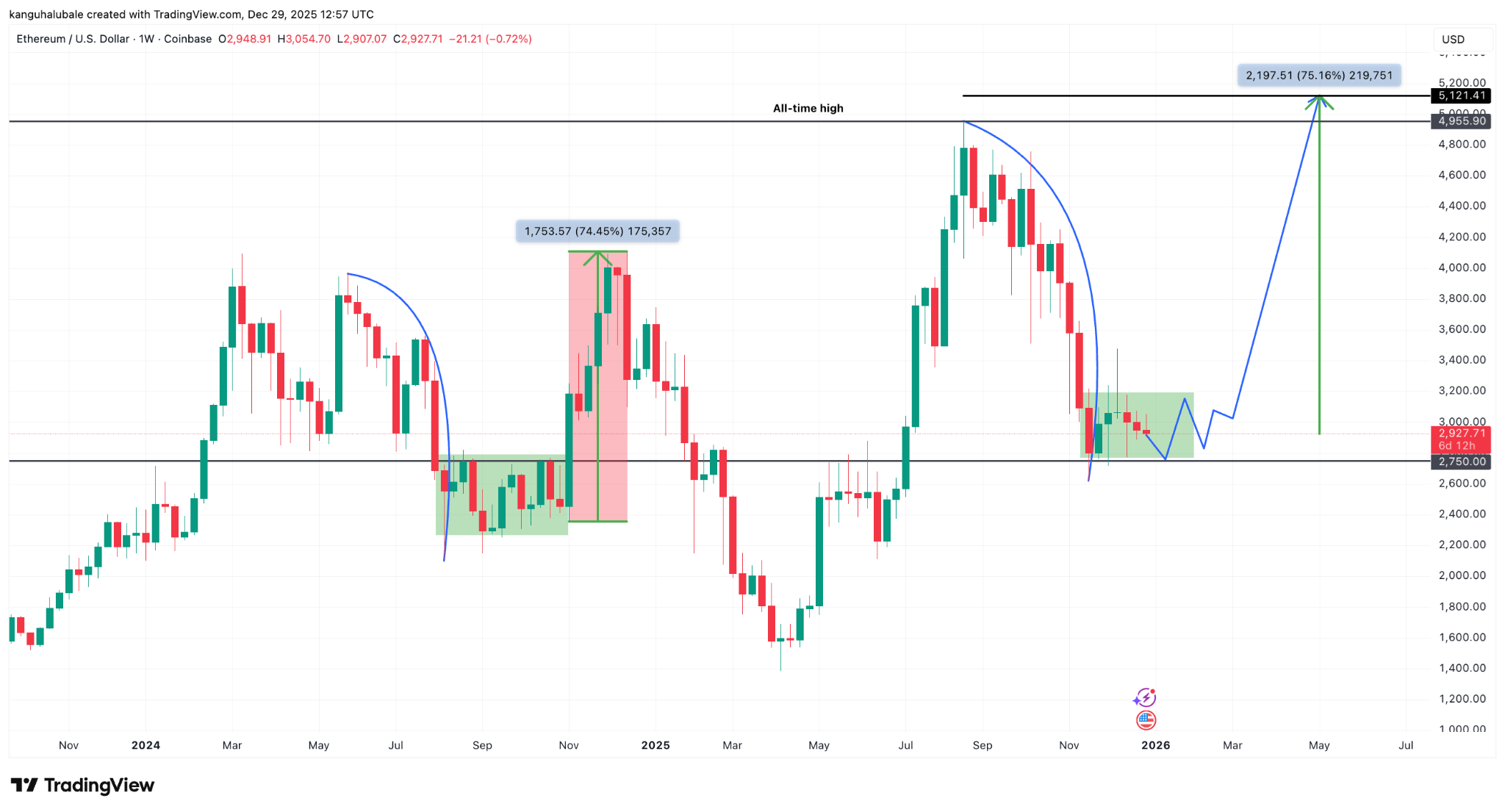 ETH/USD weekly chart. Source: TradingView
Market analysts emphasize that maintaining above $2,750 is crucial, as historical models suggest a potential surge to roughly $5,120 if bullish momentum persists. Trader Titan of Crypto noted that Ether has already retraced 61.8% of its previous impulsive wave, reinforcing the significance of this level.
Conclusion
As network activity intensifies and validator interest continues to grow, Ethereum’s bullish outlook appears reinforced. While some experts warn of potential bull traps, the current on-chain fundamentals and technical patterns point toward a favorable environment for further appreciation in Ether’s price.
This assessment underscores the importance of monitoring validator trends and technical levels for traders and investors navigating Ethereum’s evolving landscape.
This article was originally published as Ether Price Surged 120% After Staking Queue Overtook Exit Queue on Crypto Breaking News – your trusted source for crypto news, Bitcoin news, and blockchain updates.


You May Also Like

Not a loophole: Singapore AI export controls let China tap US AI legally

Exclusive interview with Smokey The Bera, co-founder of Berachain: How the innovative PoL public chain solves the liquidity problem and may be launched in a few months

Iran’s army chief warns of ‘total destruction’ for ground invasion



