MetaMask users are at risk of a new “2FA verification” phishing scam that steals their seed phrase under the guise of improving security. According to blockchainMetaMask users are at risk of a new “2FA verification” phishing scam that steals their seed phrase under the guise of improving security. According to blockchain

MetaMask users targeted by fake 2FA phishing scam that steals seed phrases

MetaMask users are at risk of a new “2FA verification” phishing scam that steals their seed phrase under the guise of improving security.

Summary
  • MetaMask users are being targeted by a phishing campaign involving a fake 2FA verification process.
  • The new campaign comes on the heels of a large-scale wallet exploit and the Trust Wallet Chrome extension incident.

According to blockchain security firm SlowMist, MetaMask users are receiving a spoofed email that creates a false sense of urgency by prompting them to enable Two-Factor Authentication. The message is MetaMask-branded and appears convincing at first glance. (See below.)
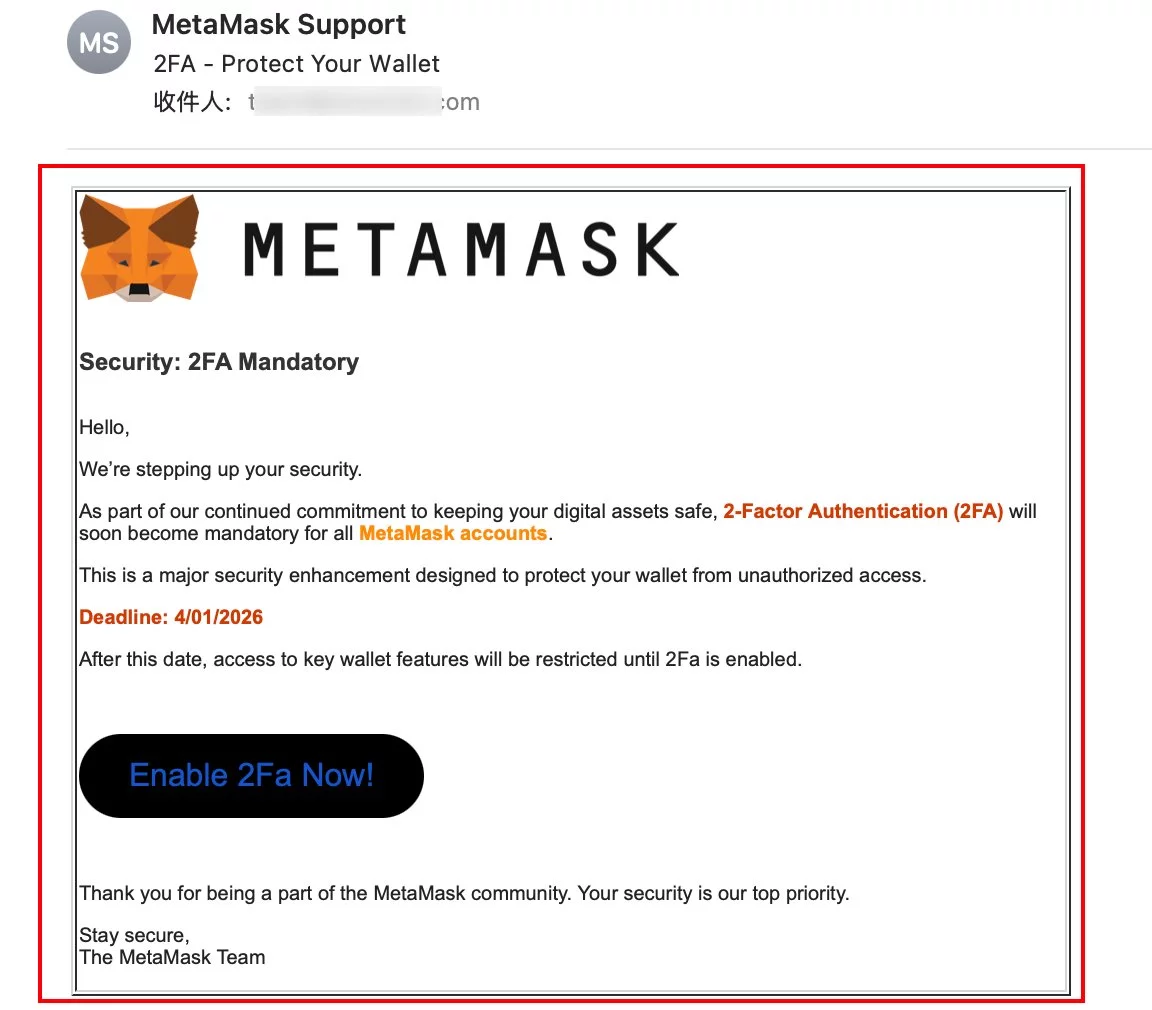
A spoof email sent by attackers.

Notably, the malicious notifier also comes with a countdown timer, which increases pressure on the user and attempts to force a quick response.

Upon clicking the “Enable 2FA Now” button, users are redirected to a fake page hosted by the attacker. However, in reality, the entire process is a sham. The main goal is to trick MetaMask users into entering their mnemonic phrase, which attackers can use to access and transfer funds from their wallets. (See below.)
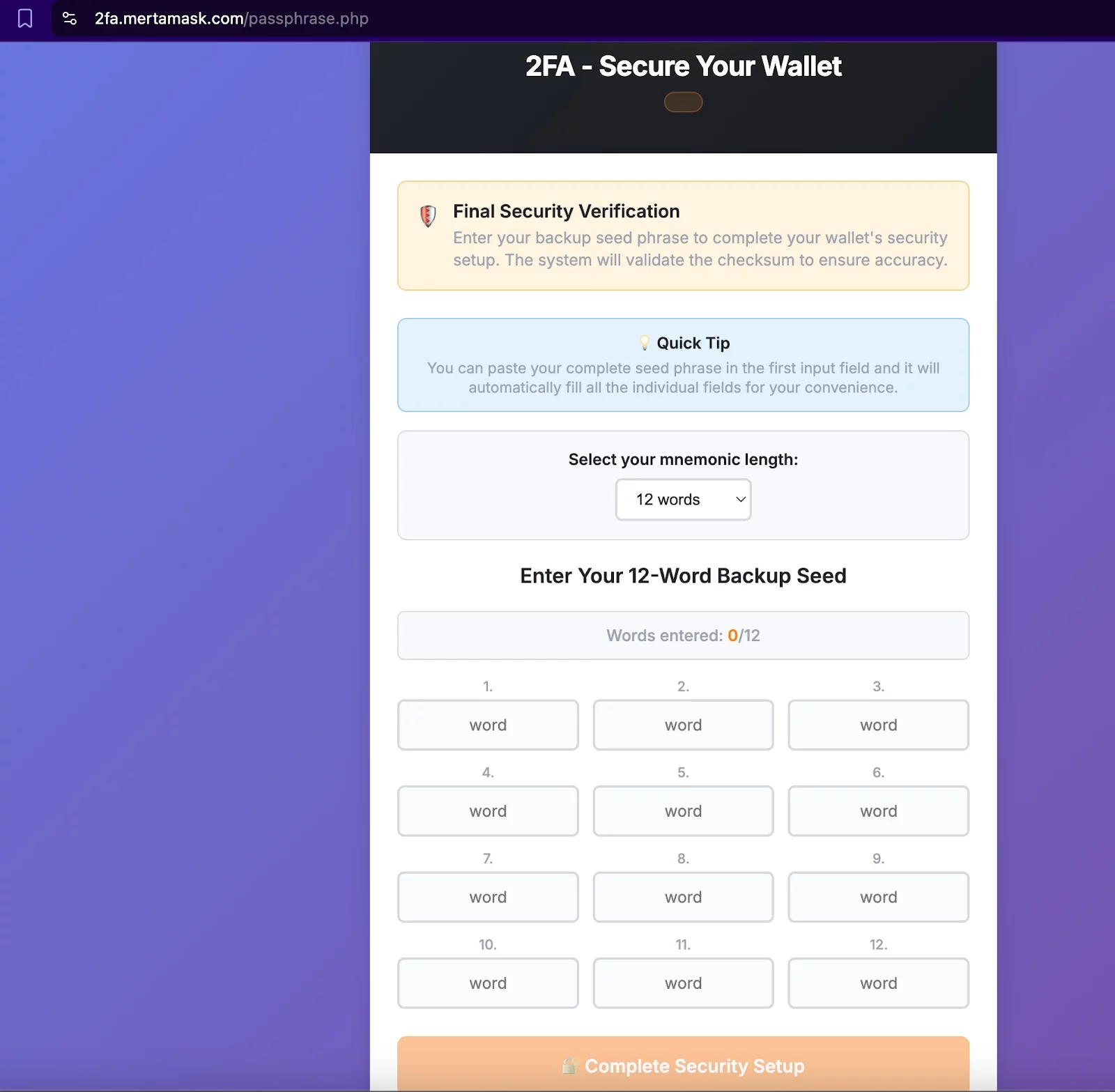
Malicious website asking users to input their seed phrase.

While at first glance a less cautious user may fall for this scheme, the spoof email contains several giveaways that can help users spot the fraud.

For instance, such phishing messages often include subtle typos or design inconsistencies that can reveal their true nature. In this case, the URL to which MetaMask users were redirected was spelled as “mertamask” instead of “metamask.” In some cases, these emails are also sent from completely unrelated email accounts, or from addresses using public domains like Gmail. (See below.)
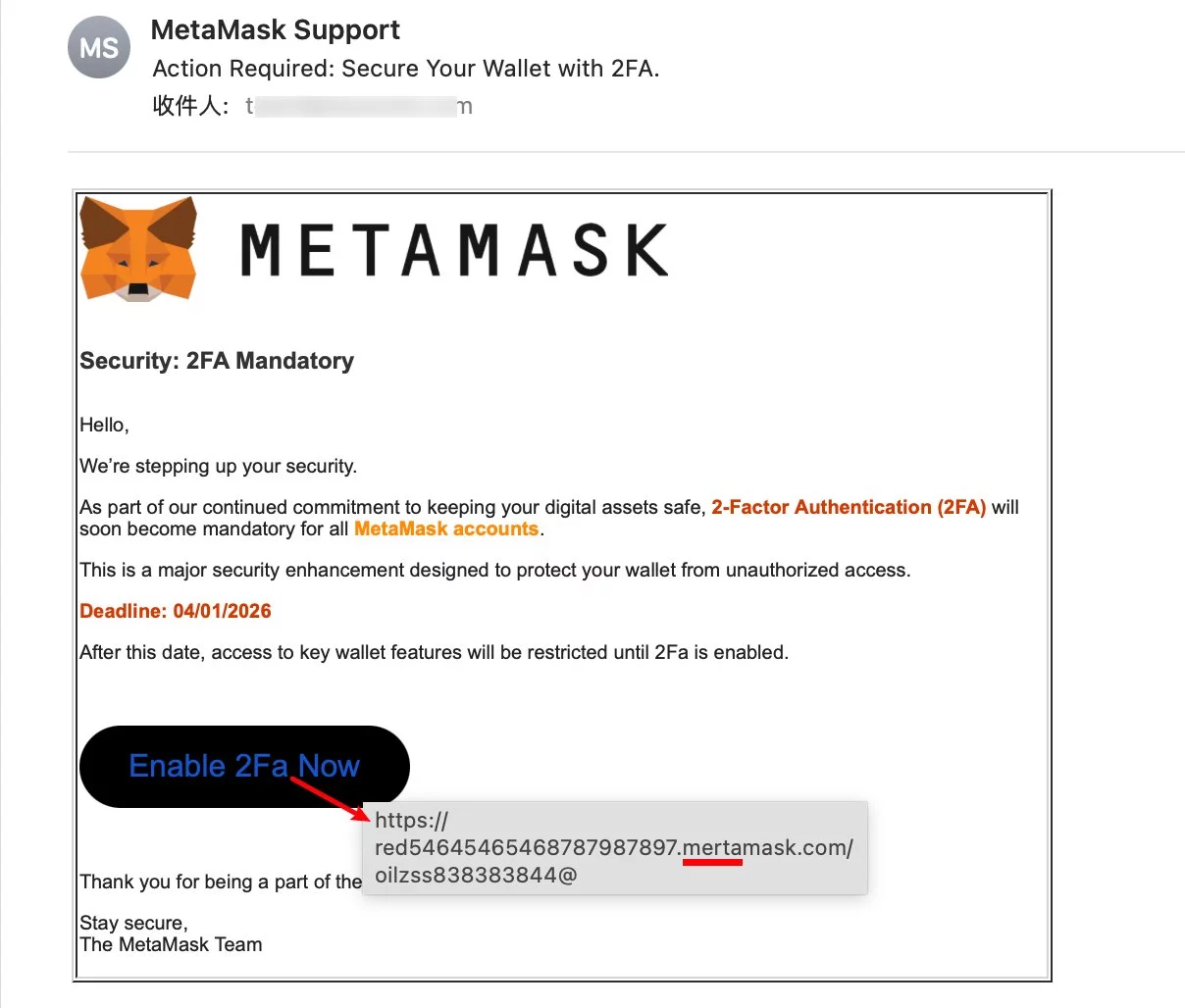
Typos within spoof emails.

Lastly, it is important to remember that MetaMask does not send unsolicited emails asking users to verify their accounts or perform security updates. Any such requests are typically scams.

Recent phishing campaigns targeting crypto users

Late last week, cybersecurity researcher Vladimir S. flagged a similar campaign that pushed a fake MetaMask app update. It is believed to be connected to an ongoing wallet-draining exploit.

According to on-chain sleuth ZachXBT, the incident resulted in losses of less than $2,000 per wallet but affected a wide range of users across several EVM-compatible networks. However, it has not been confirmed whether the two campaigns are definitely connected.

The incident was also linked to the Trust Wallet hack that occurred on Christmas Day, where losses climbed to roughly $7 million. 

The attacker managed to gain access to the wallet’s browser extension source code and uploaded a malicious version of the extension to the Chrome Web Store. Trust Wallet has vowed to compensate all users affected by the incident.

Separately, Cardano users were also warned about a different ongoing attack that circulated emails promoting a fraudulent Eternl Desktop application.

Despite these events all happening within less than two weeks, a recent Scam Sniffer report showed that total losses from crypto phishing campaigns dropped nearly 88% in 2025 from the previous year.


Market Opportunity
Scamcoin Logo
Scamcoin Price(SCAM)
$0.001094
$0.001094$0.001094
+1.20%
USD
Scamcoin (SCAM) Live Price Chart
Disclaimer: The articles reposted on this site are sourced from public platforms and are provided for informational purposes only. They do not necessarily reflect the views of MEXC. All rights remain with the original authors. If you believe any content infringes on third-party rights, please contact service@support.mexc.com for removal. MEXC makes no guarantees regarding the accuracy, completeness, or timeliness of the content and is not responsible for any actions taken based on the information provided. The content does not constitute financial, legal, or other professional advice, nor should it be considered a recommendation or endorsement by MEXC.

You May Also Like

Last Chance: BlockDAG’s $441M Presale Ends Jan 26, While Cardano & SUI Price Generate Buzz

Last Chance: BlockDAG’s $441M Presale Ends Jan 26, While Cardano & SUI Price Generate Buzz

The crypto market is heating up, and sharp traders are searching for major opportunities before the door closes. Established players like Cardano and rising stars
Share
Techbullion2026/01/08 07:00
Italy becomes first EU country to pass comprehensive AI law

Italy becomes first EU country to pass comprehensive AI law

Italy has formally passed a sweeping new law to regulate artificial intelligence, becoming the first member of the European Union to roll out comprehensive legislation in step with the bloc’s landmark AI Act. The Italian Senate granted final approval after a year of debate, concluding what Prime Minister Giorgia Meloni’s government described as a decisive […]
Share
Cryptopolitan2025/09/18 04:00
Cryptos Signal Divergence Ahead of Fed Rate Decision

Cryptos Signal Divergence Ahead of Fed Rate Decision

The post Cryptos Signal Divergence Ahead of Fed Rate Decision appeared on BitcoinEthereumNews.com. Crypto assets send conflicting signals ahead of the Federal Reserve’s September rate decision. On-chain data reveals a clear decrease in Bitcoin and Ethereum flowing into centralized exchanges, but a sharp increase in altcoin inflows. The findings come from a Tuesday report by CryptoQuant, an on-chain data platform. The firm’s data shows a stark divergence in coin volume, which has been observed in movements onto centralized exchanges over the past few weeks. Bitcoin and Ethereum Inflows Drop to Multi-Month Lows Sponsored Sponsored Bitcoin has seen a dramatic drop in exchange inflows, with the 7-day moving average plummeting to 25,000 BTC, its lowest level in over a year. The average deposit per transaction has fallen to 0.57 BTC as of September. This suggests that smaller retail investors, rather than large-scale whales, are responsible for the recent cash-outs. Ethereum is showing a similar trend, with its daily exchange inflows decreasing to a two-month low. CryptoQuant reported that the 7-day moving average for ETH deposits on exchanges is around 783,000 ETH, the lowest in two months. Other Altcoins See Renewed Selling Pressure In contrast, other altcoin deposit activity on exchanges has surged. The number of altcoin deposit transactions on centralized exchanges was quite steady in May and June of this year, maintaining a 7-day moving average of about 20,000 to 30,000. Recently, however, that figure has jumped to 55,000 transactions. Altcoins: Exchange Inflow Transaction Count. Source: CryptoQuant CryptoQuant projects that altcoins, given their increased inflow activity, could face relatively higher selling pressure compared to BTC and ETH. Meanwhile, the balance of stablecoins on exchanges—a key indicator of potential buying pressure—has increased significantly. The report notes that the exchange USDT balance, around $273 million in April, grew to $379 million by August 31, marking a new yearly high. CryptoQuant interprets this surge as a reflection of…
Share
BitcoinEthereumNews2025/09/18 01:01