U.S. digital asset market structure talks are heading into their endgame without any resolution on the stablecoin ‘yield v rewards’ issue, while the Trump family’s stablecoin project wants a national bank charter.
January 6 brought word that Senate Banking Committee Chair Tim Scott (R-SC) had made a “closing offer” to the committee’s Democratic members regarding the Responsible Financial Innovation Act (RFIA). The move comes as Scott confirmed the committee will hold a markup session on the draft legislation on January 15, with or without buy-in from Democrats.
The two parties’ representatives held a meeting on Tuesday to discuss areas in which consensus remains elusive. These include legal liabilities for decentralized finance (DeFi) developers, bipartisan representation on regulatory agencies, limits on elected officials (and their families) profiting off crypto ventures, and perhaps thorniest of all, whether digital asset exchanges like Coinbase (NASDAQ: COIN) can offer their users financial ‘rewards’ for holding stablecoins on their platforms.
The GENIUS Act, signed into law last summer, prohibits stablecoin issuers from offering ‘yield’ or interest to their users, and U.S. banks believe this also bars third-party platforms from offering rewards. The banks want Congress to include language emphatically stating that view in any market structure legislation that emerges from the Senate’s Banking and Agriculture committees.
(The Ag committee will hold its own markup session on its market structure bill next week, reportedly the same day as Banking. There’s no word on how significantly this bill may have been revised since its TBD discussion draft was released last November, but reports indicate some significant barriers to consensus remain.)
The banks argue that stablecoin rewards will cause massive deposit flight as customers seek higher returns than banks are offering in interest on savings accounts. This flight could force banks to tighten their loan issuance, a concern they claim is magnified in smaller communities served by smaller banks.
On January 5, the banks got public support from the American Bankers Association’s Community Bankers Council, which sent a letter to senators warning that a failure to address this issue “will put economic growth and local communities at risk.”
The letter praises Congress for including the ‘yield/interest’ ban in GENIUS, but claims some crypto operators “have exploited a perceived loophole allowing stablecoin issuers to indirectly fund payments to stablecoin holders through digital asset exchanges and other partners. With this activity, the exception swallows the rule.”
The letter warns that “if billions are displaced from community bank lending, small businesses, farmers, students, and home buyers in towns like ours will suffer. Crypto exchanges and the constellation of stablecoin-affiliated companies are not designed to fill the lending gap, nor will they be able to offer FDIC-insured products, a point they omit from their aggressive advertising.”
The letter closes by urging senators to make it “clear in market structure legislation that the prohibition on interest applies to affiliates and partners of stablecoin issuers.” Signed by nearly 100 banking CEOs, the letter includes a postscript detailing the estimated value of potential deposit flight from community banks in each U.S. state.
On January 7, Punchbowl News quoted some of the Banking committee’s GOP members suggesting they’d vote ‘no’ on RFIA without some satisfactory resolution of the yield v rewards issue. Sen. John Kennedy (R-LA) said the issue was “important” and the RFIA’s future is “in jeopardy if we don’t work something out.”
Sen. Thom Tillis (R-NC) reportedly spoke at length during Tuesday’s meeting regarding the need to limit third-party rewards. Sen. Mike Rounds (R-SD) hedged his support, saying there’d been some “real, significant advancements” in recent days but “I don’t know that it’s ready to go yet.” Rounds added that he’s “not worried about it getting done on a particular day, this week or next week.”
Rounds might not be worried, but Scott and the crypto sector appear concerned that Congress could soon become distracted by November’s midterm elections. Healthcare, federal spending, and President Trump’s international escapades could push digital asset matters onto the backburner until it’s too late to move a bill through Congress in the current session.
Trump’s DeFi project wants bank charter
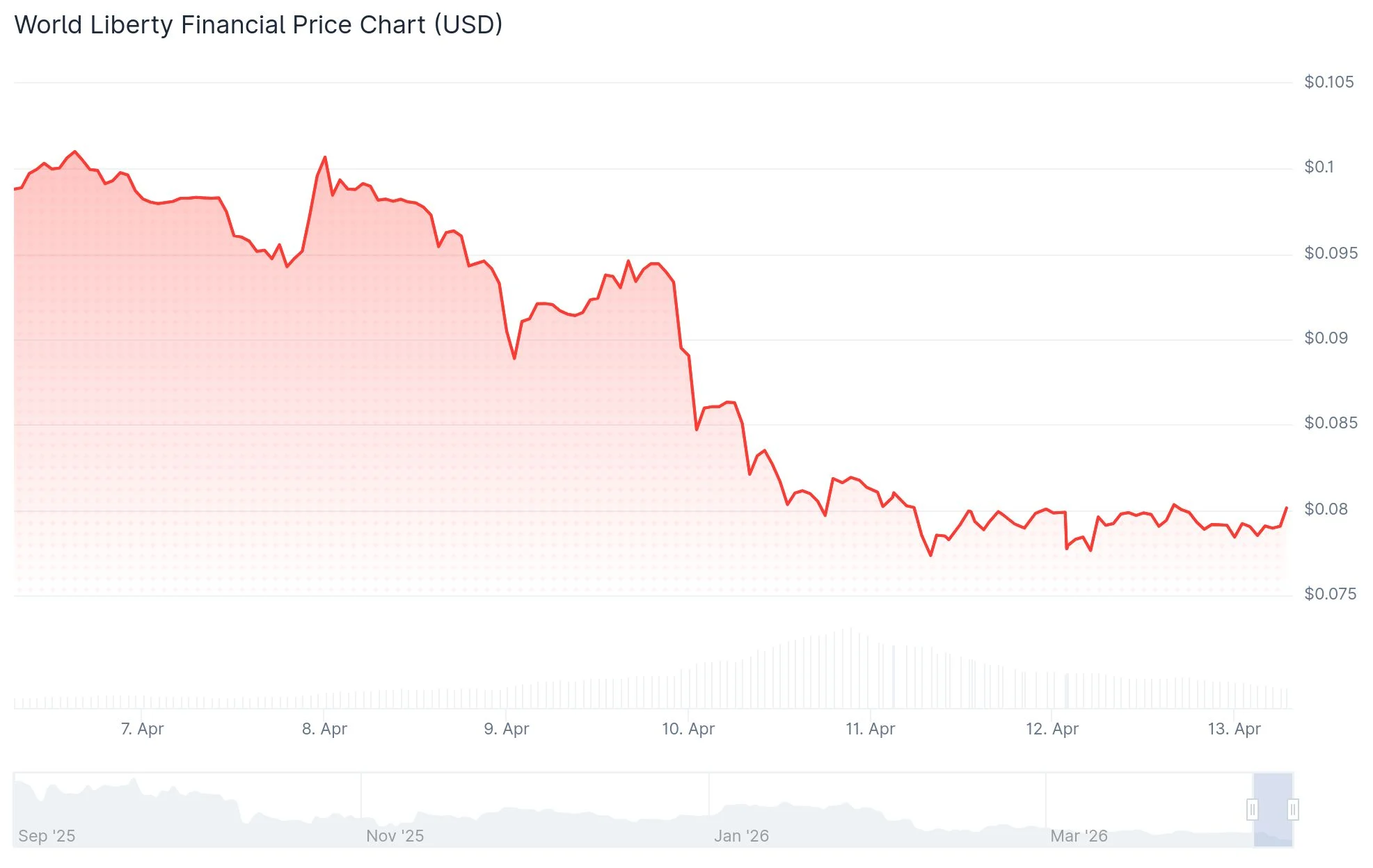
While Senate Dems push for some kind of restraints on Trump’s ability to profit off his family’s numerous crypto ventures, the family’s DeFi project World Liberty Financial (WLF) just asked the federal government to give it a national banking license to build out its stablecoin operations.
On Wednesday, WLF announced that it had filed a de novo application with the Treasury Department’s Office of the Comptroller of the Currency (OCC) to establish World Liberty Trust Company, National Association (WLTC), “a proposed national trust bank purpose-built for stablecoin operations.”
Trust banks can’t issue loans or accept customer deposits, but WLF says the license “will position WLTC to issue USD1.” USD1 is the stablecoin WLF launched last spring and has since grown its market cap to an impressive $3.4 billion (thanks in part to a controversial $2 billion sale). USD1 currently ranks seventh on the USD stablecoin market cap chart, about $250 million behind PYUSD, issued by payment processor PayPal (NASDAQ: PYPL).
WLTC has three “core services” it wishes to provide, including minting and redeeming USD1; converting between U.S. dollars and USD1; as well as providing “secure custody for USD1 and other accepted stablecoins, with conversion services at prevailing market rates.”
WLF’s general counsel, Mack McCain, will serve as WLTC’s trust officer. McCain, who previously toiled at trading platform Robinhood Markets (NASDAQ: HOOD), said WLTC will live up to its obligations for “segregated customer assets, independent reserve management, and regular examination. That gives banks, asset managers, and corporations the regulatory clarity they need to further expand their use of USD1.”
Under the OCC’s new leadership, crypto operators have found it much easier to secure banking charters than in the past, with five applications receiving conditional approvals on December 12. Among the advantages of being your own bank is the ability to custody the fiat reserves backing stablecoins yourself, saving you the hassle (and the cost) of delegating that responsibility to a third party.
USD1’s reserves are currently held by BitGo, one of the recipients of those recent bank charters. BitGo CEO Mike Belshe claimed his company was “proud to have supported USD1’s rapid growth … and looks forward to continuing as a key strategic partner as WLTC becomes fully operational and USD1 enters its next stage of growth.”
President Trump is currently listed as WLF’s ‘Co-Founder Emeritus’ while his three sons—Don. Jr, Eric, and Barron—also appear as Co-Founders. A Trump-controlled entity (DT Marks DEFI LLC) originally controlled 75% of WLF but reduced this stake to 40% by June 2025.
Suffice it to say, Wednesday’s news isn’t likely to make Senate Dems more willing to cave on the ‘ethics’ language still absent from the market structure legislation scheduled to be marked-up next week.
Back to the top ↑
Tether launches Rumble wallet, breaks Tether Gold into spendable nuggets
Wednesday saw the Rumble (NASDAQ: RUM) conservative video-sharing platform launch its long-promised crypto wallet. Rumble Wallet was built on the new Wallet Development Kit belonging to Tether, which is not only the issuer of the market-leading USDT stablecoin but also holds a near-controlling stake in Rumble.
Rumble Wallet’s fiat on-/off-ramps will be provided by MoonPay, the fintech platform that recently added Caroline Pham, former acting chair of the U.S. Commodity Futures Trading Commission (CFTC), as its new chief legal and administrative officer.
Rumble Wallet will allow the platform’s users to tip video creators using USDT, BTC, or XAUt (aka Tether Gold). Given Rumble’s predominantly U.S.-focus, Ardoino said back in November that the Rumble Wallet would also support USAT “when launched,” but Wednesday’s release makes no mention of USAT.
USAT is the allegedly GENIUS-compliant stablecoin that Tether announced in September and promised to launch by year’s end. But USAT’s X account just keeps issuing ‘coming soon’ tweets while Tether CEO Paolo Ardoino claimed the token was “loading” back on December 18. On New Year’s Eve, USAT CEO Bo Hines tweeted that the stablecoin was “incoming.” (If this goes on much longer, Tether execs will need to break out the thesaurus.)
Getting back to XAUt, Tether recently announced Scudo, a “new unit of account” for XAUt that’s “designed to bring back gold as a means of payment.” Basically, Scudo mirrors the Bitcoin principle of dividing an individual token into tiny units of account called ‘sats.’ But rather than representing 1/100,000,000 of a Bitcoin, one Scudo will represent 1/1000 of a troy ounce of gold (so $4.50, based on gold’s ~$4,500 price at time of writing). However, users can transact “in whole or partial Scudo units,” offering further flexibility in using XAUt.
XAUt has been slower to catch on than USDT, as evidenced by their respective market caps ($2.3 billion vs $187 billion), although XAUt has only been around for six years versus 11 years for USDT. It remains to be seen how quickly USAT will grow if/when it finally arrives.
Back to the top ↑
Wyoming welcomes public sales of state-backed FRNT
A different stablecoin experiment took another turn on Wednesday, as Wyoming Governor Mark Gordon tweeted his pleasure at announcing “the official launch of the Frontier Stable Token (FRNT$).” The Wyoming Stable Token Commission (WSTC) simultaneously tweeted that it had made FRNT “available for public purchase through Wyoming-domiciled cryptocurrency exchange Kraken.”
FRNT, formerly known as the Wyoming Stable Token, became the first state-issued dollar-backed stablecoin last August when it was deployed on seven networks (Arbitrum, Avalanche, Base, Ethereum, Optimism, Polygon, and Solana). Omnichain interoperability specialists LayerZero are serving as FRNT’s ‘token issuance partner’ while Fireblocks is providing blockchain infrastructure.
The Solana-based FRNT is available via Kraken, while the Avalanche version can be obtained via Rain’s Visa (NASDAQ: V)-integrated card platform. Cross-chain bridging to the other networks is available via the Stargate Finance protocol.
Last August, the WSTC stated that it didn’t “anticipate” selling FRNT directly to the public, relying instead on “a network of authorized resellers” like Kraken, which received a Special Depository Institution charter from Wyoming in 2020.
The WSTC says peer-to-peer FRNT transactors will benefit from “settlement in seconds, incurring fees of <$0.01, available anywhere w/ an internet connection, instant auditability, and reduced counterparty risk—intended for retail use and institutions.”
The WSTC added that it’s looking forward to “scaling FRNT in 2026,” including “onboarding new partners for the resale of FRNT, deploying FRNT within State agencies to make operations cheaper and more efficient, and partnering with other public entities looking to do the same.”
FRNT’s overcollateralized fiat reserves—strictly U.S. dollars and short-term U.S. Treasury bills—are held in trust by the Wyoming state government, with management provided by the fixed income division of Wall Street investment group Franklin Templeton (NYSE: BEN) and custody provided by its affiliate Fiduciary Trust Company International.
Gov. Gordon said his state “has long been at the forefront of financial innovation, and the launch of $FRNT marks a defining moment in our state’s continued leadership. By introducing the nation’s first state-issued stable token, we are demonstrating how thoughtful, transparent regulation and new technologies can be harnessed to expand access, lower costs, and strengthen public trust.”
Interestingly, since the state is FRNT’s issuer, it might not be bound by the GENIUS Act’s prohibition on private issuers offering yield to token holders. And since the state plans to direct FRNT’s net revenue to state educational programs, they have an obvious incentive to maximize revenue by whatever legal means are available.
Last summer, a state senator expressed confidence that the state could legally circumvent the GENIUS prohibition. On Wednesday, a WSTC spokesperson told Decrypt that the state is “exploring the possibility of providing yield, however, it is not something we have at this stage.”
Back to the top ↑
Watch | Teranode explained: BSV leaders on blockchain scaling & the future of digital economy
Source: https://coingeek.com/trump-defi-project-seeks-bank-charter-to-grow-usd1-stablecoin/