

Digital Asset Market Clarity Act Back to Trigger Crypto Rebound?

The highly anticipated US cryptocurrency regulation, the Digital Asset Market Clarity (CLARITY) Act, enters a critical week in Washington, as Senate committees prepare for markups.
This development on the SEC's & CFTC's regulations could significantly influence institutional investment and overall crypto market sentiment.
So far, US spot Bitcoin ETFs marked the largest daily inflows in three months, drawing in $753.7 million.
This trend suggests a resurgence of institutional interest as investors realign their strategies following year-end rebalancing.
Bitcoin has broken through its recent range, currently sitting at around $96,500, representing a 1.37% increase over the past 24 hours. A sustained move above $97,000 is crucial for the token to retest $100,000.
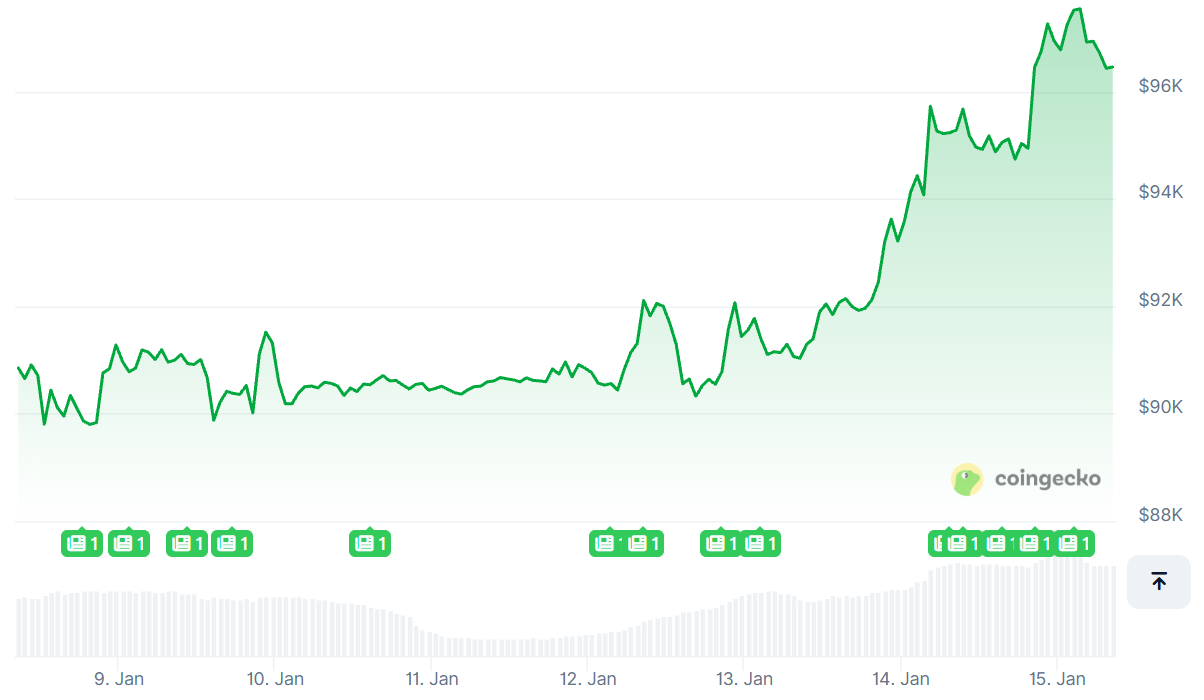 Source: CoinGecko
The Senate Banking Committee has released an updated version of the CLARITY Act, preparing for its upcoming markup and amendment discussions scheduled for late January.
This week, Senate Republicans on the Banking, Housing, and Urban Affairs Committee unveiled a collection of fact sheets outlining the Act.
The markup by the Senate’s Banking Committee is still set for January 15.
The documents released prior to the committee markup present the legislation as a thorough effort to establish a definitive federal structure for digital asset markets, while enhancing safeguards for investors and tackling issues related to illicit finance.
Supporters of the legislation contend that the lack of clear regulations has driven operations overseas, putting both stakeholders and national security at risk.
The CLARITY Act seeks to provide developers and investors with legal certainty, enforce stringent compliance standards for digital asset trading platforms, and establish clear boundaries between the SEC and the CFTC.
Key Points
Stablecoin Rewards Restricted: Although transaction-related incentives or specific program rewards are permitted, the draft prohibits stablecoin issuers from offering prizes or yields solely for the act of holding stablecoins.
This paragraph is likely to undergo significant revisions during the markup process because of its broadly favorable depiction of traditional banks and the industry's adverse response to it.
Classification of Digital Assets Through Securities Act: The draft proposes amendments to the 'Securities Act of 1933' to provide room for digital assets known as "ancillary assets" or "network tokens."
Requirements for Disclosure and SEC Regulation: The draft calls for the SEC to create regulations to oversee these "ancillary assets" or "network tokens." The upcoming regulations will feature detailed disclosure requirements designed to tackle governance, token economics, and other critical aspects affecting the market and investors.
Regulatory Framework for DeFi Under SEC and Treasury Supervision: Disclosure, recordkeeping, and compliance with securities laws are among the areas that the proposal asks the SEC and the Treasury to address in its rulemaking regarding DeFi trading procedures.
This is a major milestone in the legislative process of establishing a framework to regulate decentralized financial operations.
Bank Secrecy Act and Anti-Money Laundering Rules: The proposed law calls on the Treasury to define what the Bank Secrecy Act and anti-money laundering rules anticipate from DeFi platforms and protocols, laying the groundwork for clear legal requirements on AML compliance in decentralized environments.
Digital Assets Within Banking Framework: In the coming years, it is likely that every product and service provided by financial institutions will integrate digital assets and distributed ledger technology.
The draft not only provides greater authority but also requires the Federal Reserve, the Office of the Comptroller of the Currency, and the Federal Deposit Insurance Corporation to set appropriate capital requirements as a safeguard against the expanded powers.
Strategic Placement Within the CLARITY Act Structure
To summarize, the Senate Banking Committee draft expands upon the CLARITY Act's legislative trajectory by seeking to define digital asset classes more precisely, define regulatory roles and duties, and move away from an outcome-driven structure that is rule-driven and transparent and toward one that is enforcement-driven.
At the same time, firms dealing with digital assets should be subject to stringent regulations, and there should be a greater emphasis on agency-driven implementation in the current draft.
Given the anticipated amount of revisions, the committee's reported version of the bill could differ substantially from the language supplied before markup.
Brian Armstrong, the CEO of Coinbase, expressed his inability to endorse the bill in its current form after reviewing the draft language from the Senate Banking Committee.
Armstrong cautioned that the provisions concerning tokenized equities, DeFi, and stablecoin awards would render the package "significantly inferior to the existing situation."
The addition of ethical requirements targeting the president and senior officials has sparked a clear schism between Democrats and Republicans, which Senator Tim Scott, Chairman of the Senate Banking Committee, must negotiate while confronted with substantial hurdles.
The extent to which businesses may provide incentives on stablecoins is another issue he has to resolve, drawing attention to the friction between crypto-centric businesses and some parts of the banking industry.
After a long and contentious process of private meetings, careful edits, and several revisions, the most methodical institution has successfully navigated this legislation.
The outcome is a replacement proposal called the Digital Asset Market Clarity Act, which incorporates the title of the bill that passed the House of Representatives and incorporates market structure, decentralized finance, and banking regulations.
Senator Cynthia Lummis has been an outspoken supporter of cryptocurrency policies and has had a major impact on the current debates.
Prior to her departure from the Senate, she plans to implement rules for the structure of the market and is trying to include parts of her larger digital-asset framework.
Lummis, who is about to retire, has made this her retiring legacy, calling on her colleagues to end the gridlock and reach a bipartisan agreement that can be passed into law on digital asset regulation.
Now, the real test for cryptos will come after the Senate Committee meeting, and the direction will dictate the wider adoption theory since Bitcoin's resurgence to new life highs.


You May Also Like

Shiba Inu Price Prediction Weakens as AI Token Sector Surges 30% to $19B While Pepeto SHIB and TAO Take Different Paths

Central banks to raise rates amid inflation from Iran’s oil supply cuts: FT




