

DAO Governance Crisis: Vitalik Buterin’s Urgent Call for Revolutionary New Models
BitcoinWorld
DAO Governance Crisis: Vitalik Buterin’s Urgent Call for Revolutionary New Models
In a pivotal statement that has sent ripples through the cryptocurrency community, Ethereum co-founder Vitalik Buterin has issued a stark warning about the fundamental flaws in contemporary DAO governance. Speaking from his verified social media account on March 15, 2025, Buterin declared the prevailing token-holder voting model not only inefficient but dangerously reminiscent of traditional political failures. This critique strikes at the heart of a core Ethereum ideal, challenging developers and communities worldwide to envision a better path forward for decentralized autonomous organizations.
DAO Governance at a Crossroads: Buterin’s Core Critique
Vitalik Buterin’s analysis identifies a profound structural weakness in current DAO operations. He argues that the standard model, which grants voting power proportional to token ownership, inherently replicates the concentration problems and participant apathy seen in conventional systems. Consequently, this framework often leads to voter fatigue, low participation rates, and decisions that may not reflect the collective intelligence or long-term interests of the entire community. Buterin emphasizes that while DAOs represented a foundational inspiration during Ethereum’s early conceptual phase, their practical implementation has diverged significantly from the original vision of robust, equitable, and effective decentralized governance.
Historical context underscores this concern. The first major DAO, “The DAO” launched in 2016, famously collapsed due to a code exploit, but its governance model also faced criticism. Since then, numerous organizations like MakerDAO, Uniswap, and Compound have experimented with various structures. However, academic studies and on-chain data consistently reveal participation rates often below 10% of token holders for major proposals, validating Buterin’s point about systemic inefficiency. This governance fatigue threatens the sustainability and innovative potential of the entire decentralized ecosystem.
Five Critical Pillars for DAO Governance Reform
Buterin did not merely critique; he provided a concrete framework for improvement by outlining five essential areas requiring innovation. These pillars serve as a roadmap for researchers and builders aiming to create the next generation of decentralized organizations.
1. The Limitations of Decentralized Oracles
DAOs frequently rely on oracles to bring external, real-world data onto the blockchain for decision-making. However, current oracle systems face significant challenges regarding reliability, manipulation resistance, and cost. Buterin suggests that governance models must evolve to either mitigate oracle dependence or integrate more robust, decentralized truth-finding mechanisms. For instance, a DAO funding public goods might need verifiable data on project outcomes, which today remains a complex and vulnerable input.
2. On-Chain Dispute Resolution Systems
Conflicts are inevitable in any organization. Traditional DAOs often lack formal, efficient, and fair on-chain systems to adjudicate disputes, leading to forum debates that stall progress or, worse, hard forks that split communities. Buterin highlights the need for built-in, lightweight judicial mechanisms, potentially drawing from concepts like Kleros’s decentralized courts or purpose-built governance subcommittees with clear appeal protocols.
| Current Challenge | Buterin’s Implied Direction |
|---|---|
| Low voter participation & apathy | Models beyond pure token voting (e.g., proof-of-personhood, reputation) |
| Short-termism in funding | Sustainable treasury management & long-term vesting |
| Dispute resolution bottlenecks | Integrated on-chain arbitration layers |
| Oracle reliability issues | Governance designs that minimize oracle criticality |
3. Managing Common-Pool Resources
This pillar addresses how a DAO manages its shared treasury, intellectual property, or ecosystem assets. The classic “tragedy of the commons” problem emerges when no clear rules prevent resource depletion. Buterin points to the need for innovative mechanisms inspired by Elinor Ostrom’s Nobel-winning principles for managing common goods, potentially using programmable constraints and community-guarded thresholds to ensure long-term resource health.
4. Funding Short-Term Projects and Experiments
DAO governance often struggles to allocate capital efficiently to small, agile, or experimental initiatives. The overhead of a full governance proposal for a minor grant is disproportionate. Buterin’s commentary suggests exploring delegated grant committees, quadratic funding mechanisms, or continuous token-curated registries that can empower smaller teams and foster innovation without overwhelming the main governance body.
5. Ensuring Long-Term Project Sustainability
Perhaps the most significant challenge is aligning incentives for multi-year horizons. Many DAOs face pressure to distribute treasury assets to token holders, potentially starving future development. Buterin implies a need for built-in sustainability engines, such as allocating a percentage of protocol revenue to a permanently locked endowment or creating mechanisms that reward long-term staking and contribution over speculative trading.
The Broader Impact on Blockchain and Web3
Buterin’s critique arrives at a crucial juncture for Web3. As decentralized organizations move beyond DeFi protocols to govern social media platforms, creative collectives, and even city-scale projects, their governance flaws carry greater real-world consequences. Experts like Cornell professor Ari Juels have similarly warned that “on-chain governance is not a panacea” and must learn from centuries of political science. The call for reform is therefore not just technical but socio-technical, demanding interdisciplinary solutions.
Furthermore, the regulatory landscape is taking note. Authorities like the U.S. Securities and Exchange Commission are increasingly scrutinizing whether certain DAO structures constitute unregistered securities. More robust, transparent, and legitimate governance models could help DAOs demonstrate true decentralization and operational maturity, potentially shaping favorable regulatory outcomes. This external pressure adds urgency to Buterin’s internal critique.
Conclusion
Vitalik Buterin’s analysis of DAO governance presents a necessary and timely challenge to the status quo. By pinpointing the inefficiencies of token-centric voting and outlining five critical areas for improvement—from oracle limitations to long-term sustainability—he has charted a course for meaningful innovation. The evolution of decentralized autonomous organizations remains fundamental to the promise of Ethereum and the broader Web3 vision. Addressing these governance flaws is not merely an optimization task but a prerequisite for building resilient, equitable, and truly autonomous digital institutions that can withstand the tests of time and scale. The community’s response to this call will likely define the next era of decentralized collaboration.
FAQs
Q1: What is the main problem with current DAO governance according to Buterin?
Buterin argues the primary problem is over-reliance on token-holder voting, which leads to low participation, voter fatigue, and concentration of power, mirroring flaws in traditional political systems rather than achieving genuine, efficient decentralized governance.
Q2: What are decentralized oracles, and why are they a problem for DAOs?
Decentralized oracles are services that feed external real-world data into blockchains. They are a problem because DAOs often depend on them for decision-making, but oracles can be unreliable, expensive, or manipulated, creating a critical vulnerability in the governance process.
Q3: How might DAOs improve funding for short-term projects?
Potential improvements include establishing delegated grant committees with limited budgets, implementing quadratic funding models to match community donations, or creating continuous approval processes for smaller grants to reduce proposal overhead.
Q4: What does “managing common-pool resources” mean in a DAO context?
It refers to the governance of shared assets like the protocol treasury, token reserves, or intellectual property. The challenge is to create rules that prevent over-exploitation (the “tragedy of the commons”) and ensure these resources support the DAO’s long-term health.
Q5: Why is Buterin’s critique important for the future of Ethereum and Web3?
DAOs are central to the Web3 vision of user-owned internet and decentralized applications. If their governance remains inefficient and unsustainable, it could limit the scale, legitimacy, and impact of the entire ecosystem. Buterin’s call to action pushes for foundational improvements necessary for long-term success.
This post DAO Governance Crisis: Vitalik Buterin’s Urgent Call for Revolutionary New Models first appeared on BitcoinWorld.


You May Also Like
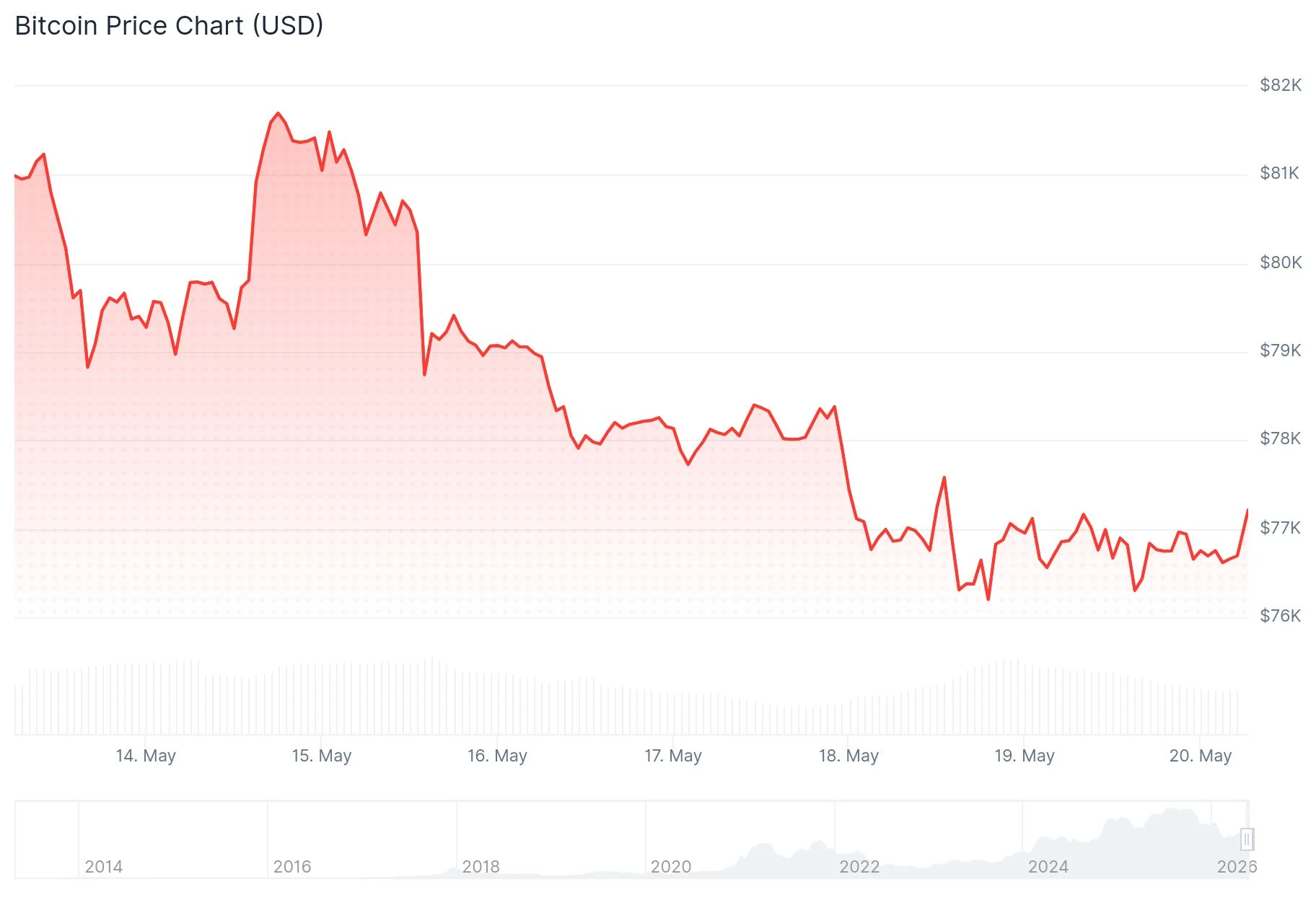
Bitcoin (BTC) Hovers Above $77K Amid Iran Diplomacy and Rising Treasury Yields

Beyond Cleaning: What Else You Must Check Before Moving Out




