Ethereum Reaches Record Daily Transactions as Gas Fees Fall to Lows
- Ethereum’s weekly average transactions hit around 2.5M, while gas fees dropped to nearly $0.15.
- Last month’s Fusaka, along with the latest Blob Parameter Only upgrades, increased network capacity and reduced Layer-2 data costs.
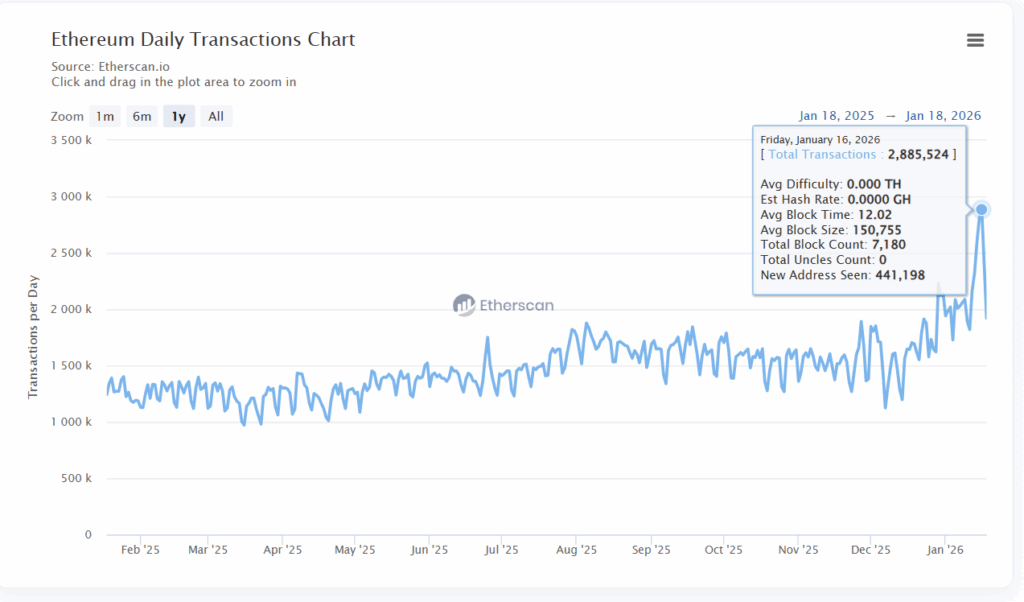
Ethereum’s network activity has reached unprecedented heights, with the last week’s average of daily transactions rising to almost 2.5 million, even as gas prices have plummeted to new lows. This rare combination of surge in network activity and low transaction costs comes after recent protocol upgrades and scaling improvements that have eased congestion and dramatically reduced costs for users.
 Source: Etherscan
With that, a new all-time high of 2.88 million transactions was recorded on January 16, showing improved scalability, and the spike follows a late-December 2025 acceleration in on-chain activity. As well as lower transaction costs, while calculating the past week’s average transaction cost was around $0.15 fee. As of January 18, the average transaction fee stands at $0.18, and total transactions stands in $1.92 million.
Ethereum Upgrades Drive Higher Activity
The spike in network activity occurred approximately seven weeks after Ethereum’s Fusaka hard fork upgrade rolled out. The upgrade introduced PeerDAS (Peer Data Availability Sampling) and began Ethereum’s new two-major-upgrades-per-year timetable.
More recently, the final Blob Parameters Only upgrade, which means data containers released on January 8, increased the blob target from 15 and the maximum limit to 21. This improvement reduced data costs for Layer-2 rollups, making transactions more affordable and allowing the network to handle more activity smoothly.
Vitalik Urges Simplicity For Ethereum’s Future
These improvements are part of Ethereum’s current strategy for increasing speed and user experience. Vitalik’s roadmap discussion in his recent X post is centered on the protocol’s lasting health and simplicity.
Also, he explains that developers are often eager to add new features to achieve short-term functionality. Over time, that habit creates technical debt, which he described as highly destructive to the network’s future, so he introduced a process of garbage collection to counter this, which eliminates dependencies while also ensuring the network’s security and self-sufficiency.
With that, he argues that Ethereum should prioritize protocol simplicity, removing complexity and strengthening decentralization so that the network can remain secure and self-sovereign, rather than adding complex features.
Highlighted Crypto News Today:
U.S. Bitcoin ETFs See $1.42B Inflows as Ethereum ETFs Stay Strong


You May Also Like

Beyond Cleaning: What Else You Must Check Before Moving Out

Justice Department has 'gone off the rails' for Trump's 'pretzel logic': analysis