

Dogecoin price weakens as descending channel targets lower support
Dogecoin price remains stuck in a descending channel, with weak demand at $0.11 support. If this level breaks, the next rotation could target $0.09 channel support.
- DOGE is stuck in a descending channel with lower highs and lower lows
- $0.11 support is holding, but rebounds show weak follow-through
- A breakdown opens downside continuation toward $0.09 channel support
Dogecoin (DOGE) price continues to trade with bearish momentum as price action remains confined within a clearly defined descending channel. The structure reflects sustained selling pressure, with Dogecoin printing lower highs and lower lows, and each recovery attempt failing to generate meaningful follow-through.
With sellers maintaining control and price grinding lower, DOGE is now hovering near a key demand zone around $0.11, which has acted as support throughout the decline.
Doge price key technical points
- DOGE remains bearish inside a descending channel with lower highs and lower lows
- $0.11 support is holding for now, but bounce strength remains weak
- A breakdown opens downside continuation risk toward $0.09 channel support
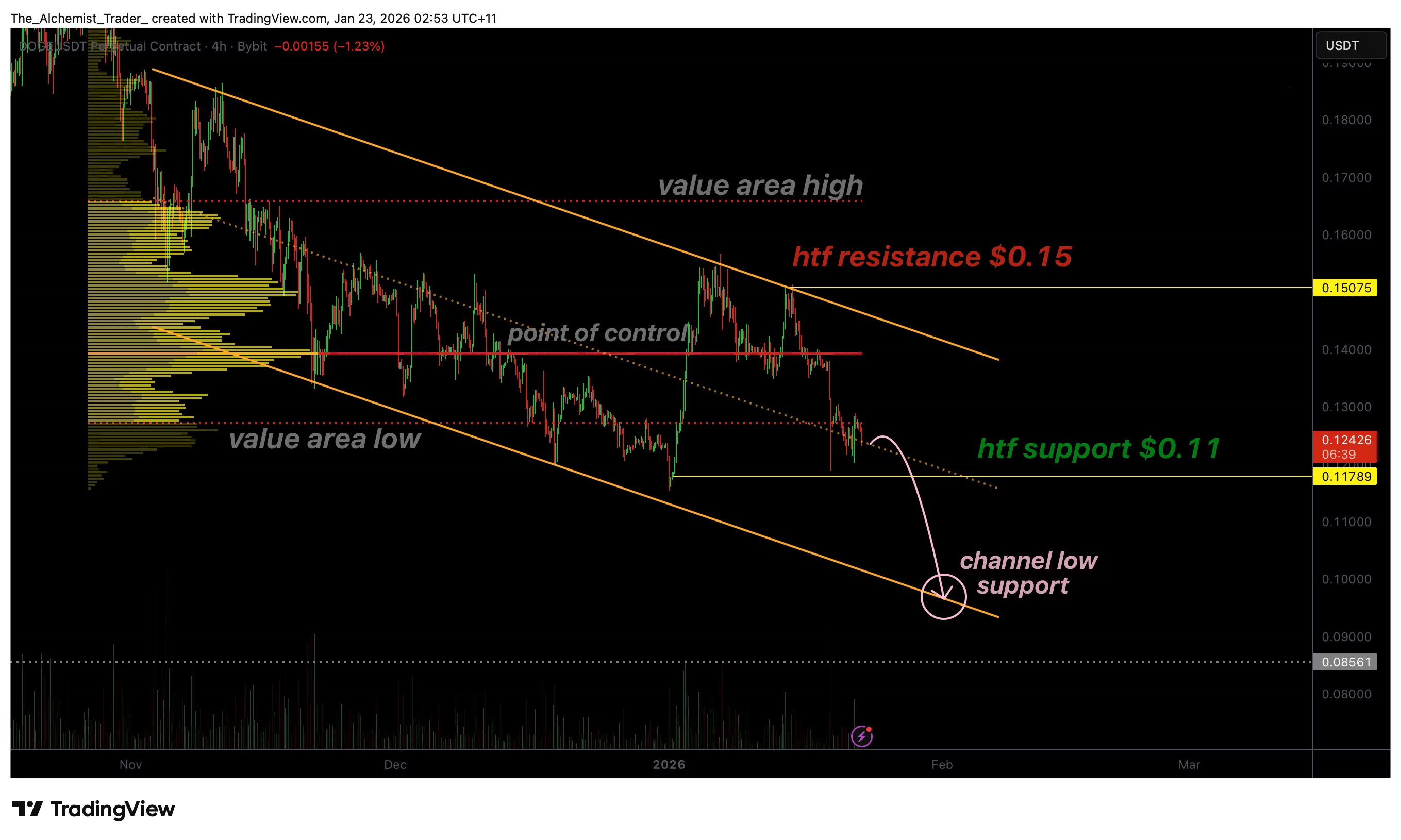
Descending channels often form during extended corrective phases and typically signal trend continuation until proven otherwise. In Dogecoin’s case, the channel structure is clean and consistent: each bounce has been capped by resistance, and the market continues rotating lower in a controlled but persistent downtrend.
The significance of this structure is that it provides a technical roadmap for where price is likely to rotate next. When DOGE fails to break above channel resistance, bearish momentum remains intact. As long as the market respects this channel, downside continuation remains the higher-probability scenario.
For bullish reversal conditions to develop, DOGE would need to reclaim the channel’s upper boundary and establish higher lows. That shift has not occurred yet, and the prevailing structure continues to favor bears.
Lack of follow-through suggests sellers still control price
One of the clearest signals of weakness is the lack of follow-through after bounces. Dogecoin has repeatedly respected $0.11, but each bounce has been shallow and has failed to shift the market structure.
This behavior typically reflects low demand. Buyers are stepping in at support, but not aggressively enough to change the trend. When demand remains weak at support, it increases the chance that the market will eventually break down once liquidity is fully consumed.
This is often how downtrends progress: support holds temporarily, but without strong follow-through, the market slowly compresses until sellers push through and trigger a downside acceleration.
Mid-Channel positioning favors continued downside rotation
Dogecoin is currently trading near the midpoint of the descending channel, an important technical level. Midpoints often act as transition zones where price either reclaims momentum for a reversal attempt or continues the existing trend lower.
Given DOGE’s weak demand, bearish structure, and inability to reclaim key resistance levels, the channel midpoint positioning favors another continuation move toward the lower boundary of the channel. If price remains trapped in this mid-channel region without breaking higher, the probability increases for DOGE to print another lower low.
This sets the stage for a potential downside push toward $0.09, where the channel support and deeper liquidity sit.
Breakdown scenario: $0.09 channel support comes into focus
If Dogecoin loses $0.11 support on a closing basis, the probability of a full rotation toward the $0.09 channel low increases. This would represent the next major structural target in the downtrend and likely trigger a more aggressive downside move as stops are hit and liquidity is taken out below support.
The $0.09 zone becomes the next major area where buyers may attempt a stronger defense. Channel lows often produce reactive bounces, but the broader trend remains bearish unless DOGE can reclaim structure and break above channel resistance.
If DOGE reaches $0.09 and fails to bounce, the risk of further yearly lows increases, reinforcing the thesis of continued downtrend.
What would flip DOGE bullish again?
For Dogecoin to shift bullish, the market must break the descending channel and establish bullish market structure. This requires:
- Reclaiming resistance levels on a closing basis
- Breaking above channel resistance
- Establishing higher lows
- Volume expansion during upside rotation
Without these signals, DOGE remains in a bearish continuation framework, with downside levels as the priority targets.
What to expect in the coming price action
Dogecoin remains bearish as price continues trading inside a descending channel, with weak demand and shallow rebounds keeping downside continuation risk elevated. The $0.11 support zone is the key level holding the market up in the short term, but the lack of bullish follow-through suggests sellers are still in control and a deeper rotation remains possible.
If DOGE breaks below $0.11 with bearish confirmation, the probability increases for an expansion toward the $0.09 channel support, where the next major demand zone and liquidity target sit. Until Dogecoin breaks the descending channel to the upside, the bearish structure remains intact, and lower levels continue to be favored.


You May Also Like

Netflix (NFLX) Stock: Rome Court Declares Price Increases Unlawful, Mandates Customer Refunds

Netflix (NFLX) Stock: Italian Court Orders Refunds Over Illegal Price Hikes




