Bitcoin price traded cautiously on Friday after the Bank of Japan kept its benchmark interest rate at 0.75%.  Investors are balancing short-term relief against Bitcoin price traded cautiously on Friday after the Bank of Japan kept its benchmark interest rate at 0.75%.  Investors are balancing short-term relief against

How will Bitcoin price react as Bank of Japan holds interest rate at 0.75%?

Bitcoin price traded cautiously on Friday after the Bank of Japan kept its benchmark interest rate at 0.75%. 

Summary
  • The Bank of Japan kept its benchmark interest rate at 0.75% but future hikes are possible if inflation persists.
  • Bitcoin traded slightly below $90,000, reflecting short-term calm but ongoing caution from yen-driven liquidity pressures.
  • Technical indicators point to weakening momentum, making support near $89,500–$90,000 a key level to watch.

Investors are balancing short-term relief against ongoing liquidity concerns linked to Japan’s policy decision.

The BOJ voted 8–1 on Jan. 23 to maintain its interest rate at the level set following its hike in December. This was the highest rate in about 30 years. 

Why the BOJ decision matters for Bitcoin

Markets had largely expected the BOJ rate to hold steady, and the decision removed the risk of an immediate policy shock. Instead of moving sharply as it had after earlier rate hikes, Bitcoin’s (BTC) initial response reflected the calm, remaining slightly below $90,000.

The central bank’s statement wasn’t entirely neutral. The BOJ increased its inflation forecasts, allowing for additional rate hikes in the event that price pressures persist.

The shift in Japan’s stance away from extremely loose monetary policies over the last two years has significantly influenced global liquidity, a factor that carries considerable weight for cryptocurrency markets.

Following the BOJ’s interest rate increase in July 2024, Bitcoin fell roughly 26%, from $68,000 to $50,000 in the days that followed. A similar move in January 2025 resulted in a roughly 25% drop over a few weeks, from $74,000 to almost $55,000.

After the December 2025 hike to 0.75%, Bitcoin stayed relatively steady contrary to expectations. It hovered around $90,000, showing that traders had already priced in part of the move. 

The Bank of Japan’s decision to hold rates steady has removed the immediate shock of another hike, explaining why Bitcoin is moving sideways near $89,000-$90,000. Analysts say the cryptocurrency could stay near this range or pull back further unless buyers push it above $92,000–$94,000. 

Any meaningful gains will depend on investors taking on more risk or improvements in global economic conditions.

Bitcoin price technical analysis

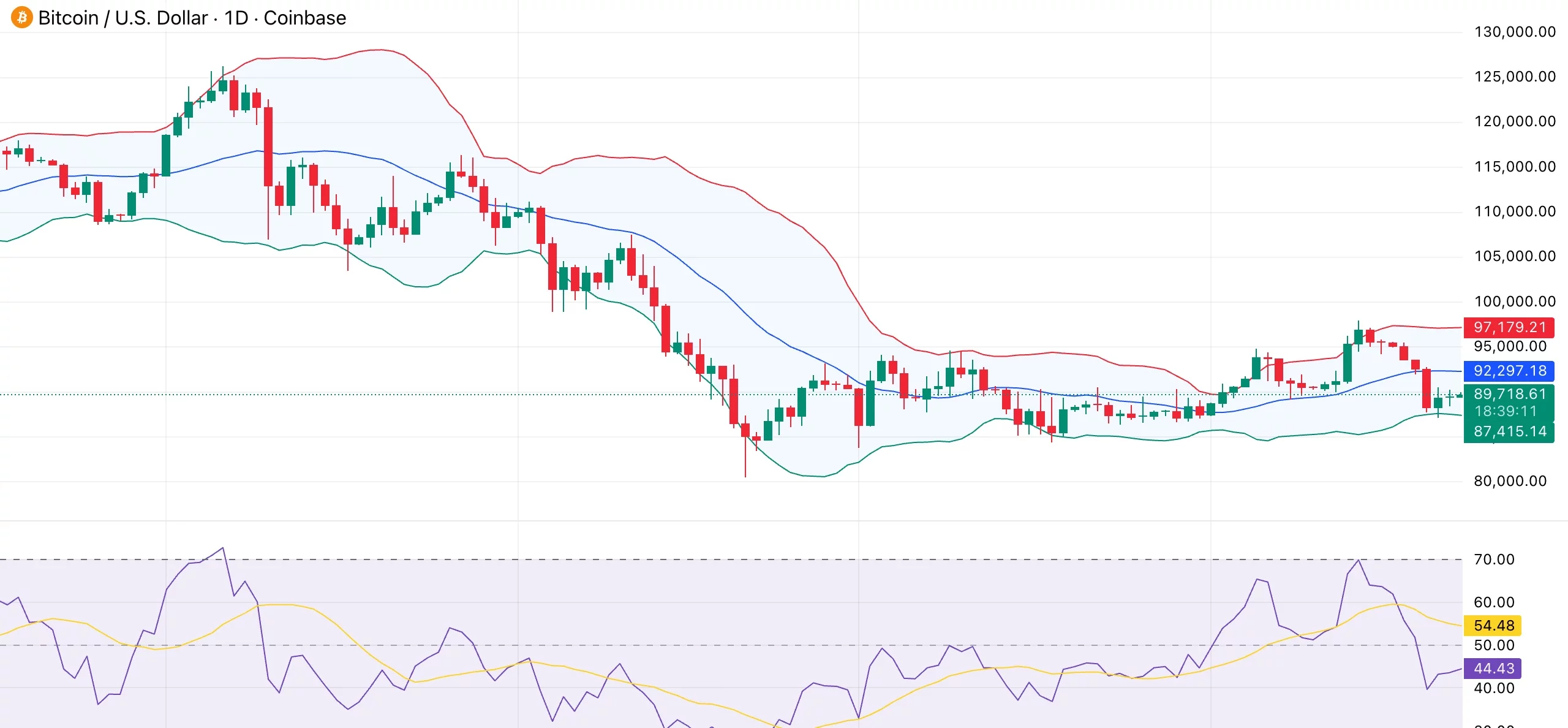
Bitcoin appears to be on unstable ground. The price has fallen below the 20-day moving average and is testing the 50-day average near $92,000, a level that has repeatedly capped recovery attempts over the past weeks. The overall trend suggests the market is still in a corrective phase.
How will Bitcoin price react as Bank of Japan holds interest rate at 0.75%? - 1

As sellers intervened during the most recent bounce, the rally stalled between $97,000 and $98,000, creating a lower high. This rejection occurred in the upper Bollinger Band, which has often capped upward movements.

Momentum indicators show caution. The relative strength index has dropped to the mid-40s after reaching overbought levels earlier this month, suggesting falling demand as opposed to sideways consolidation.

Following a period of compression, volatility has begun to rise, making downward movements more likely.

Immediate support sits at $89,500–$90,000. That zone has held so far, but a daily close below $89,000 could lead to a deeper pullback toward $87,000–$88,000, near the lower Bollinger Band.


Disclaimer: The articles reposted on this site are sourced from public platforms and are provided for informational purposes only. They do not necessarily reflect the views of MEXC. All rights remain with the original authors. If you believe any content infringes on third-party rights, please contact service@support.mexc.com for removal. MEXC makes no guarantees regarding the accuracy, completeness, or timeliness of the content and is not responsible for any actions taken based on the information provided. The content does not constitute financial, legal, or other professional advice, nor should it be considered a recommendation or endorsement by MEXC.

You May Also Like

Trump and Newsom seen engaging in 'friendly banter' backstage: 'Gavin, we're good'

Trump and Newsom seen engaging in 'friendly banter' backstage: 'Gavin, we're good'

President Donald Trump and California Gov. Gavin Newsom engaged in a public war of words this week in Davos, Switzerland, but a Washington, D.C., insider revealed
Share
Rawstory2026/01/23 19:55
Visa Direct Enhances Mercuryo’s Real-Time Crypto-to-Fiat Conversions

Visa Direct Enhances Mercuryo’s Real-Time Crypto-to-Fiat Conversions

TLDR Mercuryo has partnered with Visa to offer near real-time crypto-to-fiat conversions through Visa Direct. The integration enables users to off-ramp cryptocurrency
Share
Coincentral2026/01/23 20:10
Vitalik Buterin lays out new Ethereum roadmap at EDCON

Vitalik Buterin lays out new Ethereum roadmap at EDCON

The post Vitalik Buterin lays out new Ethereum roadmap at EDCON appeared on BitcoinEthereumNews.com. At EDCON 2025 in Osaka, Ethereum co-founder Vitalik Buterin delivered fresh details of Ethereum’s technical roadmap, delineating both short-term scaling goals and longer-term protocol transformations. The immediate priority, according to slides from the presentation, is scaling at the L1 level by raising the gas limit while maintaining decentralization. Tools such as block-level access lists, ZK-EVMs, gas repricing, and slot optimization were highlighted as means to improve throughput and efficiency. A central theme of the presentation was privacy, divided into protections for on-chain “writes” (transactions, voting, DeFi operations) and “reads” (retrieving blockchain state). Write privacy could be achieved through client-side zero-knowledge proofs, encrypted voting, and mixnet-based transaction relays. Read privacy efforts include trusted execution environments, private information retrieval techniques, dummy queries to obscure access patterns, and partial state nodes that reveal only necessary data. These measures aim to reduce information leakage across both ends of user interaction. In the medium term, Ethereum’s focus shifts to cross-Layer-2 interoperability. Vitalik described trustless L2 asset transfers, proof aggregation, and faster settlement mechanisms as key milestones toward a seamless rollup ecosystem. Faster slots and stronger finality, supported by techniques like erasure coding and three-stage finalization (3SF), are also in scope to enhance responsiveness and security. The roadmap also includes Stage 2 rollup advancements to strengthen verification efficiency, alongside a call for broader community participation to help build and maintain these improvements. The long-term “Lean Ethereum” blueprint emphasizes security, simplicity and optimization, with ambitions for quantum-resistant cryptography, formal verification of the protocol, and adoption of ideal primitives for hashing, signatures, and zero-knowledge proofs. Buterin stressed that these improvements are not just for scalability but to make Ethereum a stable, trustworthy foundation for the broader decentralized ecosystem. This is a developing story. This article was generated with the assistance of AI and reviewed by editor Jeffrey Albus before publication.…
Share
BitcoinEthereumNews2025/09/18 03:22