

Which crypto app has the lowest fees? Practical fee comparison guide
Use the step by step approach here as a starting point. Fee schedules and spreads change often, so validate numbers on each app's official pages before you act.
Why app fees matter when you buy crypto
Fees on crypto apps are not a single number. The total cost to buy a token usually combines stated trading fees, a spread or convenience markup on retail purchase flows, any deposit or withdrawal charges, and the on-chain network fee you pay when moving assets off an app. This matters because a low headline trading rate can be offset by a wide spread or flat convenience fee that raises the effective price you pay, especially for small buys Coinbase Help Center.
Some apps show simple retail pricing aimed at convenience, while centralized exchanges publish tiered maker and taker schedules that reward higher volume. That difference in transparency can change how you compare costs across options, and using an exchange overview can help as a quick cross-check CoinGecko exchanges overview or Investopedia’s roundup.
For everyday buyers, the practical takeaway is that you should look past the headline fee and map all cost elements that apply to your actual flow. That means the trading fee, the quoted buy price versus the market price, any deposit method fees, and potential withdrawal network costs all belong in the same calculation Binance fee schedule.
Below is a compact tool spec you can use to run a sample calculation. Keep numbers simple and use the app help pages to fill in the inputs when you test live.
Simple sample-fee calculator to estimate total cost of a buy
–
USD
Use live help pages for inputs
When you run this kind of check you will see why two apps with similar sounding trading fees can produce very different totals for the same buy. In the next sections we break down the fee components so you can find them on each app’s help pages and then run a side by side comparison.

Core fee components explained: maker/taker, spreads, transfers, and network costs
Maker and taker fees are the common structure on centralized exchanges. A maker order adds liquidity and often pays a lower fee, while a taker order removes liquidity and pays more. Volume tiers reduce rates as your monthly trading volume grows, and many exchanges offer discounts if you pay fees using the platform’s native token Binance fee schedule.
For retail consumer flows, apps sometimes add a clear convenience fee and also execute the buy at a price that includes an implicit spread over the market. That spread is an execution cost that is not always listed beside the trading fee and can make very small purchases disproportionately expensive Coinbase Help Center.
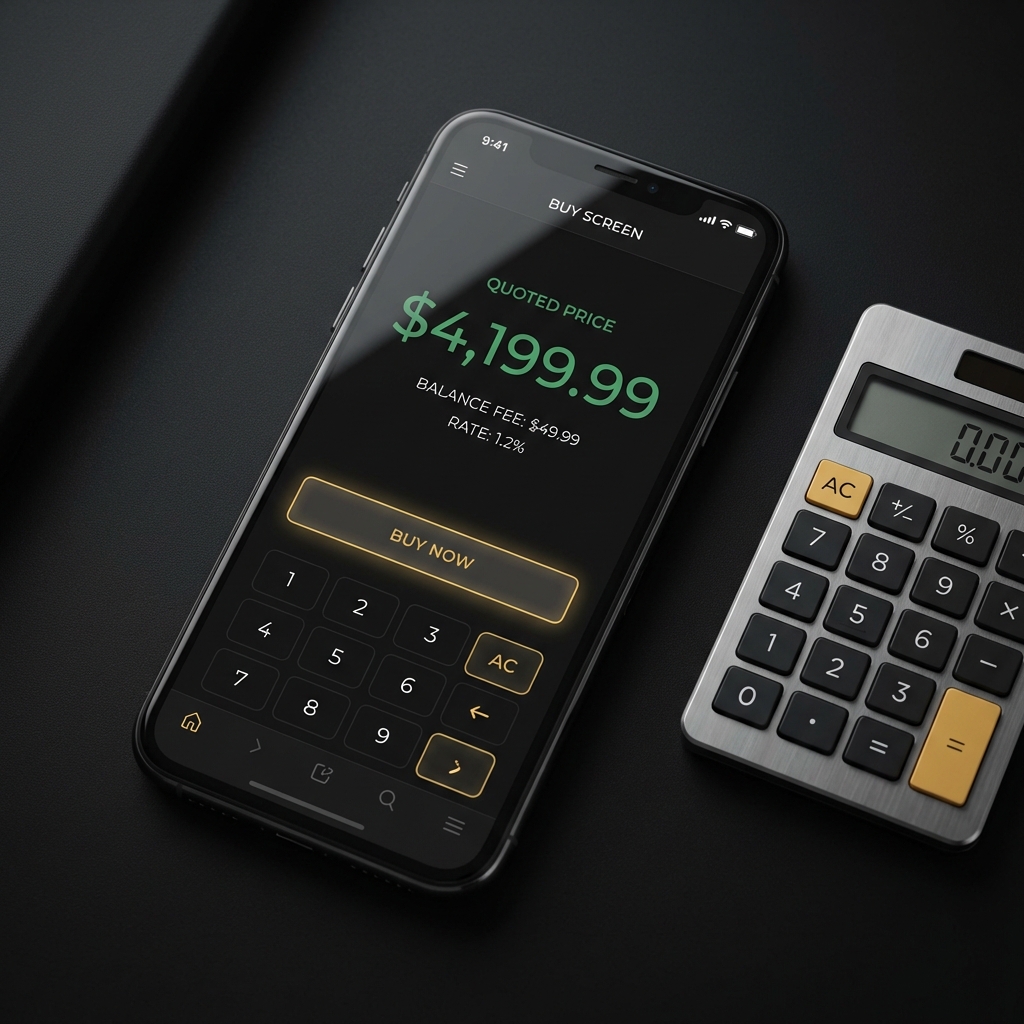
Deposit methods matter. ACH or standard bank transfers are often low cost or free on many apps, while instant card deposits or instant bank transfers usually carry either explicit fees or a higher quoted buy price. Wire transfers can have explicit bank or platform fees. Check each app’s deposit help page for the exact rules and any limits that may affect your choice Gemini fees.
On-chain network fees are charged by the blockchain to move tokens between wallets and are not controlled by the app. These fees vary with network congestion and the chosen chain. Most apps show a network fee estimate during the withdrawal flow so you can include that amount in your calculation Coinbase Help Center.
In short, the components you must identify on a fee page are: the trading fee schedule, whether the retail buy flow uses a spread or convenience markup, the costs for your deposit method, and the expected on-chain fee for withdrawals. Mapping these to the calculator above gives a clearer total cost estimate before you press buy.
How to compare apps for your trade size
Set up a sample calculation for the exact amount you will trade
Start with the exact trade amount you plan to use and run the same steps on each app. The basic sequence is: note the posted trade fee or maker/taker rate, copy the quoted buy price or listed spread if shown, note any flat convenience fee, add deposit fees, and add the expected network fee for withdrawals. Doing this in live help pages removes much of the guesswork Coinbase Help Center.
Use the calculator fields from the tool above and fill them with values you find on each app’s fee or help pages. That gives you a comparable Total cost number for each app and lets you compute the effective percentage fee by dividing Total cost by Trade amount.
Compare headline fees, spreads, and deposit options side by side – best app to buy crypto
When you compare results, pay attention to how small flat fees change the math. For example, a platform that charges a 1.00 flat convenience fee on a 20 USD buy will look expensive relative to a platform that charges 0.5 percent but no flat fee. For larger trades the percent model can be cheaper, while flat fees hit small trades the hardest Robinhood crypto fees. See exchange reviews on NerdWallet.
Also look for tiered discounts if you expect to trade frequently. If your monthly volume will be high, the maker/taker schedule and any native token discounts can change which app is cheapest long term. Those schedules are typically published on the exchange fee or support pages Kraken trading fees.
Record each app’s quoted numbers and compute the effective cost for your exact amount. Save screenshots or a short note that includes the date, so you have a record if pricing changes between your comparison and the moment you buy.
Deposit and withdrawal fees: methods that change the cost profile
Common fiat funding methods differ in cost. ACH or standard bank transfers are often free or low cost on many platforms, while instant deposits using a debit card or expedited bank transfer usually attract a fee or a higher buy price. Wires may carry explicit fees from the sending bank or the platform itself; check the app’s deposit page for exact charges and limits Gemini fees.
When you plan to withdraw, remember on-chain fees vary by chain and can change with congestion. Apps generally show a network fee estimate during the withdrawal flow so you can include it in your decision to withdraw or leave assets on the platform for a while Coinbase Help Center.
Deciding whether to keep crypto on an exchange or withdraw to your own wallet is partly about fees and partly about control. Withdrawing immediately adds a network cost that could be substantial on some chains at peak times, while leaving crypto on an exchange avoids that one-time fee but changes custody characteristics. Consider both cost and the trade-offs about ownership and security in your decision.
Factor deposit speed into the cost analysis. If you need to buy quickly, an instant deposit with a fee may be worth the convenience; if you can wait, an ACH transfer that is free or low cost will reduce total fees on the purchase.
Sample cost calculations: small buys versus large trades
Small buy example, step 1: start with your planned trade amount, for example 25 USD. Step 2: find the retail quoted buy price or spread and any flat convenience fee on the app’s help or buy flow. Many consumer broker flows include both a flat fee and an implicit spread that is not obvious unless you compare the quoted price to the live market price Coinbase Help Center. Check broader fee comparisons like Koinly’s guide.
Small buy example, step 2: assume the app shows a flat convenience fee of 0.99 and an implicit spread that increases the executed price by about 0.5 percent. Using the calculator formula, Total cost = 25*(1+0.5/100)+0.99 = 25.12+0.99 = 26.11. The effective fee percentage is (26.11-25)/25 = 4.44 percent. This illustrates how flat fees can push the effective percent far above the headline percent.
Try the sample calculation with your exact amount
Try the same calculation with your exact amount and payment method to see which app yields the lowest total cost for you.
Run my fee check
Large trade example, step 1: for a larger buy such as 10,000 USD, a platform with tiered maker/taker pricing can offer much lower effective fees because the percentage applies to a larger base and volume discounts reduce the rate. Check the exchange’s published fee schedule to see where your monthly volume would fit and whether paying with a native token reduces fees further Binance fee schedule.
Large trade example, step 2: run the same calculator with the large trade amount and include any deposit fees. In many cases the flat convenience fee becomes negligible, and the dominant cost is the maker or taker percentage plus any temporary spread from market impact. For frequent high-volume traders, the published fee tiers and token discounts are the most important cost drivers Kraken trading fees.
Native token discounts and monthly volume tiers can shift which app is cheapest. If you plan to trade often, model both one-off and recurring scenarios so you can see whether an app that looks worse for a single small buy might be cheaper over a month of activity.
Common mistakes and pitfalls when comparing crypto app fees
Common mistakes and pitfalls when comparing crypto app fees
Ignoring spreads or convenience markups is one of the most frequent errors. Comparing headline trading fees alone misses implicit costs that often appear in retail buy prices. Always compare the quoted buy price against a market reference or the app’s log so you can spot implicit spreads Robinhood crypto fees. See related market commentary here.
Using the wrong trade size for comparisons leads to misleading results. A platform that is cheapest for a 10,000 USD trade can be worse for a 25 USD buy because flat fees and minimums change the effective percentage. Run the same sample calculation for the exact amount you plan to use Coinbase Help Center.
Skipping deposit and on-chain fee checks is another common pitfall. Some deposit methods add immediate charges, and on-chain withdrawal fees can be high during congestion. Check the app’s deposit and withdrawal help pages and include those values in your total cost comparison CoinGecko exchanges overview.
Finally, relying solely on third-party aggregators without confirming on the app help pages can leave you exposed to short-term spreads or promotions that the aggregator did not capture. Use aggregators for a quick scan, but verify live numbers before committing to a trade CoinGecko exchanges overview. Also see our guide to exchange affiliate programs.
A simple checklist and next steps before you buy
Open each app’s official fee or support page and copy the relevant numbers: posted trading fee or fee tier, any quoted spread or buy price, flat convenience fees, deposit options and fees, and the withdrawal network fee estimate. Use the same trade amount across apps so the results are comparable Coinbase Help Center.
Run the sample calculation using the calculator formula in the Tool block. Compute Total cost and then the effective percentage fee for each app. Note the date and take a screenshot of the help page or the quoted buy price so you have a record if prices change.
Use an exchange aggregator as a cross-check to see relative pricing quickly, but always confirm on the app help pages because spreads and promotions can change frequently CoinGecko exchanges overview and our crypto category.
Finally, consider your expected frequency and volume. If you trade rarely and in small amounts, prioritize low flat fees or no convenience charges. If you trade often or with large volume, look for tiered pricing and any native token discounts that could lower costs over time.
Wrap-up: run a sample calculation now and double-check live fees
There is no single lowest fee app for every buyer. The cheapest option depends on your trade size, deposit method, and whether you trade often. Run a live sample calculation that adds trading fees, spreads, deposit charges, and on chain fees to see which app is cheapest for your specific flow.
The total cost to buy crypto depends on multiple components that combine to produce the final price you pay. Trading fees, spreads or convenience markups, deposit or withdrawal costs, and on-chain network fees each matter and must be added together in a simple calculation to reveal the true cost Coinbase Help Center.
Small buys are often hit hardest by flat convenience fees and implicit spreads, while larger or frequent traders can lower per-trade cost through tiered maker/taker schedules and token discounts. Use the checklist and the sample calculation method in this guide to find which app is the best app to buy crypto for your situation Binance fee schedule.
Check trading fees, any quoted spread or convenience markup on retail buys, deposit or withdrawal charges, and the blockchain network fee for withdrawals.
Flat convenience fees and minimums raise the effective percentage cost on small purchases because the fixed charge is large compared with the trade amount.
Aggregators are useful for a quick cross-check, but always verify live numbers on the app's official fee or support pages because spreads and promotions change.
FinancePolice aims to help you understand the decision factors and make a clear comparison. Use the calculator template and the live verification steps before you buy.
References
- https://help.coinbase.com/en/coinbase/trading-and-funding/pricing-and-fees/fees
- https://www.coingecko.com/en/exchanges
- https://www.binance.com/en/fee/schedule
- https://www.gemini.com/fees
- https://financepolice.com/advertise/
- https://robinhood.com/us/en/support/articles/crypto-fees/
- https://support.kraken.com/hc/en-us/articles/360022839671-Trading-fees
- https://www.investopedia.com/best-crypto-exchanges-5071855
- https://www.nerdwallet.com/investing/best/crypto-exchanges-platforms
- https://koinly.io/blog/crypto-exchange-with-lowest-fees/
- https://financepolice.com/category/crypto/
- https://financepolice.com/crypto-exchange-affiliate-programs-to-consider-heres-what-you-need-to-know/
- https://financepolice.com/bitcoin-price-analysis-btc-slips-below-90000-as-leveraged-liquidations-rock-market/


You May Also Like

Revealed: Bizarre items billed to racial profiling settlement

Ethereum’s 55% Drop Masks a Deeper Problem: Vanishing Buying Pressure, Analyst Warns

Crypto Market Drops as Fear Grows and Major Assets Decline



