Japan Proposes Strict Bond Standards for Stablecoin Collateral – Can Issuers Meet the Bar?
Japan’s Financial Services Agency has unveiled strict collateral requirements for stablecoin reserve assets, setting a remarkably high threshold that could limit which bonds qualify as backing for digital yen instruments.
The proposed rules mandate that foreign-issued bonds must carry top-tier credit ratings and come from issuers with at least 100 trillion yen ($650 billion) in outstanding debt, a bar few global entities can meet.
The draft standards emerged Monday as part of regulatory notices implementing the 2025 Payment Services Act amendments, establishing how stablecoin issuers may invest “specified trust beneficiary interests” under Japan’s evolving digital currency framework.
Japan Sets 100 trillion Yen As Minimum Bond Collateral
The proposed FSA notice restricts eligible backing assets to foreign bonds that meet dual criteria, favoring only the world’s largest sovereign and corporate issuers.
Qualifying bonds must achieve a credit risk rating of “1–2” or higher from designated agencies while originating from entities whose total bond issuance reaches the 100 trillion yen minimum.
Beyond collateral standards, new supervisory guidelines target banks and insurance subsidiaries offering cryptocurrency intermediation services.
Financial institutions must now explicitly warn customers not to underestimate digital asset risks simply because products carry a traditional banking brand.
The FSA also introduced screening requirements for businesses handling foreign stablecoins, demanding confirmation that overseas issuers will not directly solicit Japanese retail customers.
Regulators plan to coordinate cross-border with foreign authorities to monitor these instruments and their originators.
The consultation period runs through February 27, 2026, implementing Act No. 66 of 2025 that revised Japan’s settlement and electronic payment framework last June.
After public comments close, the rules will undergo final procedures before taking effect.
Stablecoins Reshape Japan’s $9 Trillion Bond Market
While the FSA tightens oversight, Japan’s emerging stablecoin sector is potentially set to transform the country’s sovereign debt landscape, with implications for the Bank of Japan’s (BOJ) influence over its $9 trillion Japanese government bond (JGB) market.
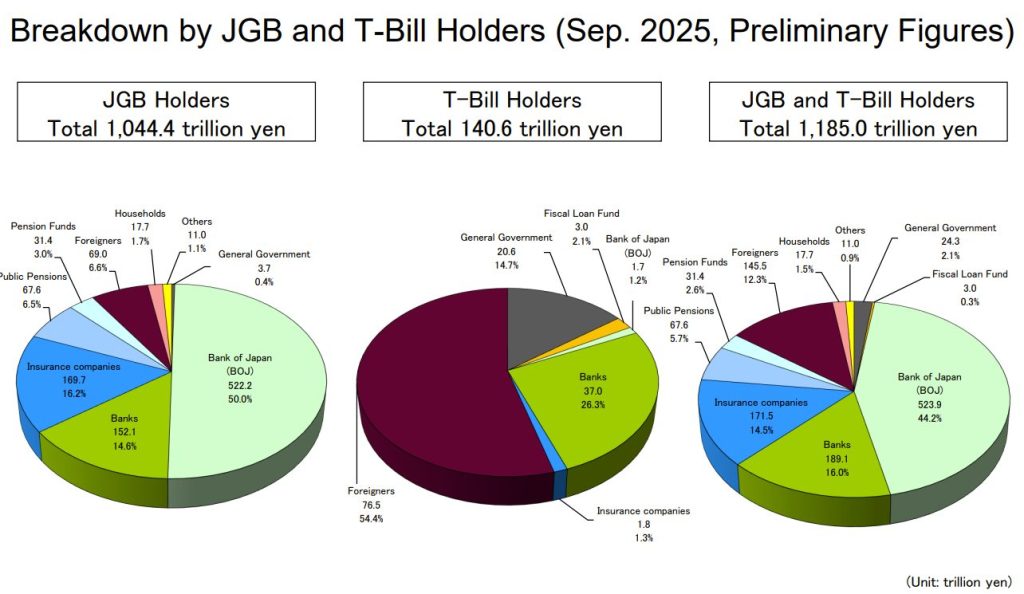 Source: Mof
JPYC, the Tokyo-based issuer of Japan’s first yen-pegged stablecoin, suggests that digital asset companies could become significant holders of government bonds as reserve requirements expand.
The company launched its yen-backed stablecoin on October 27 under Japan’s revised Payment Services Act, marking the nation’s inaugural legal framework for stablecoins.
Founder and CEO Noritaka Okabe told Reuters that stablecoin issuers might assume roles traditionally occupied by the BOJ, which has been reducing bond purchases following years of aggressive monetary easing.
“With the BOJ tapering bond buying, stablecoin issuers could emerge as the biggest holders of JGBs in the next few years,” Okabe stated, adding that while authorities could influence bond duration, controlling total holdings would prove challenging.
Currently, the BOJ dominates Japan’s JGB market, holding roughly 50% of the 1,055-trillion-yen market, followed by insurance companies and domestic banks. Foreign investors and public pensions represent smaller market shares.
 Source: MacroMicro
Okabe proposed that stablecoin issuers could fill emerging gaps, with JPYC planning to allocate 80% of proceeds to JGBs and 20% to bank deposits.
Major Banks Unite for Yen Stablecoin Initiative
Despite strict regulations, Japan’s three largest financial institutions, Mitsubishi UFJ Financial Group, Sumitomo Mitsui Financial Group, and Mizuho Financial Group, are collaborating on a joint initiative to launch yen-backed stablecoins for domestic users.
The banking trio intends to promote settlements using pegged cryptocurrencies, challenging the market dominance of dollar-denominated stablecoins like USDT and USDC.
According to Nikkei, the banks will establish infrastructure enabling corporate clients to transfer stablecoins between entities in accordance with standardized protocols, initially focusing on yen-pegged tokens, with potential dollar-pegged versions planned for future deployment.
These developments align with Japan’s broader digital finance transformation, as cashless payment adoption surged to 42.8% in 2024 from just 13.2% in 2010.
Reports also indicate that Japan’s financial watchdog is considering allowing banks to purchase and hold digital assets such as Bitcoin for investment purposes before 2028.


You May Also Like

Samsung Electronics Targets Record Q1 Profit as Memory Chip Supercycle Hits Full Stride

One Of Frank Sinatra’s Most Famous Albums Is Back In The Spotlight