BitMine Immersion Technologies, a publicly traded crypto treasury vehicle tied to investor Tom Lee, has faced a sharp mark-to-market unwind on its Ether holdingsBitMine Immersion Technologies, a publicly traded crypto treasury vehicle tied to investor Tom Lee, has faced a sharp mark-to-market unwind on its Ether holdings

BitMine Battles $6B Unrealized Ether Loss as Crypto Sell-Off Deepens

6 min read
Bitmine Battles $6b Unrealized Ether Loss As Crypto Sell-Off Deepens

BitMine Immersion Technologies, a publicly traded crypto treasury vehicle tied to investor Tom Lee, has faced a sharp mark-to-market unwind on its Ether holdings as recent liquidations ripple through crypto markets. The company boosted its Ether position by 40,302 tokens last week, lifting total holdings to more than 4.24 million ETH. Data from Dropstab indicate that unrealized losses now exceed $6 billion, illustrating how balance-sheet strategies can rapidly deteriorate when markets tilt lower and liquidity thins.

Valued at roughly $9.6 billion at current prices, BitMine’s Ether stack sits well below its October peak of about $13.9 billion, a reminder that the broader sector’s downturn has carved a sizable dent into treasury portfolios that once rode a wave of rising prices. The latest move comes as Ether itself has traded in a high-variance range, with valuations reflecting liquidity stress and the spillover effects of aggressive deleveraging across digital assets.

Source: Dropstab

The slide in Ether’s price toward the mid-$2,000s has intensified concerns about liquidity conditions in crypto markets. Observers point to a market where liquidity has been choppy at best, and where compressed liquidity amplifies the impact of large, leveraged positions. The Kobeissi Letter summarized the dynamic, noting that “air pockets” in price emerge when risk-taking is propped up by heavy leverage and crowd-like behavior among investors, exacerbating sell-offs in downtrending environments.

Related coverage has highlighted BitMine’s broader staking footprint as a source of recurring revenue, underscoring the tension between ongoing income streams and the risk of capital drawdowns during downturns. BitMine’s staking arrangements—through which Ether can generate annual revenue—illustrate how treasury strategies seek to balance yield with drawdown risk in volatile markets. The broader market narrative remains focused on whether staking economics can cushion losses in bear phases or merely provide a partial offset to mark-to-market declines.

A difficult reset for crypto markets

In late 2025 and into 2026, Tom Lee, founder of Fundstrat, has cautioned that conditions have shifted and that the year could begin on a painful note before any potential rebound. In recent remarks, Lee emphasized that the crypto market continues to bear the weight of deleveraging, even as some longer-term fundamentals remain intact. He pointed to the October crash as a pivotal moment that reset risk appetite across digital assets, a reference to market events that seasoned observers view as a turning point in the liquidity cycle.
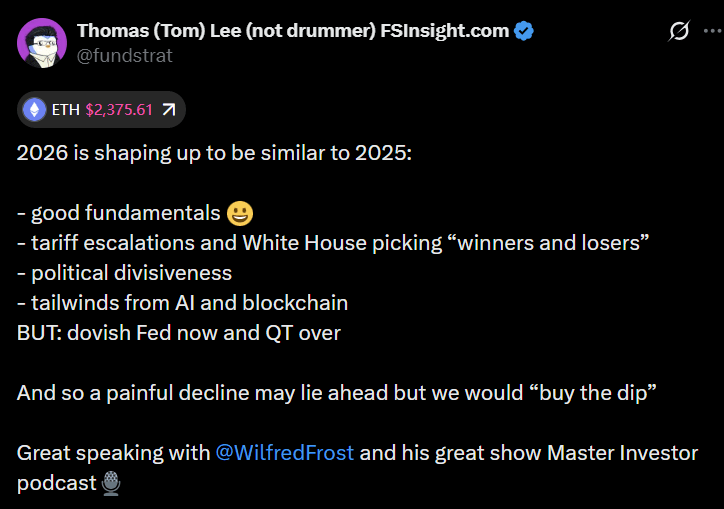
Source: Tom Lee

A recent assessment by market maker Wintermute reinforced the view that a sustained recovery in 2026 will hinge on a handful of structural improvements: renewed momentum in Bitcoin (Bitcoin (CRYPTO: BTC)) and Ether, stronger ETF participation, expanded digital asset treasury mandates, and a revival of retail inflows. Wintermute argued these catalysts are required to restore a broader “wealth effect” across markets, noting that retail participation remains tepid as investors chase faster-growth themes such as artificial intelligence and quantum computing.

Evidence from market watchers suggests that the liquidity environment will continue to shape price action well into the year. The narrative around liquidity, leverage, and crowd dynamics has intensified as crypto assets oscillate between bouts of risk-on optimism and risk-off selling, with the implication that any meaningful revival will likely be gradual rather than immediate. The market’s experience in 2025—where liquidations reshaped the asset hierarchy and shook confidence in traditional treasury strategies—serves as a reference point for how fragile balance sheets can become when volatility spikes and liquidity tightens.

For readers tracking the broader context, additional coverage has underscored the vulnerability of digital assets to liquidity shocks, including articles that highlighted how liquidations can temporarily push Bitcoin out of the world’s top assets and how stakeholders evaluate the market impact of large-scale deleveraging. These threads help explain why BitMine’s latest moves have amplified scrutiny of crypto treasury approaches at a time when risk appetite remains subdued and institutional testing of balance sheets continues.

Why it matters

The episode around BitMine’s Ether exposure is more than a single fund’s balance-sheet setback. It spotlights how publicly traded treasury strategies, even when backed by notable investors and governance structures, can be exposed to outsized drawdowns in volatile markets. For asset managers and corporate treasuries exploring crypto holdings as a yield or diversification vehicle, the affair underscores three practical considerations: the fragility of concentrated long-only exposures during liquidity shocks, the importance of risk controls around leverage and liquidations, and the potential value—and limits—of staking revenue as a cushion during drawdowns.

From a market-wide perspective, the episode feeds into a broader question about how liquidity, ETF flows, and retail participation will shape crypto momentum in 2026. If the sector is to gain a sustained wealth effect, observers say it will require a combination of improved market liquidity, renewed retail interest, and broader adoption of treasury mandates that balance yield opportunities with prudent risk management. The path forward is unlikely to be linear, but the consensus suggests that any meaningful recovery will hinge on a combination of macro resilience, structural improvements in on-chain ecosystems, and a reaccumulation phase among investors who have been sidelined by volatility.

For builders and policymakers, the case reinforces the need for transparent risk disclosures around treasury allocations, clearer guidelines for staking-based revenue models, and robust risk management frameworks that can withstand sudden shifts in liquidity. As the market recalibrates, the ability of protocols and custodians to manage leverage, liquidity, and collateral positions will be as important as the price trajectories of the assets themselves.

What to watch next

  • BitMine’s next quarterly filing and any adjustments to Ether holdings or unrealized losses.
  • Ether price stability and liquidity conditions in major markets, particularly during any macro-driven risk-off episodes.
  • Follower liquidity trends in crypto markets, including potential ETF flow changes and renewed retail involvement.
  • Any updates to BitMine’s staking revenue expectations and related on-chain yields.
  • Broader market commentary on deleveraging dynamics and the pace of recovery for BTC and ETH.

Sources & verification

  • Dropstab portfolio data on BitMine’s ETH holdings and unrealized losses (bitmine-eth-strategy-portfolio lipdgyz9ho).
  • The Kobeissi Letter discussion of liquidity fragility and price air pockets linked to leverage in crypto markets.
  • BitMine staking revenue reference article: Bitmine’s staked Ether holdings point to $164M in annual staking revenue.
  • Fundstrat notes on 2026 dynamics and Tom Lee’s commentary (Fundstrat on tough start to 2026).
  • Wintermute assessment on the conditions required for a 2026 recovery (Wintermute: crypto 2026 comeback hinges three outcomes).

This article was originally published as BitMine Battles $6B Unrealized Ether Loss as Crypto Sell-Off Deepens on Crypto Breaking News – your trusted source for crypto news, Bitcoin news, and blockchain updates.


Disclaimer: The articles reposted on this site are sourced from public platforms and are provided for informational purposes only. They do not necessarily reflect the views of MEXC. All rights remain with the original authors. If you believe any content infringes on third-party rights, please contact service@support.mexc.com for removal. MEXC makes no guarantees regarding the accuracy, completeness, or timeliness of the content and is not responsible for any actions taken based on the information provided. The content does not constitute financial, legal, or other professional advice, nor should it be considered a recommendation or endorsement by MEXC.

You May Also Like

Over 60% of crypto press releases linked to high-risk or scam projects: Report

Over 60% of crypto press releases linked to high-risk or scam projects: Report

A data analysis shows crypto press release wires are dominated by scam-linked projects, hype-driven content and low-impact announcements, raising concerns about
Share
Crypto.news2026/02/04 22:02
ArtGis Finance Partners with MetaXR to Expand its DeFi Offerings in the Metaverse

ArtGis Finance Partners with MetaXR to Expand its DeFi Offerings in the Metaverse

By using this collaboration, ArtGis utilizes MetaXR’s infrastructure to widen access to its assets and enable its customers to interact with the metaverse.
Share
Blockchainreporter2025/09/18 00:07
Crucial US Stock Market Update: What Wednesday’s Mixed Close Reveals

Crucial US Stock Market Update: What Wednesday’s Mixed Close Reveals

BitcoinWorld Crucial US Stock Market Update: What Wednesday’s Mixed Close Reveals The financial world often keeps us on our toes, and Wednesday was no exception. Investors watched closely as the US stock market concluded the day with a mixed performance across its major indexes. This snapshot offers a crucial glimpse into current investor sentiment and economic undercurrents, prompting many to ask: what exactly happened? Understanding the Latest US Stock Market Movements On Wednesday, the closing bell brought a varied picture for the US stock market. While some indexes celebrated gains, others registered slight declines, creating a truly mixed bag for investors. The Dow Jones Industrial Average showed resilience, climbing by a notable 0.57%. This positive movement suggests strength in some of the larger, more established companies. Conversely, the S&P 500, a broader benchmark often seen as a barometer for the overall market, experienced a modest dip of 0.1%. The technology-heavy Nasdaq Composite also saw a slight retreat, sliding by 0.33%. This particular index often reflects investor sentiment towards growth stocks and the tech sector. These divergent outcomes highlight the complex dynamics currently at play within the American economy. It’s not simply a matter of “up” or “down” for the entire US stock market; rather, it’s a nuanced landscape where different sectors and company types are responding to unique pressures and opportunities. Why Did the US Stock Market See Mixed Results? When the US stock market delivers a mixed performance, it often points to a tug-of-war between various economic factors. Several elements could have contributed to Wednesday’s varied closings. For instance, positive corporate earnings reports from certain industries might have bolstered the Dow. At the same time, concerns over inflation, interest rate policies by the Federal Reserve, or even global economic uncertainties could have pressured growth stocks, affecting the S&P 500 and Nasdaq. Key considerations often include: Economic Data: Recent reports on employment, manufacturing, or consumer spending can sway market sentiment. Corporate Announcements: Strong or weak earnings forecasts from influential companies can significantly impact their respective sectors. Interest Rate Expectations: The prospect of higher or lower interest rates directly influences borrowing costs for businesses and consumer spending, affecting future profitability. Geopolitical Events: Global tensions or trade policies can introduce uncertainty, causing investors to become more cautious. Understanding these underlying drivers is crucial for anyone trying to make sense of daily market fluctuations in the US stock market. Navigating Volatility in the US Stock Market A mixed close, while not a dramatic downturn, serves as a reminder that market volatility is a constant companion for investors. For those involved in the US stock market, particularly individuals managing their portfolios, these days underscore the importance of a well-thought-out strategy. It’s important not to react impulsively to daily movements. Instead, consider these actionable insights: Diversification: Spreading investments across different sectors and asset classes can help mitigate risk when one area underperforms. Long-Term Perspective: Focusing on long-term financial goals rather than short-term gains can help weather daily market swings. Stay Informed: Keeping abreast of economic news and company fundamentals provides context for market behavior. Consult Experts: Financial advisors can offer personalized guidance based on individual risk tolerance and objectives. Even small movements in major indexes can signal shifts that require attention, guiding future investment decisions within the dynamic US stock market. What’s Next for the US Stock Market? Looking ahead, investors will be keenly watching for further economic indicators and corporate announcements to gauge the direction of the US stock market. Upcoming inflation data, statements from the Federal Reserve, and quarterly earnings reports will likely provide more clarity. The interplay of these factors will continue to shape investor confidence and, consequently, the performance of the Dow, S&P 500, and Nasdaq. Remaining informed and adaptive will be key to understanding the market’s trajectory. Conclusion: Wednesday’s mixed close in the US stock market highlights the intricate balance of forces influencing financial markets. While the Dow showed strength, the S&P 500 and Nasdaq experienced slight declines, reflecting a nuanced economic landscape. This reminds us that understanding the ‘why’ behind these movements is as important as the movements themselves. As always, a thoughtful, informed approach remains the best strategy for navigating the complexities of the market. Frequently Asked Questions (FAQs) Q1: What does a “mixed close” mean for the US stock market? A1: A mixed close indicates that while some major stock indexes advanced, others declined. It suggests that different sectors or types of companies within the US stock market are experiencing varying influences, rather than a uniform market movement. Q2: Which major indexes were affected on Wednesday? A2: On Wednesday, the Dow Jones Industrial Average gained 0.57%, while the S&P 500 edged down 0.1%, and the Nasdaq Composite slid 0.33%, illustrating the mixed performance across the US stock market. Q3: What factors contribute to a mixed stock market performance? A3: Mixed performances in the US stock market can be influenced by various factors, including specific corporate earnings, economic data releases, shifts in interest rate expectations, and broader geopolitical events that affect different market segments uniquely. Q4: How should investors react to mixed market signals? A4: Investors are generally advised to maintain a long-term perspective, diversify their portfolios, stay informed about economic news, and avoid impulsive decisions. Consulting a financial advisor can also provide personalized guidance for navigating the US stock market. Q5: What indicators should investors watch for future US stock market trends? A5: Key indicators to watch include upcoming inflation reports, statements from the Federal Reserve regarding monetary policy, and quarterly corporate earnings reports. These will offer insights into the future direction of the US stock market. Did you find this analysis of the US stock market helpful? Share this article with your network on social media to help others understand the nuances of current financial trends! To learn more about the latest stock market trends, explore our article on key developments shaping the US stock market‘s future performance. This post Crucial US Stock Market Update: What Wednesday’s Mixed Close Reveals first appeared on BitcoinWorld.
Share
Coinstats2025/09/18 05:30


