

Tether Unveils Open-Source Bitcoin Mining Operating System
This article was first published on The Bit Journal.
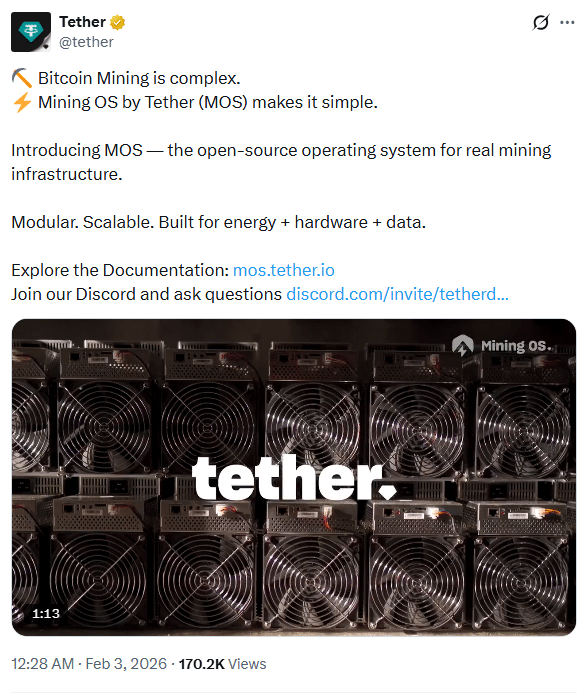
Tether has launched an operating system that seeks to remove existing barriers to running Bitcoin mining. The firm says the software will enhance its efficiency and increase access for miners.
The deployment is part of a larger trend in decentralized mining infrastructure on Bitcoin. In an X post, Tether said that it has launched MiningOS, also referred to as MOS.
The company called it a modular and scalable platform. It said the system can be used in mining operations of all sizes. The closed software ecosystem has always been part and parcel of Bitcoin mining.
 Source: X
A number of these are maintained by just a few vendors. Tether has said that it has crimped transparency and competition. MiningOS is designed to provide an open alternative to Bitcoin mining management.
MiningOS and Its Core Function
MiningOS is a self-hosted operating system built for mining. It allows operators to manage hardware directly.
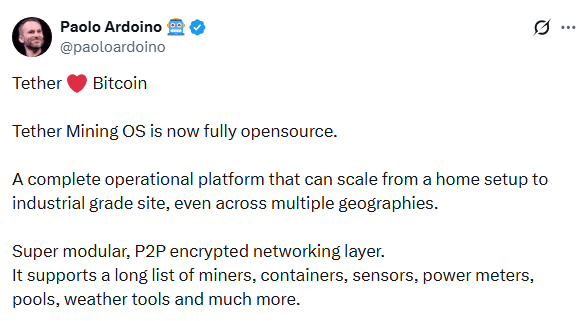
The software communicates with connected devices through a peer-to-peer network. Tether says this removes the need for centralized cloud services in BTC mining operations.
Decentralization remains a central goal of the release. Tether argues that BTC mining should not depend on centralized management platforms.
Also Read: Is Tether the New Dollar? 500 Million Users Say Yes
MiningOS is designed to eliminate third-party dependencies. This structure gives miners greater autonomy and control over their Bitcoin mining activity.
 Source: X
Flexible Design for Different Operators
Tether says MiningOS can scale easily. The system supports BTC mining setups at different levels. These range from small home operations to industrial sites across multiple regions.
Operators can adjust performance settings through a companion platform. This flexibility is meant to lower barriers to Bitcoin mining.
Open-Source Licensing and Transparency
MiningOS is released under the Apache 2.0 license. This allows free use, modification, and redistribution. Developers can build on the software without restrictions. Tether says this approach encourages collaboration in BTC mining software development.
Comparison With Other Industry Projects
Several crypto firms have explored open-source BTC mining tools. Jack Dorsey’s Block is one example. However, Block’s software is tied closely to its own hardware products.
Tether says MiningOS is hardware-agnostic. This allows it to work across a wider range of BTC mining infrastructure.
Tether’s Strategy Beyond Stablecoins
The MiningOS launch highlights Tether’s expansion beyond stablecoins. Over the past year, the firm has invested in tokenization and artificial intelligence. It has also increased its focus on decentralized finance. Bitcoin mining infrastructure now appears to be another strategic area for the company.
Tether’s direct exposure to Bitcoin adds context to the release. Since 2023, the firm has allocated a portion of its profits to Bitcoin purchases.
By early 2026, Tether held about 96,185 BTC. This places it among the largest corporate holders globally. These holdings link Tether closely to the economics of BTC mining.
Potential Impact on the Mining Sector
Bitcoin mining costs are still elevated, industrywide. Network complexity has also increased. Some open-source tools such as MiningOS could help lower operational friction.
The broader adoption can make management easier. It could also provide a way to adopt common standards for Bitcoin mining operations.
Conclusion
The launch of MiningOS by Tether represents a major leap forward for BTC mining infrastructure. The firm is advocating for open access and transparency.
It’s also a challenge to the hegemony of closed software systems. Should adoption take off, MiningOS will have an impact on how Bitcoin mines are managed and scaled.
Also Read: Bitcoin Mining and Climate: The ESG Case That Investors Are Starting to Take Seriously
Appendix: Glossary of Key Terms
MiningOS (MOS): An open source operating system developed by Tether designed to optimize and scale Bitcoin mining facilities.
Open-source software: Software that the public can use, modify and share.
P2P network: A network that enables devices to connect with one another, without having a central source of authority.
Apache 2.0 License: A permissive open source license which allows you to use, modify and distribute software freely.
Decentralisation: Spreading control between multiple parties rather than being in a single, central, source.
Frequently Asked Questions About Bitcoin MiningOS
1- What is Bitcoin MiningOS?
MiningOS is an open-source operating system designed to manage Bitcoin mining hardware.
2- Who can use MiningOS?
It is intended for both small-scale and large-scale Bitcoin mining operators.
3- How does MiningOS support decentralization?
It removes reliance on centralized services and proprietary vendors.
4- Is MiningOS free to use?
Yes. It is released under the Apache 2.0 open-source license.
References
Cointelegraph
CoinDesk
Read More: Tether Unveils Open-Source Bitcoin Mining Operating System">Tether Unveils Open-Source Bitcoin Mining Operating System


You May Also Like

Rich Bitcoin traders lost $337M daily in first quarter of 2026

Musk Demands Wall Street Buy Grok AI Subscriptions




