

Trump signs executive order allowing US pension funds to invest in cryptocurrencies, potentially ushering in a major shift in the nearly $9 trillion market
Compiled by: Felix, PANews
US President Donald Trump signed an executive order on Thursday (August 7) allowing Americans to invest their 401(k) retirement savings in other alternative assets such as cryptocurrencies, private equity, and real estate. The executive order states:
- The Department of Labor has 180 days to reassess its guidance regarding the obligations of 401(k) plans and other defined contribution plans governed by the Employee Retirement Income Security Act (ERISA) regarding alternative asset investments.
- The Secretary of Labor clarified the Department of Labor's position on alternative assets and the appropriate fiduciary procedures related to offering asset allocation funds that include investments in alternative assets.
- The Secretary of Labor consults with the Secretary of the Treasury, the Securities and Exchange Commission (SEC), and other federal regulators to determine whether similar regulatory reforms should be made at those agencies.
- The U.S. Securities and Exchange Commission (SEC) is amending applicable regulations and guidance to facilitate access to alternative assets for participant-directed defined contribution retirement savings plans.
Trump's executive order explicitly categorizes cryptocurrencies with alternative assets and includes them in 401(k) retirement savings investment plans. Previously, the U.S. Department of Labor issued guidance requiring trustees to "exercise extreme caution before considering adding cryptocurrencies to the investment menu of 401(k) plan participants." This guidance was completely rescinded in May of this year.
Influenced by this news, market data showed that Bitcoin rose nearly 2% in the past 24 hours and Ethereum rose more than 7%.
Nearly $900 Million in US Pension Funds to Open Cryptocurrency Exposure
Pension plans in the United States are divided into three parts: the first is national social security funds, which guarantee basic retirement living expenses for employees. The second is corporate pension plans, of which the 401(k) plan is a key component. These plans are only available to employees of private companies and are the most common retirement plan for employees in the United States. The third part is private annuity plans.
A 401(k) plan is a tax-advantaged retirement savings plan offered by an employer. It's primarily employee-contributed, meaning employees contribute a portion of their pre-tax salary to their 401(k) account. The employer typically also matches the employee's contribution. For example, employees contribute 6% of their salary, with the employer contributing an additional 3% or 6%. (The specific percentages and rules are determined by the employer.)
In 2025, the IRS capped employee voluntary contributions at $23,500, with an additional $7,500 for employees 50 and older. Employees can typically choose from a range of investment funds offered by their employers, bearing their own investment risk. However, withdrawals before age 59.5 are typically subject to a 10% penalty tax and back income tax.
Currently, the market concentration of 401(k) platform providers in the United States is relatively high. It is estimated that the top five providers (Fidelity, Empower, Vanguard, Principal, and ADP) together control more than 60% of 401(k) market assets.
In terms of business models, Fidelity, Empower, Principal, and Voya tend to be comprehensive, offering recordkeeping, investment management, and proprietary fund products. Vanguard and BlackRock primarily specialize in investment management.
According to a report released by the Investment Company Institute (ICI) in June of this year, 401(k) plans hold $8.7 trillion in assets, with over 90 million Americans participating in employer-sponsored defined contribution plans. Within 401(k)s, mutual funds manage $5.3 trillion in assets, representing 61%. Equity funds, the largest category, hold $3.2 trillion, followed by commingled funds, which hold approximately $1.4 trillion.
Mixed reviews, positive for cryptocurrencies
While introducing crypto assets into 401(k)s increases the risk of retirement funds, it is undoubtedly a boon for the emerging crypto industry.
Analyst Geiger Capital tweeted , “401k pensions hold about $9 trillion in assets. If just 5% of that were invested in Bitcoin, it would be worth $450 billion. Bitcoin’s total market capitalization is $2 trillion.”
Tom Dunleavy, partner at investment firm Varys Capital, analyzed that "most Americans allocate a portion of their biweekly paychecks (usually between 1% and 10%) to their 401(k) retirement accounts. Typically, stocks account for 60% and bonds account for 40%. If the allocation to cryptocurrencies suddenly becomes 5%, you will see hundreds of billions of dollars of funds pouring into this asset class in the next few years."
“The short-term impact of Trump’s 401(k) executive order is that it sends another message to investors that the regulatory awakening of cryptocurrencies is here to stay,” said Ryan Rasmussen, director of research at Bitwise. “That will obviously push the market higher.” “Over the medium term, the executive order and the responses from 401(k) plan providers will drive tens, if not hundreds of billions, of dollars into crypto assets.”
In contrast to the cheers from the crypto community, rational voices have also emerged from the traditional financial sector, reminding that this move also comes with certain risks and challenges.
First, investment fees could erode returns. Private equity funds typically charge investors a 2% annual management fee, plus 20% of the fund's profits. Morningstar analyst Jason Kephart said the executive order presents "tremendous opportunities" for asset managers, but also raises concerns among individual investors. "The added costs, complexity, and reduced transparency make the picture less clear."
Second, there will be an increase in litigation. Brian Gardner, chief Washington policy strategist at Stifel, predicts that the Department of Labor will need to review its guidance on plan fiduciary duties, as losses in private investments by 401(k) plan participants could lead to lawsuits against managers.
Thirdly, lack of liquidity is a major drawback. While 401(k)s allow for investments in private equity, these assets are often illiquid, and investors' funds can often be tied up for months or even years. This can mean that private equity fund holders in 401(k) plans may find it difficult to quickly sell their shares, either to raise cash or purchase other investments.
Finally, it's worth noting that while the executive order has been signed, providers like Fidelity and Vanguard will need to develop appropriate products, and the widespread adoption of these products could take years.
Related Reading: $12.5 Trillion in Retirement Funds? Does Trump Support Cryptocurrency in 401(k) Plans?


You May Also Like
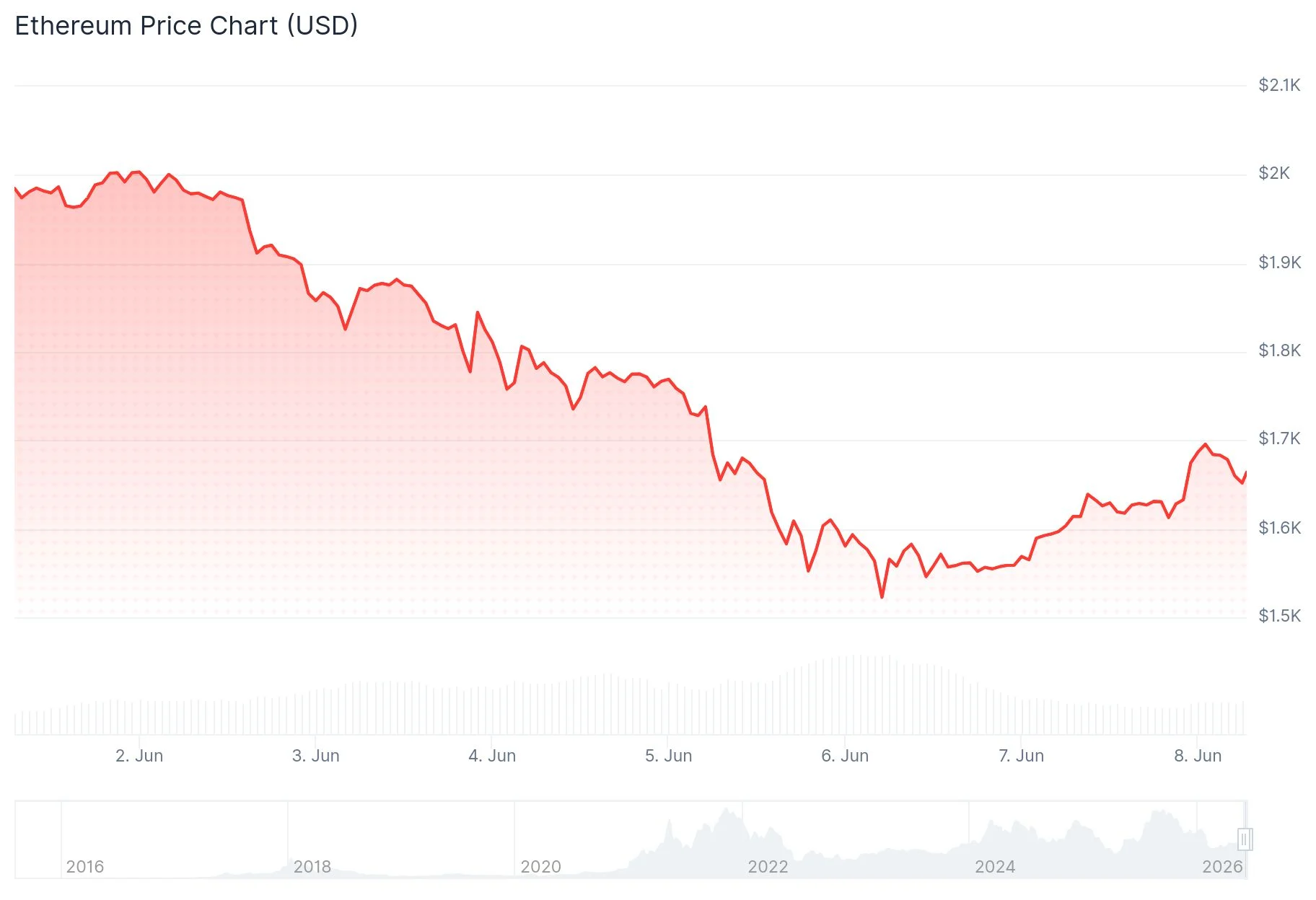
Ethereum (ETH) Crashes to $1,500 — Can Bulls Defend or Is $1,000 Coming?

Arthur Hayes says ‘I Didn’t Buy’ amid $2M HYPE transfer

Bitcoin Options Skew Turns Bearish: What the $60K Put Wall Says After the Washout



