On Friday afternoon, after powering up to 970 exahash per second (EH/s) the day prior, Bitcoin’s computational force cranked even further, hitting 976 EH/s—just 24 EH/s shy of the colossal 1 zettahash per second (ZH/s) threshold. Bitcoin’s Mining Might Continues to Flex The hashrate kept pushing upward and, a mere ten blocks before the network’s […]On Friday afternoon, after powering up to 970 exahash per second (EH/s) the day prior, Bitcoin’s computational force cranked even further, hitting 976 EH/s—just 24 EH/s shy of the colossal 1 zettahash per second (ZH/s) threshold. Bitcoin’s Mining Might Continues to Flex The hashrate kept pushing upward and, a mere ten blocks before the network’s […]

Bitcoin’s Hashrate Roars to 976 EH/S — Just a Hair From 1 ZH/s Glory

On Friday afternoon, after powering up to 970 exahash per second (EH/s) the day prior, Bitcoin’s computational force cranked even further, hitting 976 EH/s—just 24 EH/s shy of the colossal 1 zettahash per second (ZH/s) threshold.

Bitcoin’s Mining Might Continues to Flex

The hashrate kept pushing upward and, a mere ten blocks before the network’s next difficulty adjustment, the reading reached 976 EH/s based on the seven-day simple moving average (SMA), according to hashrateindex.com metrics.
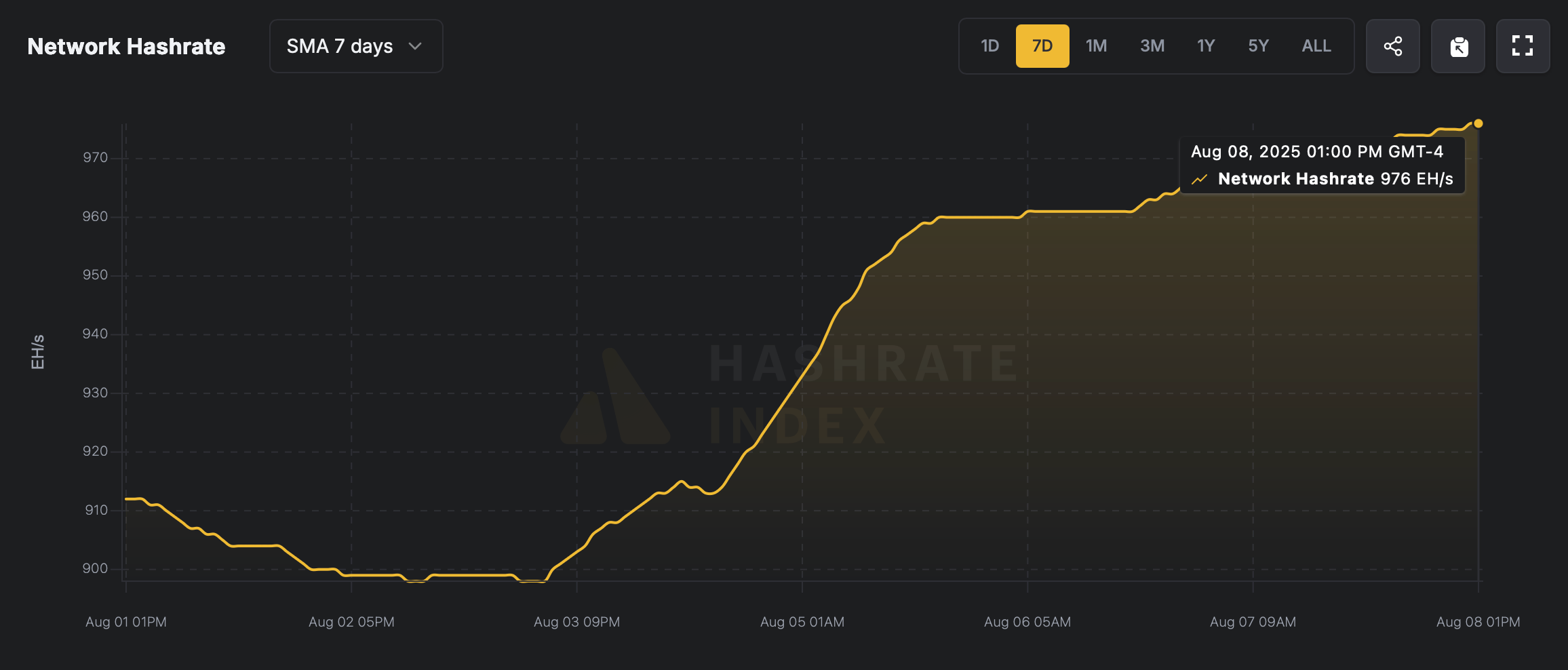
Bitcoin’s Hashrate Roars to 976 EH/S — Just a Hair From 1 ZH/s GloryComputational power metrics recorded by hashrateindex.com.

The seven-day SMA metric smooths out short-term swings by averaging data over the set period, making it easier to spot true directional trends since pinpointing the exact hashrate is notoriously tricky.

The seven-day SMA has become the go-to measure in the industry, providing a standardized snapshot that keeps analyses consistent. For example, the three-day simple moving average (SMA) paints a much loftier picture of Bitcoin’s horsepower, showing that the network briefly touched 1 zettahash between Aug. 5 and 6 earlier this week.

At 2:05 p.m. Eastern time, the live read-out clocked 972 EH/s, with Foundry powering a massive 278 EH/s—28.64% of the total. Antpool comes in second, steering 18.1% of the hashrate with more than 175 EH/s, while Viabtc follows with 128 EH/s (13.25%). F2pool holds fourth place, contributing just over 100 EH/s, or 10.35% of the network.
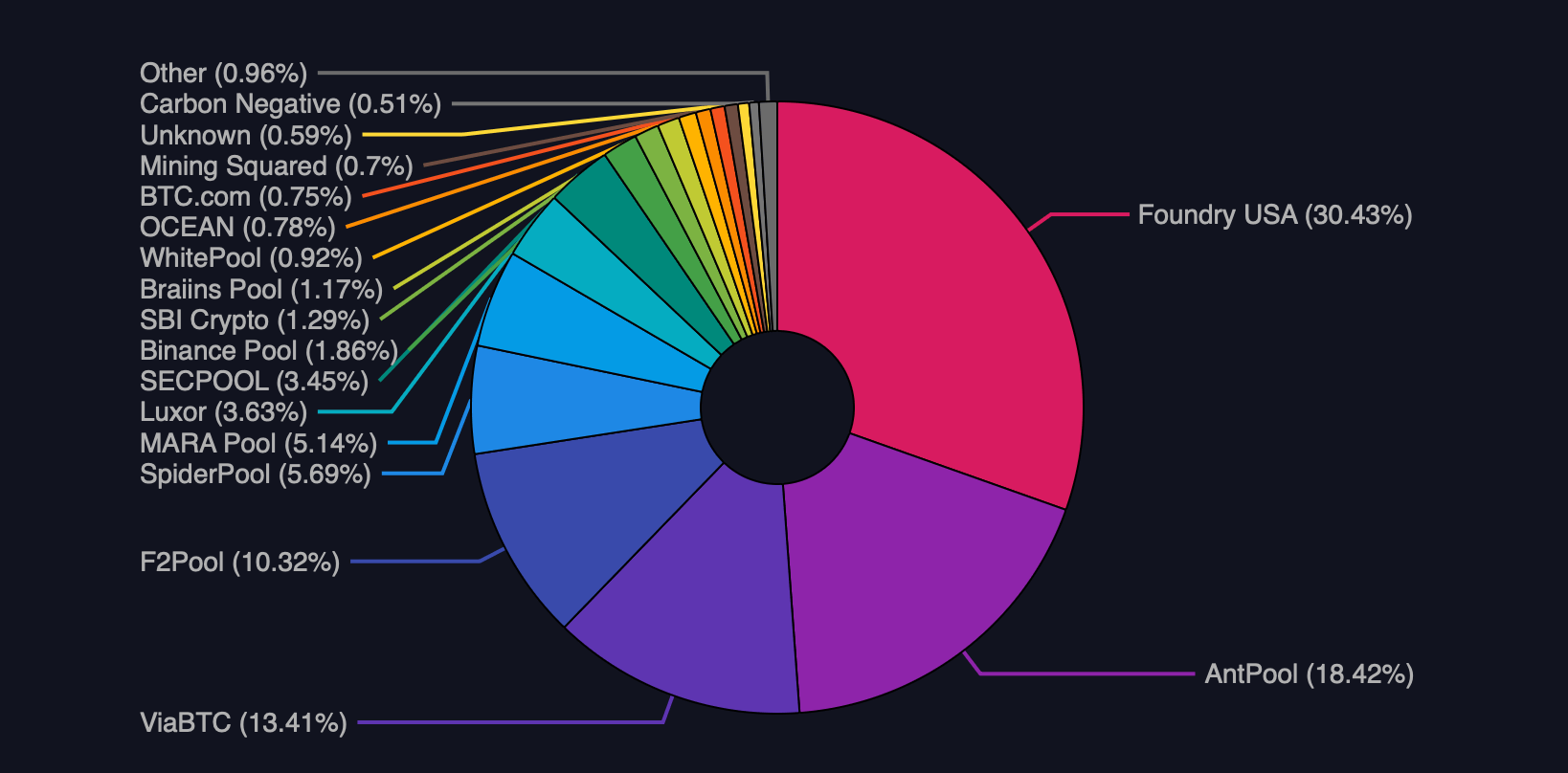
Bitcoin’s Hashrate Roars to 976 EH/S — Just a Hair From 1 ZH/s GloryMining pool distribution according to mempool.space.

In fifth place, Spiderpool runs at 83 EH/s, claiming 8.5% of Bitcoin’s collective computing firepower. If growth continues at this pace, the milestone could soon be surpassed, potentially redefining industry benchmarks and reinforcing the protocol’s standing as the most secure and resilient blockchain on the planet.

Bitcoin’s climb toward the 1 zettahash mark (1 sextillion hashes per second) signals a pivotal moment for the network, hinting at the sheer scale of resources now backing its security. If growth continues at this pace, the milestone could soon be surpassed and be constant, potentially redefining industry benchmarks and reinforcing the protocol’s standing as the most secure and resilient blockchain on the planet.

Such computational intensity also reflects the increasing competitiveness among mining pools, where efficiency and scale can dictate dominance. As leading players edge forward with ever-higher contributions, the race for hashrate control could spark new investments in hardware, energy sourcing, and global mining infrastructure, reshaping the balance of power in the bitcoin mining arena.


Disclaimer: The articles reposted on this site are sourced from public platforms and are provided for informational purposes only. They do not necessarily reflect the views of MEXC. All rights remain with the original authors. If you believe any content infringes on third-party rights, please contact service@support.mexc.com for removal. MEXC makes no guarantees regarding the accuracy, completeness, or timeliness of the content and is not responsible for any actions taken based on the information provided. The content does not constitute financial, legal, or other professional advice, nor should it be considered a recommendation or endorsement by MEXC.

You May Also Like

The Channel Factories We’ve Been Waiting For

The Channel Factories We’ve Been Waiting For

The post The Channel Factories We’ve Been Waiting For appeared on BitcoinEthereumNews.com. Visions of future technology are often prescient about the broad strokes while flubbing the details. The tablets in “2001: A Space Odyssey” do indeed look like iPads, but you never see the astronauts paying for subscriptions or wasting hours on Candy Crush.  Channel factories are one vision that arose early in the history of the Lightning Network to address some challenges that Lightning has faced from the beginning. Despite having grown to become Bitcoin’s most successful layer-2 scaling solution, with instant and low-fee payments, Lightning’s scale is limited by its reliance on payment channels. Although Lightning shifts most transactions off-chain, each payment channel still requires an on-chain transaction to open and (usually) another to close. As adoption grows, pressure on the blockchain grows with it. The need for a more scalable approach to managing channels is clear. Channel factories were supposed to meet this need, but where are they? In 2025, subnetworks are emerging that revive the impetus of channel factories with some new details that vastly increase their potential. They are natively interoperable with Lightning and achieve greater scale by allowing a group of participants to open a shared multisig UTXO and create multiple bilateral channels, which reduces the number of on-chain transactions and improves capital efficiency. Achieving greater scale by reducing complexity, Ark and Spark perform the same function as traditional channel factories with new designs and additional capabilities based on shared UTXOs.  Channel Factories 101 Channel factories have been around since the inception of Lightning. A factory is a multiparty contract where multiple users (not just two, as in a Dryja-Poon channel) cooperatively lock funds in a single multisig UTXO. They can open, close and update channels off-chain without updating the blockchain for each operation. Only when participants leave or the factory dissolves is an on-chain transaction…
Share
BitcoinEthereumNews2025/09/18 00:09
Onyxcoin Price Breakout Coming — Is a 38% Move Next?

Onyxcoin Price Breakout Coming — Is a 38% Move Next?

The post Onyxcoin Price Breakout Coming — Is a 38% Move Next? appeared on BitcoinEthereumNews.com. Onyxcoin price action has entered a tense standoff between bulls
Share
BitcoinEthereumNews2026/01/14 00:33
Buterin pushes Layer 2 interoperability as cornerstone of Ethereum’s future

Buterin pushes Layer 2 interoperability as cornerstone of Ethereum’s future

Ethereum founder, Vitalik Buterin, has unveiled new goals for the Ethereum blockchain today at the Japan Developer Conference. The plan lays out short-term, mid-term, and long-term goals touching on L2 interoperability and faster responsiveness among others. In terms of technology, he said again that he is sure that Layer 2 options are the best way […]
Share
Cryptopolitan2025/09/18 01:15