Ethereum Bull Case: A Range Breakout Could Propel ETH Price Toward $7,000

The post Ethereum Bull Case: A Range Breakout Could Propel ETH Price Toward $7,000 appeared first on Coinpedia Fintech News
Ethereum slipped below the $2,000 mark for the first time since May 2025 as intense selling pressure swept through the crypto market. Bitcoin’s drop to $60,000 added to the downside momentum, dragging ETH lower until buyers stepped in around $1,753, a level that helped stall the decline and spark a rebound.
The recovery lifted the ETH price back above $1,975, suggesting the move lower was largely technically driven rather than event-led. With no major negative catalyst behind the sell-off, rising buying pressure fueled a swift bounce, shifting focus to whether Ethereum can now build on this recovery or if the rebound remains a short-term reaction within a broader range.
Weekly Chart Signals Compression Ahead of a Breakout
This ETH weekly chart captures a long phase of consolidation that traders often see before a big expansion move. Ethereum has been printing higher lows since the 2022 bottom, while price keeps getting capped near the $3,800–$4,000 resistance zone. The recent move above that level, followed by a sharp pullback, looks like a classic fakeout meant to flush late entries. With the broader structure still intact, this setup leans more toward prolonged accumulation than a trend breakdown.
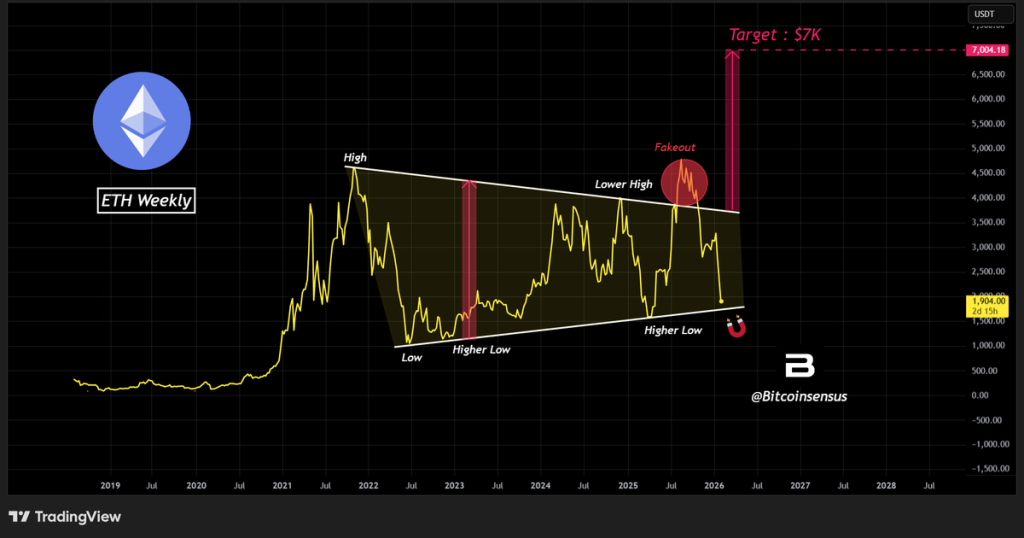 Source: X
For traders, the line in the sand sits around $2,800–$3,000, where the higher-low structure is anchored. As long as ETH holds this zone, upside attempts remain valid. A strong weekly close above $4,200 would signal real acceptance and could open the path toward $5,000–$5,500, with $7,000 as the larger breakout target. Losing $2,800 on a weekly close would weaken the setup and point to more sideways or corrective price action.
Ethereum Price at a Decision Point
Ethereum’s current price action reflects stabilization, not confirmation. After defending the $1,750–$1,900 macro support zone, ETH has managed to rebound above $1,950, but it continues to struggle below the $2,150 resistance, which remains the first level bulls need to reclaim to regain short-term control.
From a higher-timeframe perspective, the weekly higher-low structure is still intact, meaning the broader bullish thesis has not been invalidated yet. However, the lack of a strong follow-through move and continued rejection near resistance suggests ETH is still range-bound, not trending.
As long as ETH holds above $1,750, the downside risk remains containe,d and the market stays in a positioning phase. A weekly close below $1,700 would weaken the structure and open the door to a deeper correction. On the upside, a reclaim of $2,150, followed by acceptance above the $2,600 mid-range, would be the first signs that Ethereum is preparing for a broader breakout attempt.


You May Also Like

How an ideological fracture embroiled Trump DOJ’s push to prosecute enemies

Trump's civil rights chief attended wedding of 'Stop the Steal' organizer: report