Table of Links Abstract and 1. Introduction 2. Experiment Definition 3. Experiment Design and Conduct 3.1 Latin Square Designs 3.2 Subjects, Tasks and Objects 3.3 Conduct 3.4 Measures 4. Data Analysis 4.1 Model Assumptions 4.2 Analysis of Variance (ANOVA) 4.3 Treatment Comparisons 4.4 Effect Size and Power Analysis 5. Experiment Limitations and 5.1 Threats to the Conclusion Validity 5.2 Threats to Internal Validity 5.3 Threats to Construct Validity 5.4 Threats to External Validity 6. Discussion and 6.1 Duration 6.2 Effort 7. Conclusions and Further Work, and References 3.4 Measures We used the time records of subjects to define the following measures: \ Duration: It is the elapsed time in minutes to write the program. Before starting the program assignment, subjects wrote down the current time. When they completed the program, they registered the finish time; then we calculate the difference in minutes between start and finish time. \ Effort: It measures the amount of labor spent to perform a task. It is the total programming effort in person-minutes to write a program. Total effort for a pair is the duration multiplied by two. Tables 3 and 4 show the measures (in minutes) collected for the experiment. \ \ \ :::info Authors: (1) Omar S. Gómez, full time professor of Software Engineering at Mathematics Faculty of the Autonomous University of Yucatan (UADY); (2) José L. Batún, full time professor of Statistics at Mathematics Faculty of the Autonomous University of Yucatan (UADY); (3) Raúl A. Aguilar, Faculty of Mathematics, Autonomous University of Yucatan Merida, Yucatan 97119, Mexico. ::: :::info This paper is available on arxiv under CC BY-NC-ND 4.0 DEED license. ::: \Table of Links Abstract and 1. Introduction 2. Experiment Definition 3. Experiment Design and Conduct 3.1 Latin Square Designs 3.2 Subjects, Tasks and Objects 3.3 Conduct 3.4 Measures 4. Data Analysis 4.1 Model Assumptions 4.2 Analysis of Variance (ANOVA) 4.3 Treatment Comparisons 4.4 Effect Size and Power Analysis 5. Experiment Limitations and 5.1 Threats to the Conclusion Validity 5.2 Threats to Internal Validity 5.3 Threats to Construct Validity 5.4 Threats to External Validity 6. Discussion and 6.1 Duration 6.2 Effort 7. Conclusions and Further Work, and References 3.4 Measures We used the time records of subjects to define the following measures: \ Duration: It is the elapsed time in minutes to write the program. Before starting the program assignment, subjects wrote down the current time. When they completed the program, they registered the finish time; then we calculate the difference in minutes between start and finish time. \ Effort: It measures the amount of labor spent to perform a task. It is the total programming effort in person-minutes to write a program. Total effort for a pair is the duration multiplied by two. Tables 3 and 4 show the measures (in minutes) collected for the experiment. \ \ \ :::info Authors: (1) Omar S. Gómez, full time professor of Software Engineering at Mathematics Faculty of the Autonomous University of Yucatan (UADY); (2) José L. Batún, full time professor of Statistics at Mathematics Faculty of the Autonomous University of Yucatan (UADY); (3) Raúl A. Aguilar, Faculty of Mathematics, Autonomous University of Yucatan Merida, Yucatan 97119, Mexico. ::: :::info This paper is available on arxiv under CC BY-NC-ND 4.0 DEED license. ::: \

A Simple Guide to Measuring Time and Labor in Programming

Abstract and 1. Introduction

2. Experiment Definition

3. Experiment Design and Conduct

3.1 Latin Square Designs

3.2 Subjects, Tasks and Objects

3.3 Conduct

3.4 Measures

4. Data Analysis

4.1 Model Assumptions

4.2 Analysis of Variance (ANOVA)

4.3 Treatment Comparisons

4.4 Effect Size and Power Analysis

5. Experiment Limitations and 5.1 Threats to the Conclusion Validity

5.2 Threats to Internal Validity

5.3 Threats to Construct Validity

5.4 Threats to External Validity

6. Discussion and 6.1 Duration

6.2 Effort

7. Conclusions and Further Work, and References

3.4 Measures

We used the time records of subjects to define the following measures:

\ Duration: It is the elapsed time in minutes to write the program. Before starting the program assignment, subjects wrote down the current time. When they completed the program, they registered the finish time; then we calculate the difference in minutes between start and finish time.

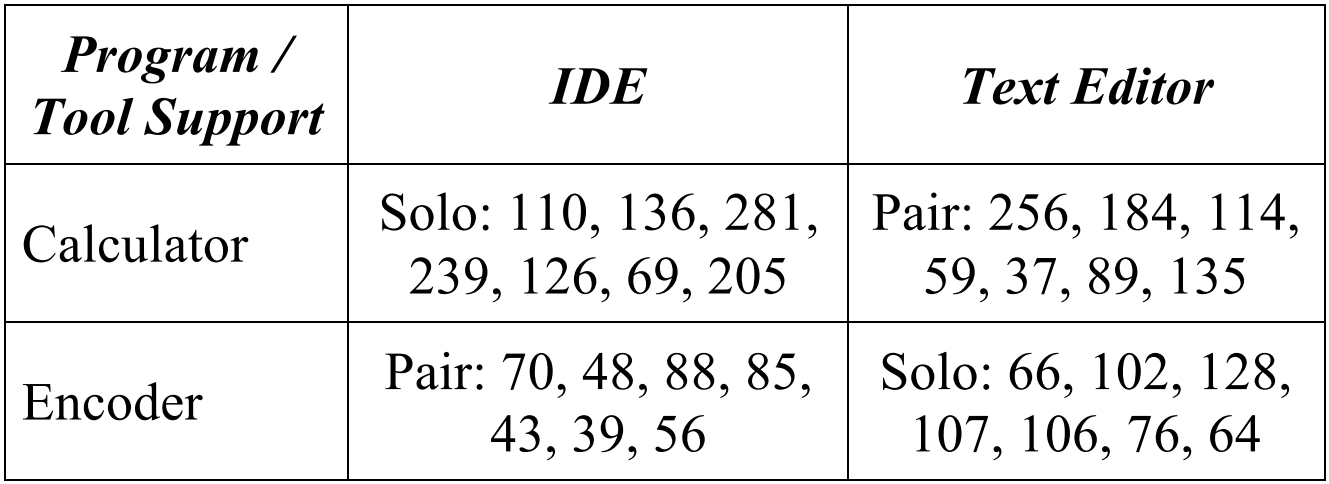
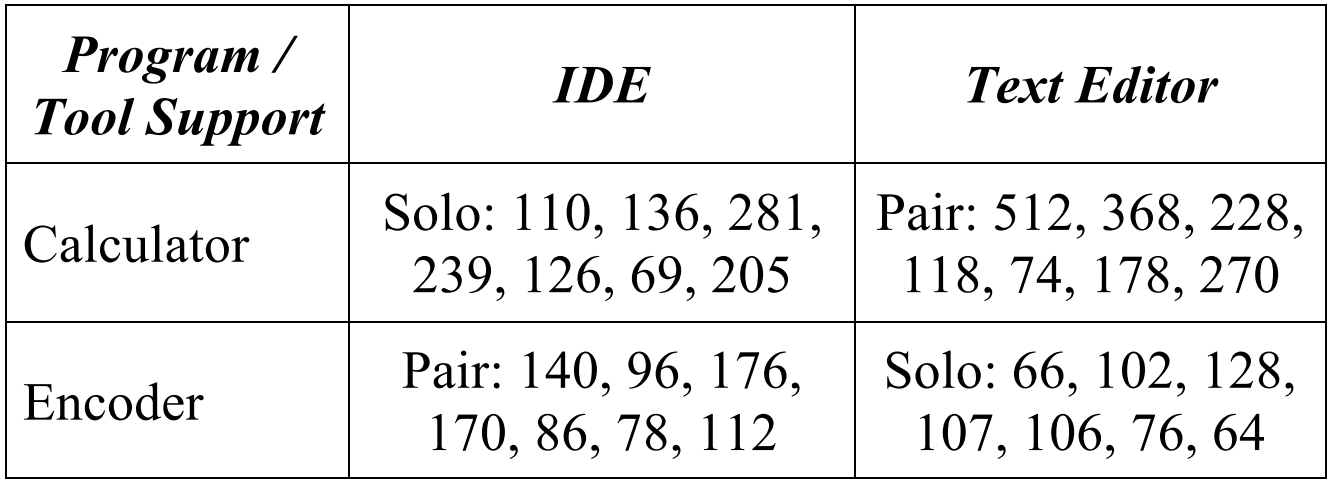
\ Effort: It measures the amount of labor spent to perform a task. It is the total programming effort in person-minutes to write a program. Total effort for a pair is the duration multiplied by two. Tables 3 and 4 show the measures (in minutes) collected for the experiment.

\ Table 3: Measures collected for duration

\ Table 4: Measures collected for effort

\

:::info Authors:

(1) Omar S. Gómez, full time professor of Software Engineering at Mathematics Faculty of the Autonomous University of Yucatan (UADY);

(2) José L. Batún, full time professor of Statistics at Mathematics Faculty of the Autonomous University of Yucatan (UADY);

(3) Raúl A. Aguilar, Faculty of Mathematics, Autonomous University of Yucatan Merida, Yucatan 97119, Mexico.

:::


:::info This paper is available on arxiv under CC BY-NC-ND 4.0 DEED license.

:::

\

Market Opportunity
Effect AI Logo
Effect AI Price(EFFECT)
$0.005167
$0.005167$0.005167
+0.60%
USD
Effect AI (EFFECT) Live Price Chart
Disclaimer: The articles reposted on this site are sourced from public platforms and are provided for informational purposes only. They do not necessarily reflect the views of MEXC. All rights remain with the original authors. If you believe any content infringes on third-party rights, please contact service@support.mexc.com for removal. MEXC makes no guarantees regarding the accuracy, completeness, or timeliness of the content and is not responsible for any actions taken based on the information provided. The content does not constitute financial, legal, or other professional advice, nor should it be considered a recommendation or endorsement by MEXC.