Crypto markets took another beating Tuesday, with Bitcoin tumbling under $113,000 and Ether slipping beneath $4,200 as investors grew jittery ahead of Federal Reserve Chair Jerome Powell’s high-stakes Jackson Hole address. The prospect of a “hawkish surprise” is sucking the air out of risk assets — and crypto is catching the brunt.Crypto markets took another beating Tuesday, with Bitcoin tumbling under $113,000 and Ether slipping beneath $4,200 as investors grew jittery ahead of Federal Reserve Chair Jerome Powell’s high-stakes Jackson Hole address. The prospect of a “hawkish surprise” is sucking the air out of risk assets — and crypto is catching the brunt.

Bitcoin Slides Below $113K as Markets Brace for Powell’s Jackson Hole Pivot

Crypto markets took another beating Tuesday, with Bitcoin tumbling under $114,000 and Ether slipping beneath $4,200 as investors grew jittery ahead of Federal Reserve Chair Jerome Powell’s high-stakes Jackson Hole address. The prospect of a “hawkish surprise” is sucking the air out of risk assets — and crypto is catching the brunt.

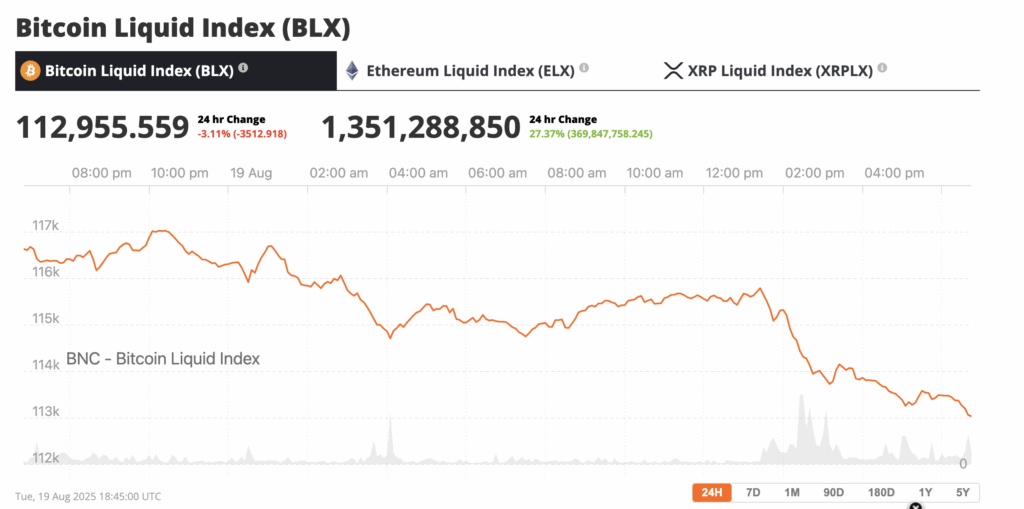
After smashing through $124,000 just days ago, Bitcoin has dropped more than 9% from its record peak, trading as low as $113,000 in the early U.S. session — its weakest level in nearly two weeks. Ether slid 3.5% on the day, and altcoins like Chainlink, Avalanche, Toncoin, Ethena, and Aptos all bled between 4–6%.

The broader picture? Investors are reassessing the Fed’s next move. Last week, most of Wall Street was pricing in a near-certainty of a September rate cut. But a hot Producer Price Index (PPI) report flipped that narrative, reviving fears that inflation is refusing to die quietly. That puts Powell’s Friday speech squarely in the spotlight.
After smashing through $124,000 just days ago, Bitcoin has dropped more than 9% from its record peak, trading as low as $113,000 in the early U.S. session — its weakest level in nearly two weeks. Ether slid 3.5% on the day, and altcoins like Chainlink, Avalanche, Toncoin, Ethena, and Aptos all bled between 4–6%. The broader picture? Investors are reassessing the Fed’s next move. Last week, most of Wall Street was pricing in a near-certainty of a September rate cut. But a hot Producer Price Index (PPI) report flipped that narrative, reviving fears that inflation is refusing to die quietly. That puts Powell’s Friday speech squarely in the spotlight. Bitcoin dropped below $113,000, source: Bitcoin Liquid Index The Treasury Bubble Deflates The carnage wasn’t confined to tokens. Shares of so-called “crypto treasury strategy” companies — firms that pivoted into holding Bitcoin or Ether as a corporate treasury asset — continued to unwind. KindlyMD (NAKA), a BTC accumulator, fell another 14%. Bitmine Immersion (BNMR) and Sharplink Gaming (SBET), both Ethereum-aligned plays, sank 10% and 8%. Even the heavyweight in this niche, Michael Saylor’s MicroStrategy (MSTR), is wobbling — down nearly 6% Tuesday and off 37% from its all-time high late last year. Still, the long arc of Saylor’s Bitcoin gamble remains intact: MSTR shares are up more than 20x since he started buying BTC five years ago. First-mover advantage buys you a lot of cushion. Jackson Hole: All Eyes on Powell The Kansas City Fed’s annual symposium in Jackson Hole is normally a highbrow academic affair. This year, it feels more like a market cliffhanger. The Fed has been walking a tightrope — balancing a slowing economy and signs of labor market cooling against stubbornly sticky inflation data. Bank of America economists, hardly known for crypto drama, bluntly noted: “With inflation essentially stuck over the past year, tariff pass-through still expected, and unemployment low, we still think there is a strong case for the Fed to remain on hold.” Traders are listening. Odds of a September cut have dropped from 98% last week to 85% today, per the CME FedWatch tool. That’s still heavily skewed toward easing — but the shift underscores just how fragile sentiment is. What It Means for Crypto Short-term: Risk-off means Bitcoin and Ether are vulnerable to more downside. The $110K level for BTC is now the line to watch. Medium-term: If Powell signals patience, crypto might face more turbulence before stabilizing. Rate cuts are still coming — but the Fed may want to keep its “hawkish credibility” intact longer. Long-term: The treasury-strategy bubble is a cautionary tale. Simply rebranding as a “crypto treasury company” no longer works now that easy gains are gone. Only firms with real cash flow and disciplined balance sheets will survive the washout. The bigger irony? Crypto markets are simultaneously clamoring for looser monetary policy — and trying to prove they’re an alternative to fiat central banking. Powell’s words on Friday will test just how far that paradox stretches.


Bitcoin dropped below $113,000, source: Bitcoin Liquid Index

The Treasury Bubble Deflates

The carnage wasn’t confined to tokens. Shares of so-called “crypto treasury strategy” companies — firms that pivoted into holding Bitcoin or Ether as a corporate treasury asset — continued to unwind.

  • KindlyMD (NAKA), a BTC accumulator, fell another 14%.
  • Bitmine Immersion (BNMR) and Sharplink Gaming (SBET), both Ethereum-aligned plays, sank 10% and 8%.

Even the heavyweight in this niche, Michael Saylor’s MicroStrategy (MSTR), is wobbling — down nearly 6% Tuesday and off 37% from its all-time high late last year. Still, the long arc of Saylor’s Bitcoin gamble remains intact: MSTR shares are up more than 20x since he started buying BTC five years ago. First-mover advantage buys you a lot of cushion.

Jackson Hole: All Eyes on Powell

The Kansas City Fed’s annual symposium in Jackson Hole is normally a highbrow academic affair. This year, it feels more like a market cliffhanger. The Fed has been walking a tightrope — balancing a slowing economy and signs of labor market cooling against stubbornly sticky inflation data.

Bank of America economists, hardly known for crypto drama, bluntly noted:

“With inflation essentially stuck over the past year, tariff pass-through still expected, and unemployment low, we still think there is a strong case for the Fed to remain on hold.”

Traders are listening. Odds of a September cut have dropped from 98% last week to 85% today, per the CME FedWatch tool. That’s still heavily skewed toward easing — but the shift underscores just how fragile sentiment is.

What It Means for Crypto

  • Short-term: Risk-off means Bitcoin and Ether are vulnerable to more downside. The $110K level for BTC is now the line to watch. 
  • Medium-term: If Powell signals patience, crypto might face more turbulence before stabilizing. Rate cuts are still coming — but the Fed may want to keep its “hawkish credibility” intact longer. 
  • Long-term: The treasury-strategy bubble is a cautionary tale. Simply rebranding as a “crypto treasury company” no longer works now that easy gains are gone. Only firms with real cash flow and disciplined balance sheets will survive the washout. 

The bigger irony? Crypto markets are simultaneously clamoring for looser monetary policy — and trying to prove they’re an alternative to fiat central banking. Powell’s words on Friday will test just how far that paradox stretches.


Disclaimer: The articles reposted on this site are sourced from public platforms and are provided for informational purposes only. They do not necessarily reflect the views of MEXC. All rights remain with the original authors. If you believe any content infringes on third-party rights, please contact service@support.mexc.com for removal. MEXC makes no guarantees regarding the accuracy, completeness, or timeliness of the content and is not responsible for any actions taken based on the information provided. The content does not constitute financial, legal, or other professional advice, nor should it be considered a recommendation or endorsement by MEXC.

You May Also Like

Fed rate decision September 2025

Fed rate decision September 2025

The post Fed rate decision September 2025 appeared on BitcoinEthereumNews.com. WASHINGTON – The Federal Reserve on Wednesday approved a widely anticipated rate cut and signaled that two more are on the way before the end of the year as concerns intensified over the U.S. labor market. In an 11-to-1 vote signaling less dissent than Wall Street had anticipated, the Federal Open Market Committee lowered its benchmark overnight lending rate by a quarter percentage point. The decision puts the overnight funds rate in a range between 4.00%-4.25%. Newly-installed Governor Stephen Miran was the only policymaker voting against the quarter-point move, instead advocating for a half-point cut. Governors Michelle Bowman and Christopher Waller, looked at for possible additional dissents, both voted for the 25-basis point reduction. All were appointed by President Donald Trump, who has badgered the Fed all summer to cut not merely in its traditional quarter-point moves but to lower the fed funds rate quickly and aggressively. In the post-meeting statement, the committee again characterized economic activity as having “moderated” but added language saying that “job gains have slowed” and noted that inflation “has moved up and remains somewhat elevated.” Lower job growth and higher inflation are in conflict with the Fed’s twin goals of stable prices and full employment.  “Uncertainty about the economic outlook remains elevated” the Fed statement said. “The Committee is attentive to the risks to both sides of its dual mandate and judges that downside risks to employment have risen.” Markets showed mixed reaction to the developments, with the Dow Jones Industrial Average up more than 300 points but the S&P 500 and Nasdaq Composite posting losses. Treasury yields were modestly lower. At his post-meeting news conference, Fed Chair Jerome Powell echoed the concerns about the labor market. “The marked slowing in both the supply of and demand for workers is unusual in this less dynamic…
Share
BitcoinEthereumNews2025/09/18 02:44
3 Paradoxes of Altcoin Season in September

3 Paradoxes of Altcoin Season in September

The post 3 Paradoxes of Altcoin Season in September appeared on BitcoinEthereumNews.com. Analyses and data indicate that the crypto market is experiencing its most active altcoin season since early 2025, with many altcoins outperforming Bitcoin. However, behind this excitement lies a paradox. Most retail investors remain uneasy as their portfolios show little to no profit. This article outlines the main reasons behind this situation. Altcoin Market Cap Rises but Dominance Shrinks Sponsored TradingView data shows that the TOTAL3 market cap (excluding BTC and ETH) reached a new high of over $1.1 trillion in September. Yet the share of OTHERS (excluding the top 10) has declined since 2022, now standing at just 8%. OTHERS Dominance And TOTAL3 Capitalization. Source: TradingView. In past cycles, such as 2017 and 2021, TOTAL3 and OTHERS.D rose together. That trend reflected capital flowing not only into large-cap altcoins but also into mid-cap and low-cap ones. The current divergence shows that capital is concentrated in stablecoins and a handful of top-10 altcoins such as SOL, XRP, BNB, DOG, HYPE, and LINK. Smaller altcoins receive far less liquidity, making it hard for their prices to return to levels where investors previously bought. This creates a situation where only a few win while most face losses. Retail investors also tend to diversify across many coins instead of adding size to top altcoins. That explains why many portfolios remain stagnant despite a broader market rally. Sponsored “Position sizing is everything. Many people hold 25–30 tokens at once. A 100x on a token that makes up only 1% of your portfolio won’t meaningfully change your life. It’s better to make a few high-conviction bets than to overdiversify,” analyst The DeFi Investor said. Altcoin Index Surges but Investor Sentiment Remains Cautious The Altcoin Season Index from Blockchain Center now stands at 80 points. This indicates that over 80% of the top 50 altcoins outperformed…
Share
BitcoinEthereumNews2025/09/18 01:43
Bitcoin devs cheer block reconstruction stats, ignore security budget concerns

Bitcoin devs cheer block reconstruction stats, ignore security budget concerns

The post Bitcoin devs cheer block reconstruction stats, ignore security budget concerns appeared on BitcoinEthereumNews.com. This morning, Bitcoin Core developers celebrated improved block reconstruction statistics for node operators while conveniently ignoring the reason for these statistics — the downward trend in fees for Bitcoin’s security budget. Reacting with heart emojis and thumbs up to a green chart showing over 80% “successful compact block reconstructions without any requested transactions,” they conveniently omitted red trend lines of the fees that Bitcoin users pay for mining security which powered those green statistics. Block reconstructions occur when a node requests additional information about transactions within a compact block. Although compact blocks allow nodes to quickly relay valid bundles of transactions across the internet, the more frequently that nodes can reconstruct without extra, cumbersome transaction requests from their peers is a positive trend. Because so many nodes switched over in August to relay transactions bidding 0.1 sat/vB across their mempools, nodes now have to request less transaction data to reconstruct blocks containing sub-1 sat/vB transactions. After nodes switched over in August to accept and relay pending transactions bidding less than 1 sat/vB, disparate mempools became harmonized as most nodes had a better view of which transactions would likely join upcoming blocks. As a result, block reconstruction times improved, as nodes needed less information about these sub-1 sat/vB transactions. In July, several miners admitted that user demand for Bitcoin blockspace had persisted at such a low that they were willing to accept transaction fees of just 0.1 satoshi per virtual byte — 90% lower than their prior 1 sat/vB minimum. With so many blocks partially empty, they succumbed to the temptation to accept at least something — even 1 billionth of one bitcoin (BTC) — rather than $0 to fill up some of the excess blockspace. Read more: Bitcoin’s transaction fees have fallen to a multi-year low Green stats for block reconstruction after transaction fees crash After…
Share
BitcoinEthereumNews2025/09/18 04:07