SoFi will roll out a Bitcoin-powered international money transfer service inside its consumer app, becoming—per Lightspark CEO David Marcus—“the first US bank to use Bitcoin and Universal Money Addresses (UMA) to offer 24/7, realtime, cheap global payments.” The integration uses the Bitcoin Lightning Network as the cross-border settlement rail and will debut later this year, […]SoFi will roll out a Bitcoin-powered international money transfer service inside its consumer app, becoming—per Lightspark CEO David Marcus—“the first US bank to use Bitcoin and Universal Money Addresses (UMA) to offer 24/7, realtime, cheap global payments.” The integration uses the Bitcoin Lightning Network as the cross-border settlement rail and will debut later this year, […]

Bitcoin Breakthrough: First US Bank Integrates Lightning Network

SoFi will roll out a Bitcoin-powered international money transfer service inside its consumer app, becoming—per Lightspark CEO David Marcus—“the first US bank to use Bitcoin and Universal Money Addresses (UMA) to offer 24/7, realtime, cheap global payments.” The integration uses the Bitcoin Lightning Network as the cross-border settlement rail and will debut later this year, with Mexico as the first corridor.

First US Bank Plugged Into Bitcoin Lightning

In its announcement on August 19, SoFi said members will be able to send funds abroad directly from the SoFi app “with lower fees and faster delivery compared to traditional remittance service providers.” Technically, dollars are converted to Bitcoin in real time, routed over Lightning, and reconverted instantly on the other side to local currency that lands in a recipient’s bank account—without users needing a third-party app. SoFi added that total costs will be “below the current national average,” with exchange rates and fees shown up front. The feature will be available through SoFi Checking & Savings, offered by SoFi Bank, N.A., Member FDIC, with a waitlist already open.

“SoFi is one of the most innovative and forward-thinking financial platforms in the US today,” Lightspark’s Marcus said in the release. “Digital banks are embracing UMA because it’s fast, cheap, and secure, and it uses the only open payments network that exists, Bitcoin.” SoFi CEO Anthony Noto framed the move in terms of everyday utility: “For many SoFi members who regularly send money to loved ones internationally, the ability to quickly transfer money at low cost isn’t just a convenience, it’s a meaningful improvement to their everyday financial lives.”

Marcus amplified the launch on X, calling it a “very important milestone,” and underscoring the strategic rationale for banks: “Bitcoin’s neutrality, openness, and decentralization makes it a very compelling choice for banks as the replacement for antiquated correspondent banking vs. other centralized options. No one wants to king-make another closed, corp controlled payment network again. Open will win.” In a separate post, he urged observers to “truly digest the significance of major banks in the US, Latin America, Europe—and soon everywhere—using Bitcoin as neutral TCP/IP packets for money.”

The announcement positions SoFi within a broader shift by large consumer platforms toward Lightning-based settlement. Lightspark previously disclosed partnerships aimed at bringing Lightning and UMA to Revolut in the UK and EEA and to Brazil’s Nubank, one of the world’s largest digital banks, signaling a multi-region build-out of an “open Money Grid.” Against that backdrop, SoFi’s US bank charter makes this rollout notable in the regulated banking context.

Whether SoFi is the first US bank to integrate Lightning may depend on definitions and scope. Lightspark’s press release describes SoFi as “one of the first US-banks to offer a blockchain-powered remittances service,” whereas Marcus’ posts characterize it as the first US bank using both Bitcoin and UMA to deliver always-on, inexpensive global payments.

What is uncontested is the architecture: UMA addressing on the front end, Lightning for cross-border routing, fiat in and fiat out—with SoFi aiming for lower-than-average remittance costs and round-the-clock availability inside a mainstream banking app.

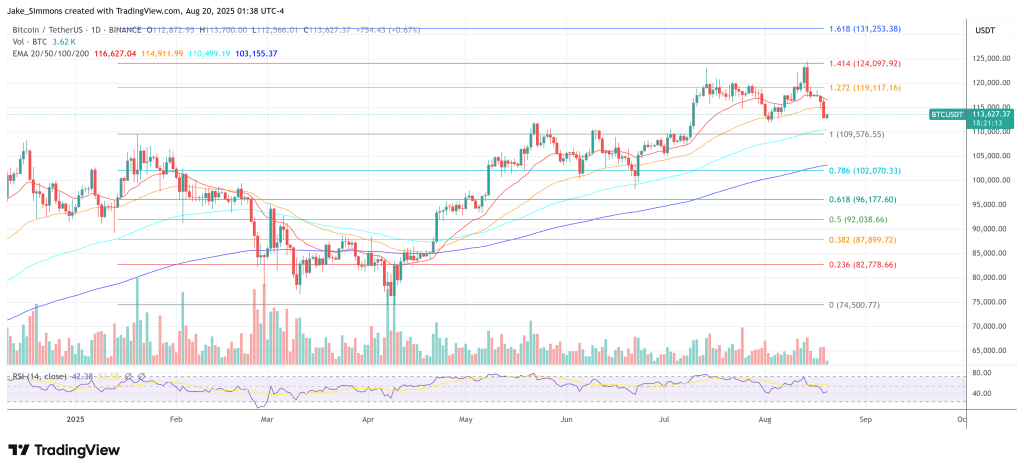
At press time, BTC traded at $113,627.
Bitcoin price
Market Opportunity
CROSS Logo
CROSS Price(CROSS)
$0.1336
$0.1336$0.1336
+0.36%
USD
CROSS (CROSS) Live Price Chart
Disclaimer: The articles reposted on this site are sourced from public platforms and are provided for informational purposes only. They do not necessarily reflect the views of MEXC. All rights remain with the original authors. If you believe any content infringes on third-party rights, please contact service@support.mexc.com for removal. MEXC makes no guarantees regarding the accuracy, completeness, or timeliness of the content and is not responsible for any actions taken based on the information provided. The content does not constitute financial, legal, or other professional advice, nor should it be considered a recommendation or endorsement by MEXC.

You May Also Like

CEO Sandeep Nailwal Shared Highlights About RWA on Polygon

CEO Sandeep Nailwal Shared Highlights About RWA on Polygon

The post CEO Sandeep Nailwal Shared Highlights About RWA on Polygon appeared on BitcoinEthereumNews.com. Polygon CEO Sandeep Nailwal highlighted Polygon’s lead in global bonds, Spiko US T-Bill, and Spiko Euro T-Bill. Polygon published an X post to share that its roadmap to GigaGas was still scaling. Sentiments around POL price were last seen to be bearish. Polygon CEO Sandeep Nailwal shared key pointers from the Dune and RWA.xyz report. These pertain to highlights about RWA on Polygon. Simultaneously, Polygon underlined its roadmap towards GigaGas. Sentiments around POL price were last seen fumbling under bearish emotions. Polygon CEO Sandeep Nailwal on Polygon RWA CEO Sandeep Nailwal highlighted three key points from the Dune and RWA.xyz report. The Chief Executive of Polygon maintained that Polygon PoS was hosting RWA TVL worth $1.13 billion across 269 assets plus 2,900 holders. Nailwal confirmed from the report that RWA was happening on Polygon. The Dune and https://t.co/W6WSFlHoQF report on RWA is out and it shows that RWA is happening on Polygon. Here are a few highlights: – Leading in Global Bonds: Polygon holds 62% share of tokenized global bonds (driven by Spiko’s euro MMF and Cashlink euro issues) – Spiko U.S.… — Sandeep | CEO, Polygon Foundation (※,※) (@sandeepnailwal) September 17, 2025 The X post published by Polygon CEO Sandeep Nailwal underlined that the ecosystem was leading in global bonds by holding a 62% share of tokenized global bonds. He further highlighted that Polygon was leading with Spiko US T-Bill at approximately 29% share of TVL along with Ethereum, adding that the ecosystem had more than 50% share in the number of holders. Finally, Sandeep highlighted from the report that there was a strong adoption for Spiko Euro T-Bill with 38% share of TVL. He added that 68% of returns were on Polygon across all the chains. Polygon Roadmap to GigaGas In a different update from Polygon, the community…
Share
BitcoinEthereumNews2025/09/18 01:10
Why Are Disaster Recovery Services Essential for SMBs?

Why Are Disaster Recovery Services Essential for SMBs?

Small and medium-sized businesses operate in an environment where downtime, data loss, or system failure can quickly turn into an existential threat. Unlike large
Share
Techbullion2026/01/14 01:16
The Android OS Architecture:  Part 1 — What an Operating System Actually Does

The Android OS Architecture: Part 1 — What an Operating System Actually Does

An operating system acts as the central coordinator between hardware and software, managing processes, memory, security, hardware access, and the user interface
Share
Hackernoon2026/01/14 00:32