

Is Pair Programming Faster? An ANOVA Analysis
Table of Links
Abstract and 1. Introduction
2. Experiment Definition
3. Experiment Design and Conduct
3.1 Latin Square Designs
3.2 Subjects, Tasks and Objects
3.3 Conduct
3.4 Measures
4. Data Analysis
4.1 Model Assumptions
4.2 Analysis of Variance (ANOVA)
4.3 Treatment Comparisons
4.4 Effect Size and Power Analysis
5. Experiment Limitations and 5.1 Threats to the Conclusion Validity
5.2 Threats to Internal Validity
5.3 Threats to Construct Validity
5.4 Threats to External Validity
6. Discussion and 6.1 Duration
6.2 Effort
7. Conclusions and Further Work, and References
4.2 Analysis of Variance (ANOVA)
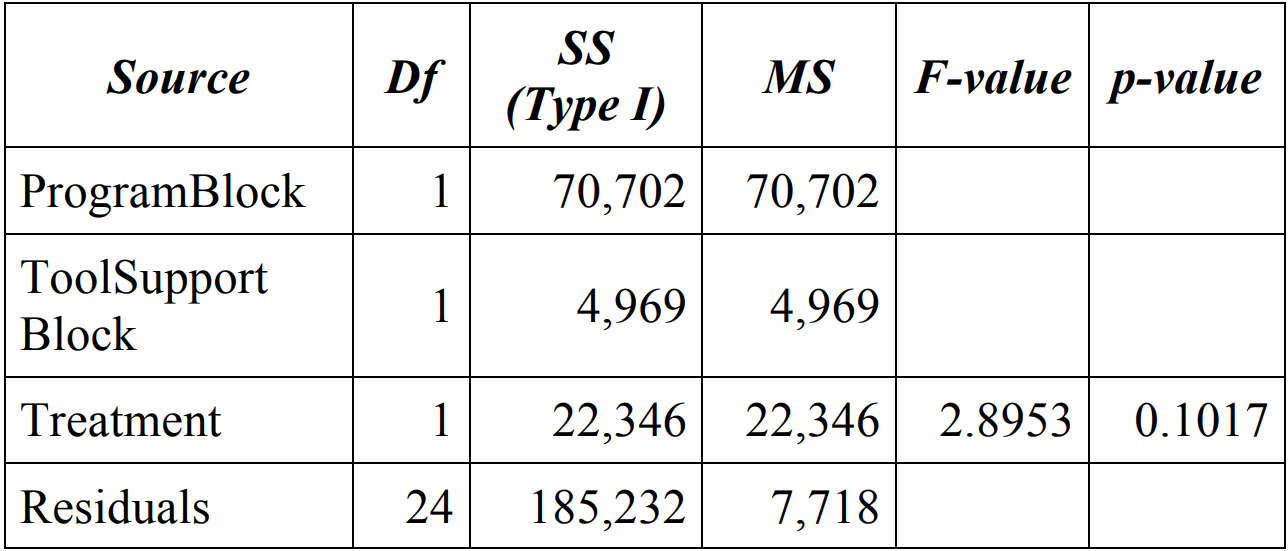
Once model assumptions were assessed, we proceed to perform the ANOVA. Table 6 shows the ANOVA for the duration measure whereas Table 7 shows the ANOVA for effort.
\ 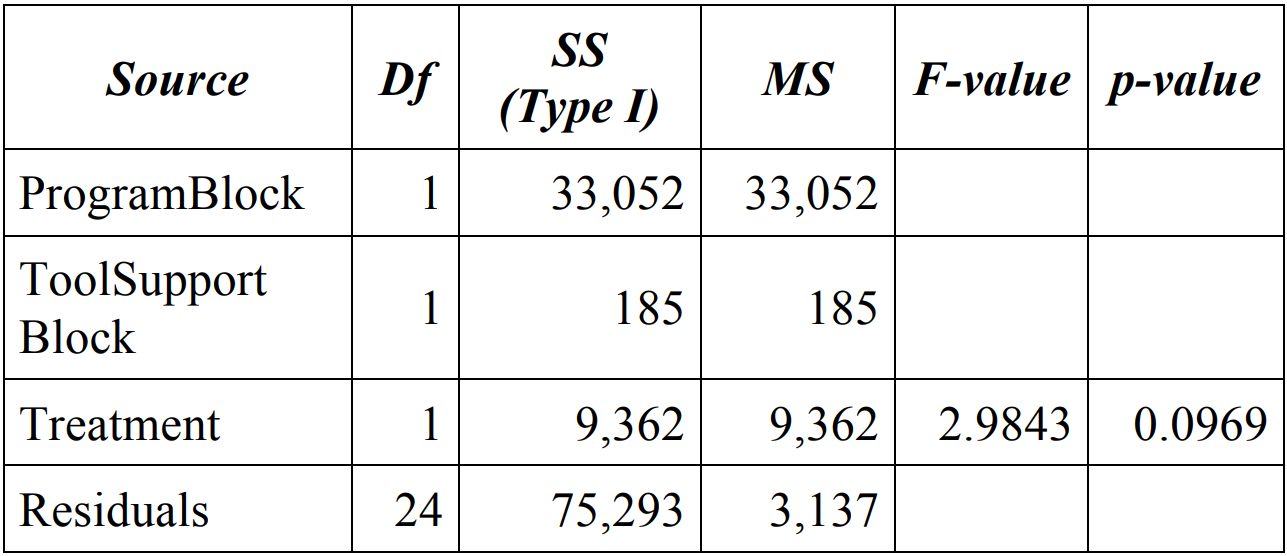
\ If we set an alpha level of 0.05 neither treatment (both ANOVA tests) are significant. However setting an alpha level of 0.1 which represents a confidence level of 90% we get significant differences in both treatments. For the first treatment (Table 6) we get a p-value = 0.0969 with respect to duration, whereas we get a p-value = 0.1017 for the second treatment (Table 7). Although this second p-value is slightly greater than 0.1, we also consider it significant.
\ 
\
:::info Authors:
(1) Omar S. Gómez, full time professor of Software Engineering at Mathematics Faculty of the Autonomous University of Yucatan (UADY);
(2) José L. Batún, full time professor of Statistics at Mathematics Faculty of the Autonomous University of Yucatan (UADY);
(3) Raúl A. Aguilar, Faculty of Mathematics, Autonomous University of Yucatan Merida, Yucatan 97119, Mexico.
:::
:::info This paper is available on arxiv under CC BY-NC-ND 4.0 DEED license.
:::
\


You May Also Like

Lucky Secures $23M Series B Funding to Scale Credit Access Across North Africa

Iran threatens retaliation as Trump vows to “hit hard,” crypto market under stress




