Network engineers and architects are essential for maintaining the internet and ensuring a connected future. The lack of fundamentals in networking is a barrier to advancing in many tech fields today. Learning networking is the best tech choice for a lifetime.Network engineers and architects are essential for maintaining the internet and ensuring a connected future. The lack of fundamentals in networking is a barrier to advancing in many tech fields today. Learning networking is the best tech choice for a lifetime.

Networking : Why You Should Understand the IPv4 Header Beyond Chasing Tools

2025/08/22 15:43

\ In a trendy tech industry, network engineering seems overshadowed by many trends, and many people forget the importance of the fundamentals of networking.

Cloud, AI, Cybersecurity, Cloud computing, Software development, how many times do you see networking mentioned among the critical skills to learn? In the fast-paced tech industry, network engineering often gets overlooked amidst emerging trends. Many tend to forget the crucial role of networking fundamentals.

Consider this: when discussions revolve around critical skills to acquire, how frequently is networking mentioned alongside cloud, AI, cybersecurity, and software development?

:::info This is article is dedicated to anyone struggling to learn networking,not experts in the field

:::

Network engineering is the foundation

In this AI era, we see the emergence of massive data centers around the world, including Stargate UAE, Stargate Norway, and xAI's Colossus, slated to be the world's largest AI supercomputer, as well as other projects in the making for the AI race. One question arises: who will build the infrastructure?

Network engineers and architects are essential for maintaining the internet and ensuring a connected future. The global economy depends on their ability to route information across all environments, from the sky to the oceans; without their expertise, nothing would function.

Imagine a day with 24 hours of no connectivity, where the world is unconnected with all the continents without internet access. Space entrepreneurship, exemplified by Starlink, highlights the critical role of connectivity. It bridges the gap for previously unconnected global regions, unlocking new opportunities. Without robust networking, global connections would be impossible. The field of network engineering is continuously evolving, ensuring that those with mastery of these skills will always be in high demand.

Consider a world where, for 24 hours, all continents are without connectivity, an unthinkable scenario!

Tools come and go, the foundation is forever

Network Engineers

It’s easy to adopt some tools and skip fundamentals; unfortunately, your gaps will betray you in the long run!

Seeing the trends, many people neglected networking to jump quickly to cloud, cybersecurity, or automation.

\

  • How to deploy networks you do not understand?

    \

  • How to secure a network you do not understand?

    \

  • How to automate workflows you do not understand?

    \ Reality check: those who neglected networking will come back to learn

    Just because script kiddies use some tools to hack means they know what they do; networking is complex and requires the fundamentals to understand what happens under the hood. Today, it’s possible to meet cloud engineers with huge gaps in networking!

    Because of the ease of use of some graphical user interfaces to provision devices and networks, network engineering was neglected, and we will see a huge skill gap in the future. Once a network is down, how can it be fixed from the graphical user interface? \n \n How many cloud engineers or pentesters can interpret a packet capture analysis from Wireshark?

    The lack of fundamentals in networking is a barrier to advancing in many tech fields today!

    Protocols: the languages of the internet

    We understand each other daily because we speak a common language with a group of people, the same applies for computers, without protocols, they can’t communicate and understand each other!

    Escaping protocols and how they work is a huge waste of time, to learn cybersecurity, network automation, cloud,…

    Without understanding how they work, you will be limited in your knowledge to understand what happens in the network.

    Advice: Learning networking is the best tech choice for a lifetime.

The IPv4 header
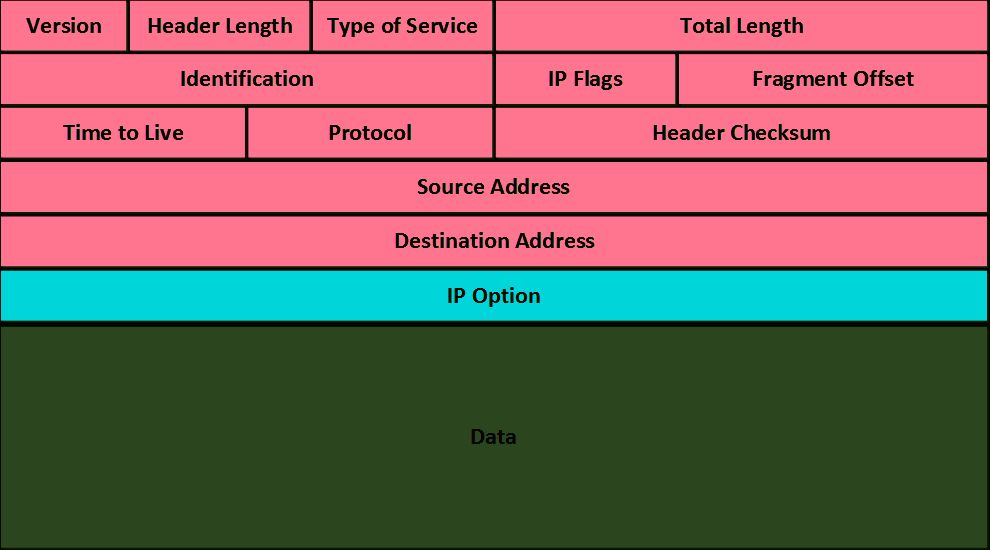
The IPV4 Header

The IPv4 header is the control information at the beginning of an Internet Protocol version 4 (IPv4) packet, containing essential data for routing and delivering the packet. Understanding how things work is crucial to knowing what’s happening in a network.

Let’s break down each part step by step :

| Version | This field defines the IP version,4 or 6. | |----|----| | Header length | This field defines the header length | | Type of service (ToS) | This field defines the type of service of this packet and includes some details such as maximize reliability, maximize throughput … | | Total Length | This field defines the total IP datagram, including the data or the fragment; its value is 65,535. |

\

| Identification | Routing is essential for information to travel between two points, ensuring that each packet is uniquely identified for efficient back-and-forth transmission. This field uniquely identifies each packet. | |----|----| | IP Flags | This field, which determines if a packet is fragmented (M) or not (D), can be exploited by experienced hackers with networking knowledge to bypass Intrusion Detection Systems (IDS) or firewalls. | | Fragment Offset | This field specifies the offset from the beginning of the IP header where fragmented packets should be reassembled. |

\

| Time to live (TTL) | This field defines the number of hops (Routers)  across the Internet before a packet expires. | |----|----| | Protocol | Protocols are the languages of the internet; this field defines what protocol is being used and shows a code for each one: 1 for ICMP, the protocol behind Ping,17 for UDP, the protocol behind VOIP. | | Header Checksum | This error-checking field ensures data integrity during transmission. It calculates a checksum using a simple algorithm to verify the header's data. |

\

| Source / Destination | The IP header's most crucial component is likely the source and destination IP addresses, which are found in these rows. | |----|----|

\

| Options | This field's length is variable, and its utilization is optional | |----|----| | Padding | This field is utilized to complete any remaining bits and bytes of the header, as required. |

Hands-on: Beyond the IPv4 headers concepts

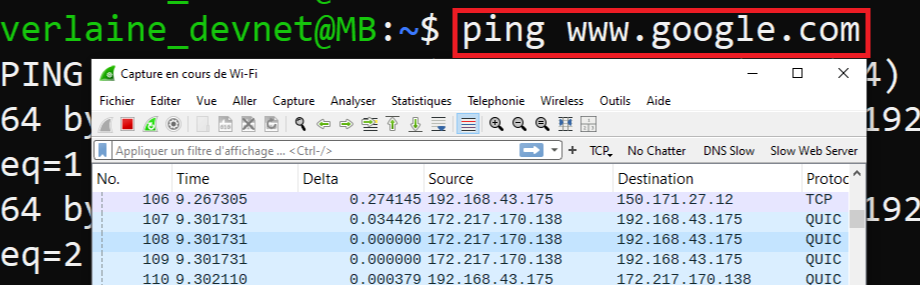
From the CLI, let’s ping www.google.com and capture the traffic on Wireshark

\ Pinging google and Capturing the traffic on Wireshark
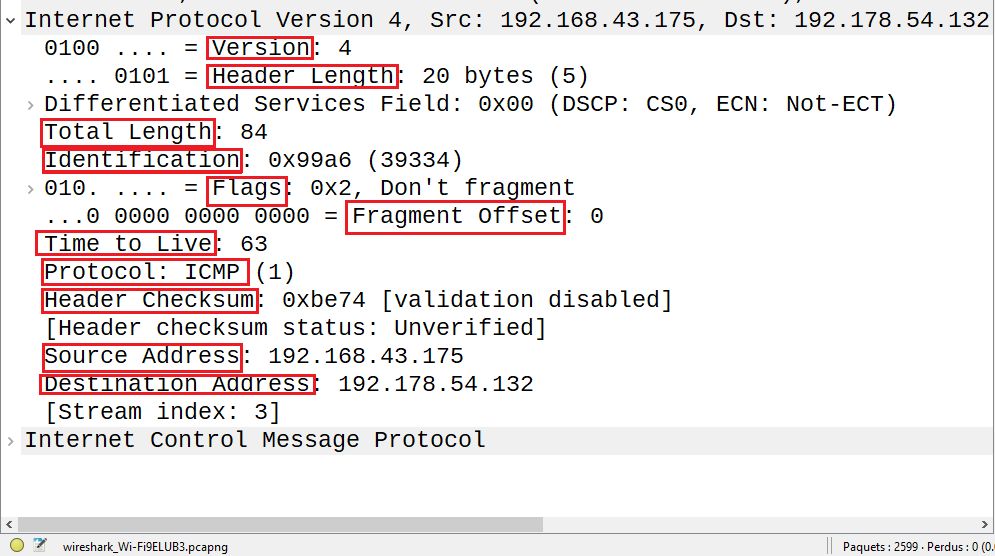
If we choose the ICMP traffic, we will see the critical field on the left pane of Wireshark and how it works every time we capture the traffic.

\ IPV4 Headers after a packet capture on wireshark
Conclusion

\Whether you are chasing cybersecurity, automation, or cloud, without network fundamentals, your journey will be a waste of time without understanding what happens behind every network and how to improve its behavior. \n \n Experienced hackers know how to escape Intrusion detection systems and firewalls by manipulating some fields in the IPv4 header. Why? Because they understand networking better than anyone else, learn networking to unlock a bunch of skills, and the rest is easy.


Disclaimer: The articles reposted on this site are sourced from public platforms and are provided for informational purposes only. They do not necessarily reflect the views of MEXC. All rights remain with the original authors. If you believe any content infringes on third-party rights, please contact service@support.mexc.com for removal. MEXC makes no guarantees regarding the accuracy, completeness, or timeliness of the content and is not responsible for any actions taken based on the information provided. The content does not constitute financial, legal, or other professional advice, nor should it be considered a recommendation or endorsement by MEXC.

You May Also Like

Fed Decides On Interest Rates Today—Here’s What To Watch For

Fed Decides On Interest Rates Today—Here’s What To Watch For

The post Fed Decides On Interest Rates Today—Here’s What To Watch For appeared on BitcoinEthereumNews.com. Topline The Federal Reserve on Wednesday will conclude a two-day policymaking meeting and release a decision on whether to lower interest rates—following months of pressure and criticism from President Donald Trump—and potentially signal whether additional cuts are on the way. President Donald Trump has urged the central bank to “CUT INTEREST RATES, NOW, AND BIGGER” than they might plan to. Getty Images Key Facts The central bank is poised to cut interest rates by at least a quarter-point, down from the 4.25% to 4.5% range where they have been held since December to between 4% and 4.25%, as Wall Street has placed 100% odds of a rate cut, according to CME’s FedWatch, with higher odds (94%) on a quarter-point cut than a half-point (6%) reduction. Fed governors Christopher Waller and Michelle Bowman, both Trump appointees, voted in July for a quarter-point reduction to rates, and they may dissent again in favor of a large cut alongside Stephen Miran, Trump’s Council of Economic Advisers’ chair, who was sworn in at the meeting’s start on Tuesday. It’s unclear whether other policymakers, including Kansas City Fed President Jeffrey Schmid and St. Louis Fed President Alberto Musalem, will favor larger cuts or opt for no reduction. Fed Chair Jerome Powell said in his Jackson Hole, Wyoming, address last month the central bank would likely consider a looser monetary policy, noting the “shifting balance of risks” on the U.S. economy “may warrant adjusting our policy stance.” David Mericle, an economist for Goldman Sachs, wrote in a note the “key question” for the Fed’s meeting is whether policymakers signal “this is likely the first in a series of consecutive cuts” as the central bank is anticipated to “acknowledge the softening in the labor market,” though they may not “nod to an October cut.” Mericle said he…
Share
BitcoinEthereumNews2025/09/18 00:23
Facts Vs. Hype: Analyst Examines XRP Supply Shock Theory

Facts Vs. Hype: Analyst Examines XRP Supply Shock Theory

Prominent analyst Cheeky Crypto (203,000 followers on YouTube) set out to verify a fast-spreading claim that XRP’s circulating supply could “vanish overnight,” and his conclusion is more nuanced than the headline suggests: nothing in the ledger disappears, but the amount of XRP that is truly liquid could be far smaller than most dashboards imply—small enough, in his view, to set the stage for an abrupt liquidity squeeze if demand spikes. XRP Supply Shock? The video opens with the host acknowledging his own skepticism—“I woke up to a rumor that XRP supply could vanish overnight. Sounds crazy, right?”—before committing to test the thesis rather than dismiss it. He frames the exercise as an attempt to reconcile a long-standing critique (“XRP’s supply is too large for high prices”) with a rival view taking hold among prominent community voices: that much of the supply counted as “circulating” is effectively unavailable to trade. His first step is a straightforward data check. Pulling public figures, he finds CoinMarketCap showing roughly 59.6 billion XRP as circulating, while XRPScan reports about 64.7 billion. The divergence prompts what becomes the video’s key methodological point: different sources count “circulating” differently. Related Reading: Analyst Sounds Major XRP Warning: Last Chance To Get In As Accumulation Balloons As he explains it, the higher on-ledger number likely includes balances that aggregators exclude or treat as restricted, most notably Ripple’s programmatic escrow. He highlights that Ripple still “holds a chunk of XRP in escrow, about 35.3 billion XRP locked up across multiple wallets, with a nominal schedule of up to 1 billion released per month and unused portions commonly re-escrowed. Those coins exist and are accounted for on-ledger, but “they aren’t actually sitting on exchanges” and are not immediately available to buyers. In his words, “for all intents and purposes, that escrow stash is effectively off of the market.” From there, the analysis moves from headline “circulating supply” to the subtler concept of effective float. Beyond escrow, he argues that large strategic holders—banks, fintechs, or other whales—may sit on material balances without supplying order books. When you strip out escrow and these non-selling stashes, he says, “the effective circulating supply… is actually way smaller than the 59 or even 64 billion figure.” He cites community estimates in the “20 or 30 billion” range for what might be truly liquid at any given moment, while emphasizing that nobody has a precise number. That effective-float framing underpins the crux of his thesis: a potential supply shock if demand accelerates faster than fresh sell-side supply appears. “Price is a dance between supply and demand,” he says; if institutional or sovereign-scale users suddenly need XRP and “the market finds that there isn’t enough XRP readily available,” order books could thin out and prices could “shoot on up, sometimes violently.” His phrase “circulating supply could collapse overnight” is presented not as a claim that tokens are destroyed or removed from the ledger, but as a market-structure scenario in which available inventory to sell dries up quickly because holders won’t part with it. How Could The XRP Supply Shock Happen? On the demand side, he anchors the hypothetical to tokenization. He points to the “very early stages of something huge in finance”—on-chain tokenization of debt, stablecoins, CBDCs and even gold—and argues the XRP Ledger aims to be “the settlement layer” for those assets.He references Ripple CTO David Schwartz’s earlier comments about an XRPL pivot toward tokenized assets and notes that an institutional research shop (Bitwise) has framed XRP as a way to play the tokenization theme. In his construction, if “trillions of dollars in value” begin settling across XRPL rails, working inventories of XRP for bridging, liquidity and settlement could rise sharply, tightening effective float. Related Reading: XRP Bearish Signal: Whales Offload $486 Million In Asset To illustrate, he offers two analogies. First, the “concert tickets” model: you think there are 100,000 tickets (100B supply), but 50,000 are held by the promoter (escrow) and 30,000 by corporate buyers (whales), leaving only 20,000 for the public; if a million people want in, prices explode. Second, a comparison to Bitcoin’s halving: while XRP has no programmatic halving, he proposes that a sudden adoption wave could function like a de facto halving of available supply—“XRP’s version of a halving could actually be the adoption event.” He also updates the narrative context that long dogged XRP. Once derided for “too much supply,” he argues the script has “totally flipped.” He cites the current cycle’s optics—“XRP is sitting above $3 with a market cap north of around $180 billion”—as evidence that raw supply counts did not cap price as tightly as critics claimed, and as a backdrop for why a scarcity narrative is gaining traction. Still, he declines to publish targets or timelines, repeatedly stressing uncertainty and risk. “I’m not a financial adviser… cryptocurrencies are highly volatile,” he reminds viewers, adding that tokenization could take off “on some other platform,” unfold more slowly than enthusiasts expect, or fail to get to “sudden shock” scale. The verdict he offers is deliberately bound. The theory that “XRP supply could vanish overnight” is imprecise on its face; the ledger will not erase coins. But after examining dashboard methodologies, escrow mechanics and the behavior of large holders, he concludes that the effective float could be meaningfully smaller than headline supply figures, and that a fast-developing tokenization use case could, under the right conditions, stress that float. “Overnight is a dramatic way to put it,” he concedes. “The change could actually be very sudden when it comes.” At press time, XRP traded at $3.0198. Featured image created with DALL.E, chart from TradingView.com
Share
NewsBTC2025/09/18 11:00