Bitcoin (BTC) Price: Rare Bottom Signal Flashes as US Tax Refunds Could Inject $150B Into Markets
TLDR
- Bitcoin’s Short-Term Holder (STH) stress metric has hit its lowest level since the 2018 bear market bottom, a signal that historically preceded large rallies.
- The same signal appeared before a 1,900% BTC price increase over three years following the 2018 bottom.
- Wells Fargo estimates up to $150 billion in US tax refunds could flow into risk assets like Bitcoin by end of March 2026.
- Bitcoin has dropped roughly 28% over four weeks, mirroring a $105 billion drop in domestic liquidity.
- Analysts at Milk Road note Bitcoin is on track for five consecutive red months — a pattern last seen in the 2018–2019 bear cycle, which preceded a 300% recovery.
Bitcoin’s short-term holder stress metric has dropped to its lowest point since the 2018 bear market bottom. The signal, tracked by Checkonchain, applies Bollinger Bands to the gap between Bitcoin’s spot price and the average cost basis of wallets that have held BTC for less than 155 days.
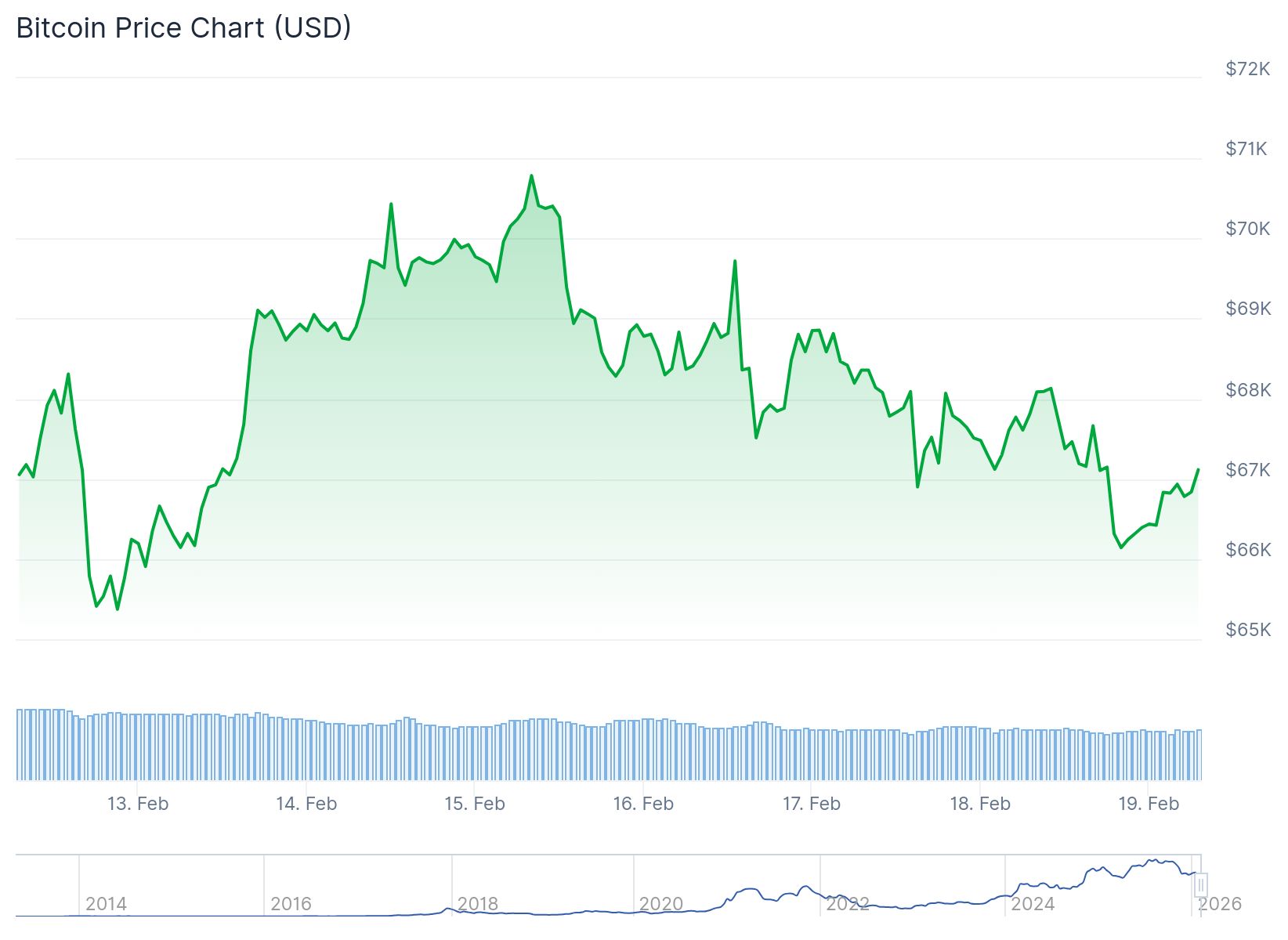 Bitcoin (BTC) Price
When the oscillator falls below the lower statistical band, it means recent buyers are sitting on losses that go beyond normal historical volatility.
The last time this reading was this low was late 2018. Following that signal, Bitcoin rallied roughly 150% within a year and approximately 1,900% over the next three years.
The same indicator also flashed ahead of the November 2022 bottom. That bottom preceded a 700% rally to a record high near $126,270.
Realized losses among short-term holder whales have remained low since Bitcoin’s October 2025 peak near $126,000. This suggests larger recent buyers have not yet sold at a loss, which analysts read as a sign of seller exhaustion.
Wells Fargo Sees Liquidity Catalyst
Wells Fargo strategist Ohsung Kwon, cited by CNBC, said larger-than-usual US tax refunds in 2026 could drive fresh buying in Bitcoin and equities. The bank estimates as much as $150 billion in refunds will be distributed, with more than 60% expected by end of March 2026.
The refunds are linked to provisions in the 2025 tax law and no changes to IRS withholding tables, meaning more cash is expected to land in taxpayer accounts.
Wells Fargo noted that Bitcoin has recently tracked domestic liquidity closely. Over the past four weeks, US domestic liquidity fell by $105 billion. Bitcoin dropped approximately 28% over the same period.
Five Red Months in a Row
Analysts at Milk Road flagged that Bitcoin is on pace for its fifth consecutive monthly decline. The last time this happened was during the 2018–2019 bear cycle, when BTC fell nearly 60% over six months before recovering 300% over the following five months.
Milk Road suggested a potential reversal could begin around April 1, 2026, which would align with peak tax refund liquidity.
Veteran trader Peter Brandt also sees potential for a short-term bounce but said BTC is not forming an inverse head-and-shoulders pattern, indicating any near-term rally may be a relief bounce rather than a confirmed bottom.
Bitcoin was trading around $67,081 at time of writing, down 1.19% on the day.
The post Bitcoin (BTC) Price: Rare Bottom Signal Flashes as US Tax Refunds Could Inject $150B Into Markets appeared first on CoinCentral.


You May Also Like

US-Israeli airstrikes destroy Iran’s Pasteur Institute headquarters

Bitcoin surges past $79,000 amid easing geopolitical tensions