

Bitcoin’s $1 Trillion Identity Crisis Deepens Amid ETF Outflows
Bitcoin might be facing a “$1 trillion identity crisis” as price weakness collides with shifting market narratives, according to a recent tweet by Walter Bloomberg.
The comment comes as Bitcoin trades more than 40% below its peak, while broader capital flows raise questions about its evolving role in the digital asset landscape.
While volatility is not new for Bitcoin, the current phase appears different in tone. The debate has shifted from short-term price action to a broader reassessment of purpose and positioning within global markets.
 Source: https://x.com/DeItaone/status/2025238138931597454
Price Drop vs. Narrative Pressure
Bitcoin’s decline from its highs has erased a substantial portion of market capitalization. However, the larger concern highlighted in the tweet is not the drawdown itself, but the weakening clarity around Bitcoin’s core investment thesis.
For years, Bitcoin’s dominant narrative centered on scarcity and its “digital gold” status. It was marketed as a hedge against inflation and currency debasement, particularly during periods of aggressive monetary expansion. Today, that thesis faces renewed scrutiny as gold strengthens and capital rotates into alternative crypto sectors.
Stablecoins increasingly dominate payment infrastructure. Tokenization of real-world assets is drawing institutional attention. Yield-bearing digital instruments are gaining traction. In that context, Bitcoin’s non-yielding structure stands out more clearly.
ETF Outflows Add to Uncertainty
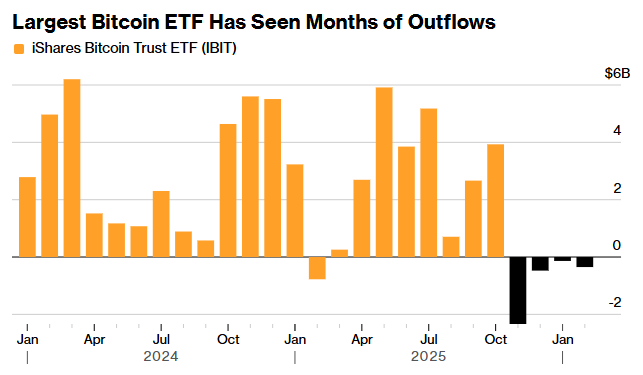
Adding to the pressure, data shows that major U.S. spot Bitcoin ETFs have experienced consecutive months of outflows. The largest products, including iShares Bitcoin Trust (IBIT), have seen sustained redemptions rather than accumulation during recent weakness.
ETFs were widely expected to serve as long-term demand anchors. Instead, recent flow trends suggest a more cautious stance from institutional participants. While this does not invalidate the broader adoption story, it does signal reduced short-term conviction.
A Cyclical Reset or Structural Shift?
Historically, Bitcoin has endured multiple deep drawdowns, including the 2018 bear market and the 2022 capitulation phase. Each cycle tested sentiment before recovery followed. Supporters argue that this period may simply represent another macro-driven reset.
However, the question raised in the tweet reflects a deeper concern: can Bitcoin redefine its role in a maturing crypto ecosystem where capital now has more choices?
Despite current uncertainty, Bitcoin remains the most liquid and globally recognized digital asset. Its network effects and infrastructure depth remain unmatched. Whether this moment marks another accumulation phase or a broader narrative transition will likely depend on how capital flows evolve in the months ahead.
The post Bitcoin’s $1 Trillion Identity Crisis Deepens Amid ETF Outflows appeared first on ETHNews.


You May Also Like

Is Adam Back Satoshi Nakamoto? CEO Responds to New York Times Investigation

Ranking Republican admits to White House reporter he regrets Trump vote: 'Make it stop!'




