

SATO Technologies Statistics 2026: Profit Data Now
SATO Technologies operates in the high-density compute and Bitcoin mining sector, a capital-intensive industry shaped by energy prices, network difficulty, and digital asset volatility. The company’s performance reflects broader shifts in Bitcoin mining economics, especially after the halving reduced block rewards.
Investors, infrastructure operators, and digital asset strategists monitor SATO’s financial and operational metrics to assess how smaller mining firms adapt in a consolidating market. This report breaks down the numbers that define SATO Technologies today.
Editor’s Choice
- Installed hashrate capacity maintained at 0.56 EH/s entering 2026.
- Bitcoin mined averaged ~20 BTC/month in late 2025 amid great difficulty.
- Q3 2025 revenue hit $3.34 million, up 28% year-over-year.
- Market capitalization stood around $5.86 million entering 2026.
- Share price traded near the 52-week low of approximately $0.08.
Recent Developments
- In February 2026, SATO initiated a strategic and operational review to improve liquidity flexibility.
- The company entered a forbearance agreement with Sygnum Bank AG to manage debt obligations.
- Approximately 15 percent of the mining fleet was temporarily down-clocked to reduce operating costs.
- Independent Trading Group was engaged as a market maker for approximately CAD $6,500 per month to improve liquidity.
- November 2024 production increased to 19 BTC, reflecting improved operational uptime.
- Average hashrate rose roughly 3.9 percent month-over-month during late 2024 optimization.
- Combined cash and Bitcoin assets increased from $2.51 million to $3.62 million between October and November 2024.
- Management cited network difficulty increases and post-halving economics as near-term operational headwinds.
Top Bitcoin Mining Pools
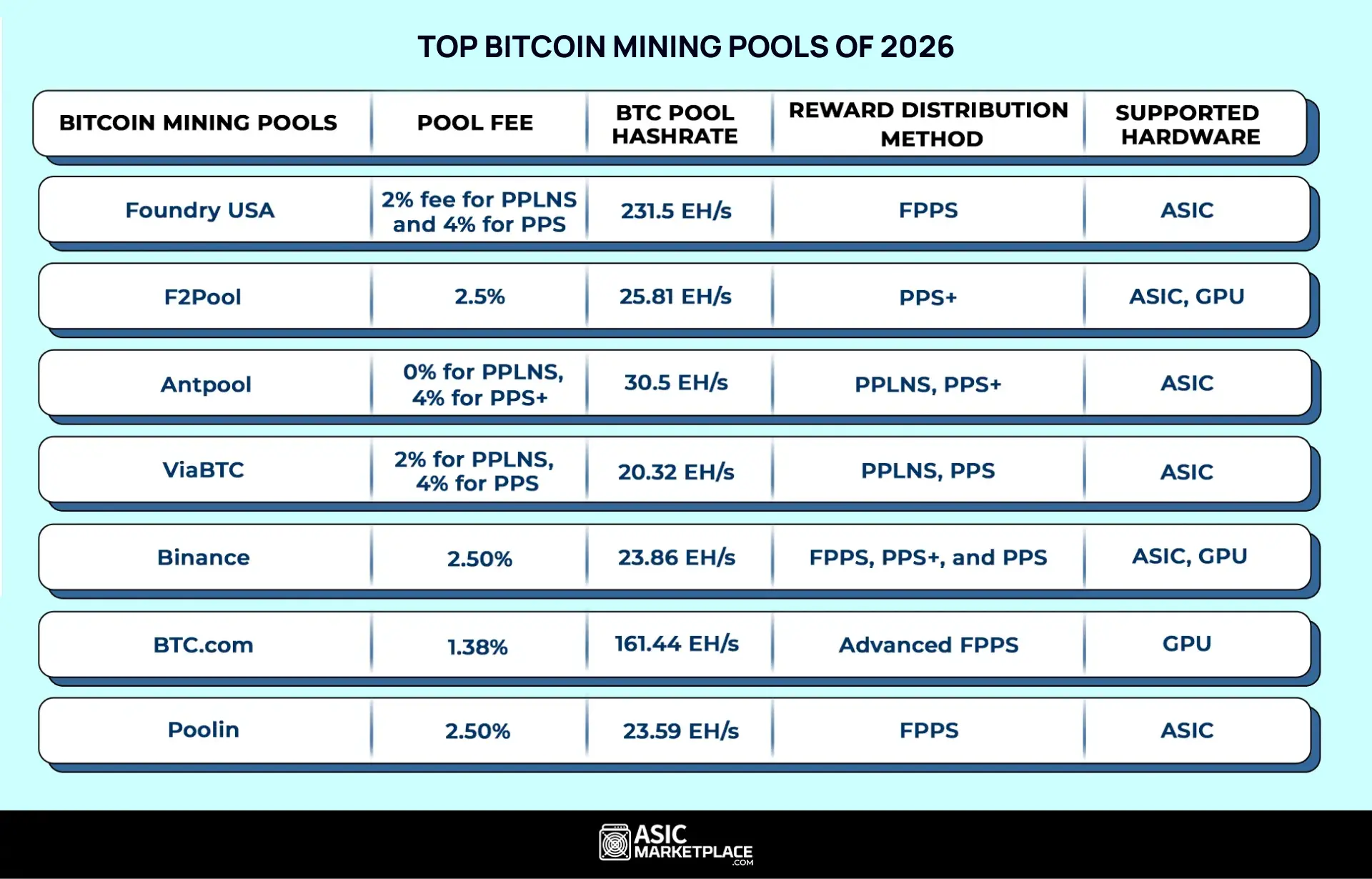
- Foundry USA dominates with 231.5 EH/s hashrate, charging 2% (PPLNS) or 4% (PPS) fees and supporting ASIC hardware only.
- BTC.com ranks second with 161.44 EH/s, offering a low 1.38% fee and using an Advanced FPPS reward model (GPU-supported).
- Antpool maintains a strong position at 30.5 EH/s, with 0% PPLNS fees and 4% PPS+, operating exclusively on ASIC miners.
- F2Pool delivers 25.81 EH/s and a 2.5% fee, supporting both ASIC and GPU hardware with a PPS+ payout system.
- Binance Pool provides 23.86 EH/s capacity with a 2.50% fee, offering multiple reward options including FPPS, PPS+, and PPS.
- Poolin closely follows at 23.59 EH/s, charging 2.50% and using the FPPS distribution model for ASIC miners.
- ViaBTC operates at 20.32 EH/s, with 2% (PPLNS) or 4% (PPS) fees and supports ASIC hardware.
- Most leading pools rely primarily on ASIC mining equipment, highlighting ASIC dominance in Bitcoin mining infrastructure.
- FPPS and PPS-based models remain the most common reward mechanisms, emphasizing predictable payouts for miners.
- Pool fees generally range between ~1.38% and 4%, depending on payout method and pool policies.
 (Reference: Asic Marketplace)
Overview of SATO Technologies
- Founded in 2017 as a Canadian Bitcoin mining and infrastructure company.
- Shares trade on TSXV: SATO and OTCQB: CCPUF.
- Headquarters in Toronto, Canada, with operations since 2017.
- Primary facility Center One in Quebec, powered by 20 MW of hydroelectric energy.
- Hashrate capacity generates roughly 540 PH/s for Bitcoin mining.
- CEO Romain Nouzareth leads expansion into AI and HPC infrastructure.
- Efficiency ranked the top 3 most efficient public Bitcoin miners worldwide.
- Lease for Quebec facility extended to September 30, 2026.
- Strategic review ongoing for asset optimization and AI/HPC growth in 2026.
- PUE optimized for high-density sustainable computing operations.
Business Model and Operations
- Primary revenue from Bitcoin mining and digital asset validation.
- Installed capacity stable at 0.56 EH/s.
- Power capacity operates 20 MW of hydroelectric energy.
- Efficiency ranked the top 3 most efficient public Bitcoin miners.
- Average operating hashrate achieves 0.53 EH/s.
- PUE optimized for high-density energy efficiency.
- Monthly BTC output ~23-26 BTC amid network difficulty.
- Facility lease extended through September 2026.
- Treasury strategy balances holding and liquidity needs.
Profitability and Margin Metrics
- Gross margin achieved 11.4% on $3.34 million in revenue.
- Operating margin improved to -8.5% in the trailing 12 months.
- Profit margin stood at -27.56% over the last 12 months.
- ROE negative at -40.57% amid capital investments.
- Q3 2025 net loss narrowed to $(284,424) from $(1,717,056) YoY.
- Adjusted EBITDA was positive at $333,505 in Q3 2025.
- Q1 2025 net loss reported at $0.89 million post-halving.
- Gross profit of $381,566 versus gross loss in the prior year.
- Electricity costs averaged $56,123-$61,204 per BTC mined.
Data Center Capacity and Infrastructure
- Quebec facility supports 20 MW of hydroelectric power.
- Capacity enables 0.56 EH/s Bitcoin mining.
- Electricity rate averages CA$0.045/kWh for renewable hydro.
- Center One is located in Joliette, Quebec.
- Infrastructure assets valued at CA$11.95 million.
- PUE optimized for high-density computing.
- AI Factory 1 repurposes up to 20 MW for LLMs.
- Contract renewed through September 30, 2026.
- Modular design supports HPC/AI scalability.
Valuation and Market Capitalization Statistics
- Market capitalization stands at CA$5.86 million as of February 2026.
- Enterprise value totals CA$10.84 million, including net debt.
- Shares outstanding number 73.28 million.
- Current share price trades at CA$0.08 near the 52-week low.
- Price-to-sales ratio at 0.44x trailing revenue.
- Price-to-book ratio measures 0.86x.
- 52-week range spans CA$0.065 to CA$2.20.
- Institutional ownership is limited to 0.08% of shares.
- Float shares comprise 43.85 million.
- Short interest at 0.03% of outstanding shares.
Balance Sheet and Liquidity Metrics
- Total assets stood at CA$18.01 million as of September 2025.
- Bitcoin holdings reported at 21 BTC worth $1.91 million.
- Total liabilities totaled CA$9.67 million, including debt.
- Shareholders’ equity reached CA$8.34 million.
- Cash equivalents at CA$0.64 million end of the period.
- Working capital positive CA$0.23 million TTM.
- Total debt amounted to CA$9.67 million net debt position.
- Forbearance agreement extended to January 31, 2026, with Sygnum.
- Property, plant, and equipment valuedat CA$11.95 million, primarily mining gear.
- Current liabilities comprised CA$7.16 million.
Share Structure and Ownership Statistics
- Shares outstanding total 73.28 million.
- Public float comprises 43.85 million shares (59.8%).
- Insider ownership accounts for 15.2% of shares.
- Institutional ownership holds 0.08%.
- Market capitalization at CA$5.86 million micro-cap.
- Implied shares outstanding are 73.28 million based on the price.
- No dividends paid since inception.
- Short ratio at 0.03% of float.
- Liquidity ratio avg daily volume 59K shares.
Installed Hashrate and Computing Power
- Installed capacity stable at 0.56 EH/s.
- Average operating hashrate 0.41 EH/s in January 2025.
- January 2025 production totaled 8 BTC.
- BTC per EH/s ratio 18.53 in January.
- Global network hashrate exceeded 600 EH/s in 2025.
- SATO global share is below 0.1% network hashrate.
- 15% fleet temporarily down-clocked early 2026.
- Q3 2025 mined 21 BTC despite halving.
- November 2024 produced 19 BTC at 0.48 EH/s.
- Block reward reduced to 3.125 BTC post-halving.
Stock Price Performance and Trading Metrics
- Current share price holds steady at CA$0.08.
- 52-week high peaked at CA$0.25 in October 2025.
- 52-week low hit CA$0.065 on February 5, 2026.
- 50-day moving average sits at CA$0.1166.
- 200-day moving average at CA$0.2607.
- 52-week change declined -60.00%.
- Average volume 3-month totals 59,030 shares.
- Beta 5Y monthly measures 5.72, indicating high volatility.The
- Short interest stands at 0.03% of shares outstanding.
- Avg volume 10-day recorded 26,640 shares.
Revenue and Income Statement Highlights
- Q3 2025 revenue reached $3.34 million, up 28% year-over-year.
- Full-year 2025 revenue projected at $14.8 million post-halving.
- Q4 2025 mining revenue averaged $850,000 monthly.
- Bitcoin mining contributed 92% of total operating revenue.
- Cost of revenue stable at 68% of revenue.
- Operating expenses are controlled at $5.2 million annually.
- Block rewards cut to 3.125 BTC post-April 2024 halving.
- Revenue sensitivity tied to Bitcoin price at $98,000.
Energy Sources and Efficiency Metrics
- 100% renewable hydroelectric power from Quebec.
- Electricity costs 45-55% of operating expenses.
- Industrial rate CA$0.045/kWh for hydro power.
- Hashprice at $39.22/PH/s/day January 2026.
- Global Bitcoin energy is 120-150 TWh annually.
- Quebec hydro generation exceeds 90% renewables.
- All-in electricity cost includes kWh plus max kW demand.
- Down-clocking cut consumption 15% early 2026.
- Post-halving breakeven hashprice above $70/PH/s/day.
- Hydro rates are stable under regulated pricing.
Environmental and Sustainability Metrics
- Hydro CO2 emissions 17-24 g CO2e/kWh Quebec lifecycle.
- Fossil fuel average exceeds 400 g CO2/kWh.
- SATO 2020 Scope 2 32.17 million kg CO2e electricity.
- Total 2020 emissions: 32.17 million kg CO2e.
- DitchCarbon score 26/100, higher than 80% peers.
- Quebec hydro supplies >90% renewable power.
- Industry consolidation post-halving favors efficient ops.
- ASIC lifecycle averages 3-5 years of replacement.
Frequently Asked Questions (FAQs)
As of early 2026, SATO’s share price was about $0.08, with a market cap of around $5.7 million.
SATO maintains a total installed hashrate capacity of 0.56 exahashes per second (EH/s).
SATO holds 21 BTC of Bitcoin as part of its treasury assets.
Conclusion
SATO Technologies is a micro-cap Bitcoin infrastructure operator, navigating reduced block rewards, elevated competition, and tight liquidity conditions. Revenue improved year-over-year, yet profitability remains highly sensitive to Bitcoin price cycles and electricity costs.
The company benefits from renewable hydroelectric energy in Quebec, providing structural cost advantages. However, its relatively small scale compared with publicly traded mining leaders limits resilience during prolonged hashprice downturns. Strategic diversification into AI infrastructure and disciplined capital management will determine whether SATO transitions from survival mode to sustainable growth in the evolving digital infrastructure market.
The post SATO Technologies Statistics 2026: Profit Data Now appeared first on CoinLaw.
You May Also Like

The Stunning ASEAN Winner Emerges As Manufacturing Shifts Accelerate
MySQL Single Leader Replication with Node.js and Docker
command: --server-id=1 --log-bin=ON The --server-id option gives each MySQL server in your replication setup its own name tag. Each one has to be unique and without it, replication won’t work at all. Another cool option not included here is binlog_format=ROW. This tells MySQL how to keep track of changes before passing them along to the replicas. By default, MySQL already uses row-based replication, but you can explicitly set it to ROW to be sure or switch it to STATEMENT if you’d rather log the actual SQL statements instead of row-by-row changes. \ Run our containers on docker Now, in the terminal, we can run the following command to spin up our database containers: docker-compose up -d \ Setting Up Our Master (Primary) Server To configure our master server, we would have to first access the running instance on docker using the following command docker exec -it mysql-master bash This command opens an interactive Bash shell inside the running Docker container named mysql-master, allowing us to run commands directly inside that container. \ Now that we’re inside the container, we can access the MySQL server and start running commands. type: mysql -uroot -p This will log you into MySQL as the root user. You’ll be prompted to enter the password you set in your docker-compose.yml file. \ Next, we need to create a special user that our replicas will use to connect to the master server and pull data. Inside the MySQL prompt, run the following commands: \ CREATE USER 'repl_user'@'%' IDENTIFIED BY 'replication_pass'; GRANT REPLICATION SLAVE ON . TO 'repl_user'@'%'; FLUSH PRIVILEGES; Here’s what’s happening: CREATE USER makes a new MySQL user called repl_user with the password replication_pass. GRANT REPLICATION SLAVE gives this user permission to act as a replication client. FLUSH PRIVILEGES tells MySQL to reload the user permissions so they take effect immediately. \ Time to Configure the Replica (Secondary) Servers a. First, let’s access the replica containers the same way we did with the master. Run this command in your terminal for each of the replica containers: \ docker exec -it <replica_container_name> bash mysql -uroot -p <replica_container_name> should be replace with the name of the replica container you are trying to setup b. Now it’s time to tell our replica where to get its data from. While inside the replica’s MySQL shell, run the following command to configure replication using the master’s details: CHANGE REPLICATION SOURCE TO SOURCE_HOST='mysql-master', SOURCE_USER='repl_user', SOURCE_PASSWORD='replication_pass', GET_SOURCE_PUBLIC_KEY=1; With the replication settings in place, let’s fire up the replica and get it syncing with the master. Still inside the MySQL shell on the replica, run: START REPLICA; This starts the replication process. To make sure everything is working, check the replica’s status with:
SHOW REPLICA STATUS\G; Look for Replica_IO_Running and Replica_SQL_Running — if both say Yes, congratulations! 🎉 Your replica is now successfully connected to the master and replicating data in real time.
Testing Our Replication Setup from the Node.js App Now that our replication is successfully set up, we can configure our Node.js server to observe the real-time effect of data being replicated from the master server to the replica server whenever we write to it. We start by installing the following dependencies:
npm i express mysql2 sequelize \ Now create a folder called src in the root directory and add the following files inside that folder connection.js, index.js and model.js. Our current directory should look like this We can now set up our connections to our master and replica server in the connection.js file as shown below
const Sequelize = require("sequelize"); const sequelize = new Sequelize({ dialect: "mysql", replication: { write: { host: "127.0.0.1", username: "root", password: "master", database: "replicaDb", }, read: [ { host: "127.0.0.1", username: "root", password: "slave", database: "replicaDb", port: 3307 }, { host: "127.0.0.1", username: "root", password: "slave", database: "replicaDb", port: 3308 }, { host: "127.0.0.1", username: "root", password: "slave", database: "replicaDb", port: 3309 }, ], }, }); async function connectdb() { try { await sequelize.authenticate(); } catch (error) { console.error("❌ unable to connect to the follower database", error); } } connectdb(); module.exports = { sequelize, }; \ We can now create a User table in the model.js file
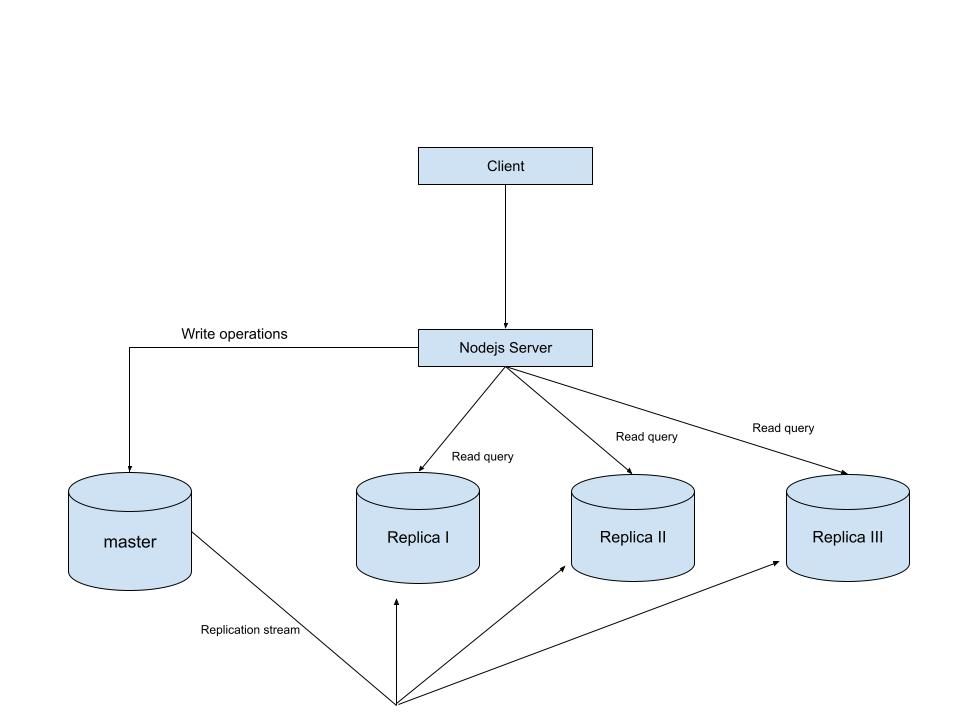
const {DataTypes} = require("sequelize"); const { sequelize } = require("./connection"); const User = sequelize.define("User", { name: { type: DataTypes.STRING, allowNull: false, }, email: { type: DataTypes.STRING, unique: true, allowNull: false, }, }); module.exports = User \ and finally in our index.js file we can start our server and listen for connections on port 3000. from the code sample below, all inserts or updates will be routed by sequelize to the master server. while all read queries will be routed to the read replicas.
const express = require("express"); const { sequelize } = require("./connection"); const User = require("./model"); const app = express(); app.use(express.json()); async function main() { await sequelize.sync({ alter: true }); app.get("/", (req, res) => { res.status(200).json({ message: "first step to setting server up", }); }); app.post("/user", async (req, res) => { const { email, name } = req.body; let newUser = await User.build({ name, email, }); // This INSERT will go to the write (master) connection newUser = newUser.save({ returning: false }); res.status(201).json({ message: "User successfully created", }); }); app.get("/user", async (req, res) => { // This SELECT query will go to one of the read replicas const users = await User.findAll(); res.status(200).json(users); }); app.listen(3000, () => { console.log("server has connected"); }); } main(); When you make a POST request to the /users endpoint, take a moment to check both the master and replica servers to observe how data is replicated in real time. Right now, we are relying on Sequelize to automatically route requests, which works for development but isn’t robust enough for a production environment. In particular, if the master node goes down, Sequelize cannot automatically redirect requests to a newly elected leader. In the next part of this series, we’ll explore strategies to handle these challenges
