Fresh from two decades at BlackRock, Joseph Chalom has stepped out of retirement to lead SharpLink Gaming Inc., a Nasdaq-listed company that has drawn comparisons to MicroStrategy for its aggressive Ethereum treasury strategy. In an exclusive interview with CryptoNews, Chalom outlines why he left traditional finance, what SharpLink is trying to achieve with ETH, and why he sees Ethereum as the foundation for the future of tokenization and decentralized finance. From BlackRock to SharpLink Chalom spent 20 years at BlackRock, where his career spanned both traditional finance and digital assets. He points to two accomplishments that defined his tenure: scaling Aladdin, BlackRock’s enterprise risk management system used by many of the world’s largest asset managers, and later leading the firm’s digital asset team. That latter role focused on bridging traditional investors with crypto markets, preparing institutions for the shift he believes is inevitable. After retiring from BlackRock in June 2025, Chalom was pulled back into the industry following a conversation with co-founder of Ethereum and CEO of Consensys, Joseph Lubin, who now serves as chairman of SharpLink’s board. “We both have a vision of a world where more efficient systems allow the exchange of value in a fundamentally different way than exists today,” Chalom said, pointing to Ethereum’s ability to settle transactions trustlessly and instantly. On Being Called the ‘MicroStrategy of Ethereum’ The comparison to Michael Saylor’s MicroStrategy, which famously accumulated billions of dollars in Bitcoin, has followed SharpLink since it began deploying its capital into ETH. Chalom acknowledges the parallel while stressing the differences between Bitcoin and Ethereum. “Michael Saylor has demonstrated that over a multi-year period, you can have a public company that buys a crypto asset and that company can trade at a premium in value,” he said. “We are trying to do a very similar thing with Ethereum, which is be a public treasury, raise capital from investors, buy Ethereum, and allow investors to participate in three things: capital appreciation, staking yield, and supporting the ecosystem,” Chalom said. Unlike Bitcoin, he added, Ethereum is a productive asset. Staking ETH can generate yield that is considered revenue, giving SharpLink an additional income stream. “We tip our hat to Michael Saylor in demonstrating that a crypto strategy in a treasury can work,” Chalom said. “We just think Ethereum is a more ideal treasury asset.” Ethereum, Tokenization, and the Long-Term Opportunity Chalom frames SharpLink’s mission around what he calls the “long-term Ethereum opportunity,” which he breaks down into three categories: stablecoins, tokenized real-world assets, and broader financial and non-financial applications. Stablecoins, the majority of which are issued on Ethereum or its Layer 2 networks, have grown into a $275 billion market. U.S. Treasury Secretary Janet Yellen has suggested that it could rise to several trillion in the coming years. Tokenization of traditional assets is the second leg of the thesis. From tokenized treasuries to equities and funds, Chalom sees programmable, instantly settling assets as a structural shift away from legacy systems that take days to settle. “When assets or securities or funds are held in tokenized format, they are programmable, tradable, sometimes 24/7, and most importantly, they settle instantly,” he said. Finally, as more real-world activity is represented in tokenized form on Ethereum, demand for ETH as the network’s native asset should rise. Chalom points to a framework: Historically, every $2 of high-quality assets secured on Ethereum translates into roughly a $1 increase in ETH’s market cap. “We’re accumulating as much ether as possible right now at the current prices, because we see significant appreciation in its value,” he said. Competition and Differentiation SharpLink is not alone in pursuing an Ethereum-focused treasury strategy. Rival BitMine has announced plans for a massive $24.5 billion raise to build its own ETH war chest, a sign of how corporate ether accumulation is accelerating. With ETH hovering near record highs, institutions are targeting a larger share of the supply. Chalom welcomes the competition. “If others have the same investment thesis, it means some of the best minds are validating this thesis, and we actually welcome that.” Still, he argues that SharpLink is uniquely positioned. The firm has built a team of institutional-grade investors and strategists and maintains a strategic partnership with ConsenSys, the Ethereum development company founded by Lubin. “That partnership gives us opportunities to participate in DeFi, capture the most expert staking yields, and potentially build Ethereum-denominated operating companies,” he said. “That is a true differentiator.” Regulation and Institutional Access Chalom is optimistic about the regulatory environment in the U.S., pointing to two developments: the GENIUS Act, which clarifies ownership and participation in crypto, and the pending CLARITY Act, which lays out market structure. Historically, institutions faced challenges around custody and mandates. But with ETFs now available and a public company wrapper via SharpLink’s Nasdaq listing, access is expanding. “Owning ETH through SharpLink is just like owning an equity,” Chalom said. “That is the first unlock. The second unlock is regulatory clarity. The headwinds have been released, and we’re at the point where there is a well-defined institutional path to owning Ethereum.” Looking Back: The First ETF Launch Chalom also reflects on his time at BlackRock during the approval of the first Bitcoin and Ethereum exchange-traded products in 2024, which he describes as “a seminal moment in the adoption of crypto by traditional institutions.” Those launches brought over $100 billion of traditional capital into Bitcoin and Ethereum, he notes, and set the stage for companies like SharpLink to strengthen the bridge between traditional markets and digital assets. “I still think it’s early in the investment opportunity in Ethereum,” Chalom adds, comparing the current moment to the early days of the internet. “The most transformation is ahead of us.” As SharpLink leans into its Ethereum-centric strategy, the comparisons to MicroStrategy may persist. But Chalom insists the company’s approach is more than a trade—it’s about building a long-term platform around a productive, revenue-generating, and programmable network asset. Whether SharpLink ultimately becomes known as the “MicroStrategy of Ethereum” or something else, the company’s moves will remain closely watched by both Wall Street and the crypto community. Price Action SharpLink Gaming Inc. (NASDAQ: SBET) has delivered a considerable rally in 2025, with shares up 128% year-to-date at $18.46 despite a volatile trading range. The stock surged to a 52-week high of $124.12 earlier this year on the back of its aggressive Ethereum treasury strategy, before retracing as markets absorbed the scale of its purchases. Still, with a market cap of $3.22 billion, SharpLink remains one of the most closely watched public companies, tying its fortunes directly to ETHFresh from two decades at BlackRock, Joseph Chalom has stepped out of retirement to lead SharpLink Gaming Inc., a Nasdaq-listed company that has drawn comparisons to MicroStrategy for its aggressive Ethereum treasury strategy. In an exclusive interview with CryptoNews, Chalom outlines why he left traditional finance, what SharpLink is trying to achieve with ETH, and why he sees Ethereum as the foundation for the future of tokenization and decentralized finance. From BlackRock to SharpLink Chalom spent 20 years at BlackRock, where his career spanned both traditional finance and digital assets. He points to two accomplishments that defined his tenure: scaling Aladdin, BlackRock’s enterprise risk management system used by many of the world’s largest asset managers, and later leading the firm’s digital asset team. That latter role focused on bridging traditional investors with crypto markets, preparing institutions for the shift he believes is inevitable. After retiring from BlackRock in June 2025, Chalom was pulled back into the industry following a conversation with co-founder of Ethereum and CEO of Consensys, Joseph Lubin, who now serves as chairman of SharpLink’s board. “We both have a vision of a world where more efficient systems allow the exchange of value in a fundamentally different way than exists today,” Chalom said, pointing to Ethereum’s ability to settle transactions trustlessly and instantly. On Being Called the ‘MicroStrategy of Ethereum’ The comparison to Michael Saylor’s MicroStrategy, which famously accumulated billions of dollars in Bitcoin, has followed SharpLink since it began deploying its capital into ETH. Chalom acknowledges the parallel while stressing the differences between Bitcoin and Ethereum. “Michael Saylor has demonstrated that over a multi-year period, you can have a public company that buys a crypto asset and that company can trade at a premium in value,” he said. “We are trying to do a very similar thing with Ethereum, which is be a public treasury, raise capital from investors, buy Ethereum, and allow investors to participate in three things: capital appreciation, staking yield, and supporting the ecosystem,” Chalom said. Unlike Bitcoin, he added, Ethereum is a productive asset. Staking ETH can generate yield that is considered revenue, giving SharpLink an additional income stream. “We tip our hat to Michael Saylor in demonstrating that a crypto strategy in a treasury can work,” Chalom said. “We just think Ethereum is a more ideal treasury asset.” Ethereum, Tokenization, and the Long-Term Opportunity Chalom frames SharpLink’s mission around what he calls the “long-term Ethereum opportunity,” which he breaks down into three categories: stablecoins, tokenized real-world assets, and broader financial and non-financial applications. Stablecoins, the majority of which are issued on Ethereum or its Layer 2 networks, have grown into a $275 billion market. U.S. Treasury Secretary Janet Yellen has suggested that it could rise to several trillion in the coming years. Tokenization of traditional assets is the second leg of the thesis. From tokenized treasuries to equities and funds, Chalom sees programmable, instantly settling assets as a structural shift away from legacy systems that take days to settle. “When assets or securities or funds are held in tokenized format, they are programmable, tradable, sometimes 24/7, and most importantly, they settle instantly,” he said. Finally, as more real-world activity is represented in tokenized form on Ethereum, demand for ETH as the network’s native asset should rise. Chalom points to a framework: Historically, every $2 of high-quality assets secured on Ethereum translates into roughly a $1 increase in ETH’s market cap. “We’re accumulating as much ether as possible right now at the current prices, because we see significant appreciation in its value,” he said. Competition and Differentiation SharpLink is not alone in pursuing an Ethereum-focused treasury strategy. Rival BitMine has announced plans for a massive $24.5 billion raise to build its own ETH war chest, a sign of how corporate ether accumulation is accelerating. With ETH hovering near record highs, institutions are targeting a larger share of the supply. Chalom welcomes the competition. “If others have the same investment thesis, it means some of the best minds are validating this thesis, and we actually welcome that.” Still, he argues that SharpLink is uniquely positioned. The firm has built a team of institutional-grade investors and strategists and maintains a strategic partnership with ConsenSys, the Ethereum development company founded by Lubin. “That partnership gives us opportunities to participate in DeFi, capture the most expert staking yields, and potentially build Ethereum-denominated operating companies,” he said. “That is a true differentiator.” Regulation and Institutional Access Chalom is optimistic about the regulatory environment in the U.S., pointing to two developments: the GENIUS Act, which clarifies ownership and participation in crypto, and the pending CLARITY Act, which lays out market structure. Historically, institutions faced challenges around custody and mandates. But with ETFs now available and a public company wrapper via SharpLink’s Nasdaq listing, access is expanding. “Owning ETH through SharpLink is just like owning an equity,” Chalom said. “That is the first unlock. The second unlock is regulatory clarity. The headwinds have been released, and we’re at the point where there is a well-defined institutional path to owning Ethereum.” Looking Back: The First ETF Launch Chalom also reflects on his time at BlackRock during the approval of the first Bitcoin and Ethereum exchange-traded products in 2024, which he describes as “a seminal moment in the adoption of crypto by traditional institutions.” Those launches brought over $100 billion of traditional capital into Bitcoin and Ethereum, he notes, and set the stage for companies like SharpLink to strengthen the bridge between traditional markets and digital assets. “I still think it’s early in the investment opportunity in Ethereum,” Chalom adds, comparing the current moment to the early days of the internet. “The most transformation is ahead of us.” As SharpLink leans into its Ethereum-centric strategy, the comparisons to MicroStrategy may persist. But Chalom insists the company’s approach is more than a trade—it’s about building a long-term platform around a productive, revenue-generating, and programmable network asset. Whether SharpLink ultimately becomes known as the “MicroStrategy of Ethereum” or something else, the company’s moves will remain closely watched by both Wall Street and the crypto community. Price Action SharpLink Gaming Inc. (NASDAQ: SBET) has delivered a considerable rally in 2025, with shares up 128% year-to-date at $18.46 despite a volatile trading range. The stock surged to a 52-week high of $124.12 earlier this year on the back of its aggressive Ethereum treasury strategy, before retracing as markets absorbed the scale of its purchases. Still, with a market cap of $3.22 billion, SharpLink remains one of the most closely watched public companies, tying its fortunes directly to ETH

SharpLink Co-CEO Joseph Chalom on Being Dubbed the ‘MicroStrategy of Ethereum’

2025/08/30 00:16
6 min read

Fresh from two decades at BlackRock, Joseph Chalom has stepped out of retirement to lead SharpLink Gaming Inc., a Nasdaq-listed company that has drawn comparisons to MicroStrategy for its aggressive Ethereum treasury strategy.

In an exclusive interview with CryptoNews, Chalom outlines why he left traditional finance, what SharpLink is trying to achieve with ETH, and why he sees Ethereum as the foundation for the future of tokenization and decentralized finance.

Chalom spent 20 years at BlackRock, where his career spanned both traditional finance and digital assets. He points to two accomplishments that defined his tenure: scaling Aladdin, BlackRock’s enterprise risk management system used by many of the world’s largest asset managers, and later leading the firm’s digital asset team.

That latter role focused on bridging traditional investors with crypto markets, preparing institutions for the shift he believes is inevitable.

After retiring from BlackRock in June 2025, Chalom was pulled back into the industry following a conversation with co-founder of Ethereum and CEO of Consensys, Joseph Lubin, who now serves as chairman of SharpLink’s board.

“We both have a vision of a world where more efficient systems allow the exchange of value in a fundamentally different way than exists today,” Chalom said, pointing to Ethereum’s ability to settle transactions trustlessly and instantly.

On Being Called the ‘MicroStrategy of Ethereum’

The comparison to Michael Saylor’s MicroStrategy, which famously accumulated billions of dollars in Bitcoin, has followed SharpLink since it began deploying its capital into ETH. Chalom acknowledges the parallel while stressing the differences between Bitcoin and Ethereum.

“Michael Saylor has demonstrated that over a multi-year period, you can have a public company that buys a crypto asset and that company can trade at a premium in value,” he said.

“We are trying to do a very similar thing with Ethereum, which is be a public treasury, raise capital from investors, buy Ethereum, and allow investors to participate in three things: capital appreciation, staking yield, and supporting the ecosystem,” Chalom said.

Unlike Bitcoin, he added, Ethereum is a productive asset. Staking ETH can generate yield that is considered revenue, giving SharpLink an additional income stream.

“We tip our hat to Michael Saylor in demonstrating that a crypto strategy in a treasury can work,” Chalom said. “We just think Ethereum is a more ideal treasury asset.”

Ethereum, Tokenization, and the Long-Term Opportunity

Chalom frames SharpLink’s mission around what he calls the “long-term Ethereum opportunity,” which he breaks down into three categories: stablecoins, tokenized real-world assets, and broader financial and non-financial applications.

Stablecoins, the majority of which are issued on Ethereum or its Layer 2 networks, have grown into a $275 billion market. U.S. Treasury Secretary Janet Yellen has suggested that it could rise to several trillion in the coming years.

Tokenization of traditional assets is the second leg of the thesis. From tokenized treasuries to equities and funds, Chalom sees programmable, instantly settling assets as a structural shift away from legacy systems that take days to settle.

“When assets or securities or funds are held in tokenized format, they are programmable, tradable, sometimes 24/7, and most importantly, they settle instantly,” he said.

Finally, as more real-world activity is represented in tokenized form on Ethereum, demand for ETH as the network’s native asset should rise. Chalom points to a framework: Historically, every $2 of high-quality assets secured on Ethereum translates into roughly a $1 increase in ETH’s market cap.

“We’re accumulating as much ether as possible right now at the current prices, because we see significant appreciation in its value,” he said.

Competition and Differentiation

SharpLink is not alone in pursuing an Ethereum-focused treasury strategy. Rival BitMine has announced plans for a massive $24.5 billion raise to build its own ETH war chest, a sign of how corporate ether accumulation is accelerating. With ETH hovering near record highs, institutions are targeting a larger share of the supply.

Chalom welcomes the competition. “If others have the same investment thesis, it means some of the best minds are validating this thesis, and we actually welcome that.”

Still, he argues that SharpLink is uniquely positioned. The firm has built a team of institutional-grade investors and strategists and maintains a strategic partnership with ConsenSys, the Ethereum development company founded by Lubin.

“That partnership gives us opportunities to participate in DeFi, capture the most expert staking yields, and potentially build Ethereum-denominated operating companies,” he said. “That is a true differentiator.”

Regulation and Institutional Access

Chalom is optimistic about the regulatory environment in the U.S., pointing to two developments: the GENIUS Act, which clarifies ownership and participation in crypto, and the pending CLARITY Act, which lays out market structure.

Historically, institutions faced challenges around custody and mandates. But with ETFs now available and a public company wrapper via SharpLink’s Nasdaq listing, access is expanding.

“Owning ETH through SharpLink is just like owning an equity,” Chalom said. “That is the first unlock. The second unlock is regulatory clarity. The headwinds have been released, and we’re at the point where there is a well-defined institutional path to owning Ethereum.”

Looking Back: The First ETF Launch

Chalom also reflects on his time at BlackRock during the approval of the first Bitcoin and Ethereum exchange-traded products in 2024, which he describes as “a seminal moment in the adoption of crypto by traditional institutions.”

Those launches brought over $100 billion of traditional capital into Bitcoin and Ethereum, he notes, and set the stage for companies like SharpLink to strengthen the bridge between traditional markets and digital assets.

“I still think it’s early in the investment opportunity in Ethereum,” Chalom adds, comparing the current moment to the early days of the internet. “The most transformation is ahead of us.”

As SharpLink leans into its Ethereum-centric strategy, the comparisons to MicroStrategy may persist. But Chalom insists the company’s approach is more than a trade—it’s about building a long-term platform around a productive, revenue-generating, and programmable network asset.

Whether SharpLink ultimately becomes known as the “MicroStrategy of Ethereum” or something else, the company’s moves will remain closely watched by both Wall Street and the crypto community.

Price Action

SharpLink Gaming Inc. (NASDAQ: SBET) has delivered a considerable rally in 2025, with shares up 128% year-to-date at $18.46 despite a volatile trading range.
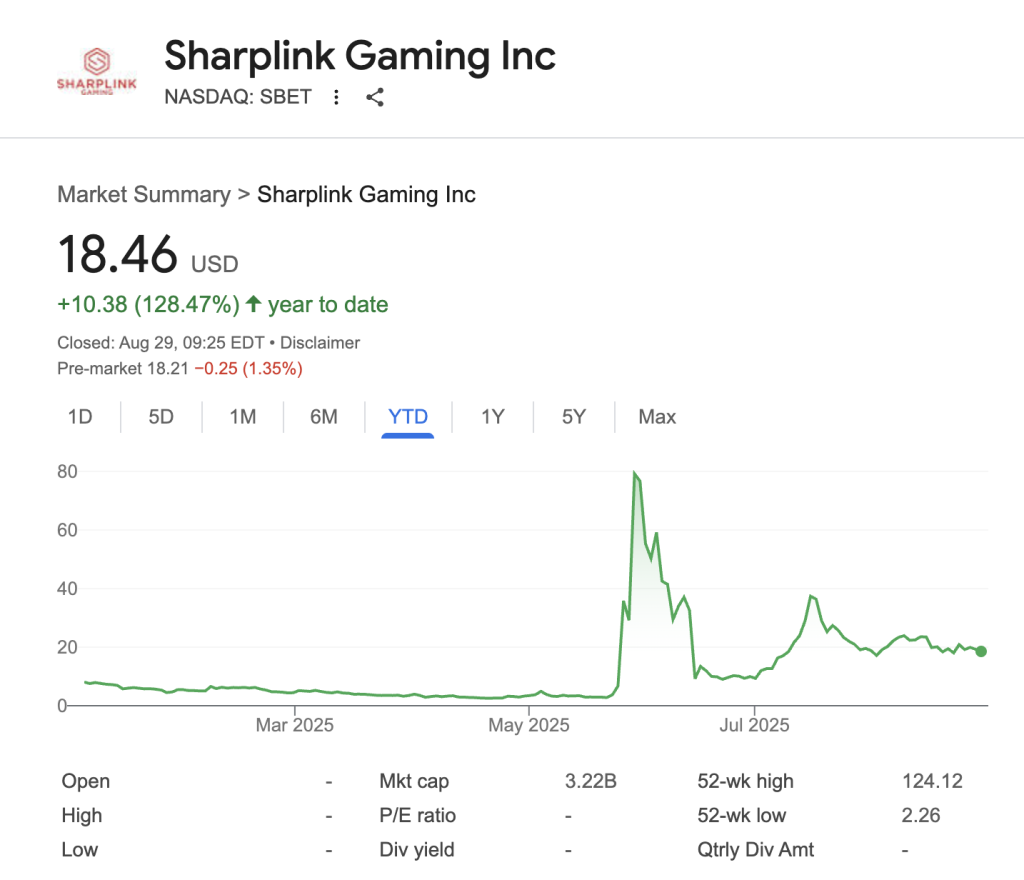
The stock surged to a 52-week high of $124.12 earlier this year on the back of its aggressive Ethereum treasury strategy, before retracing as markets absorbed the scale of its purchases. Still, with a market cap of $3.22 billion, SharpLink remains one of the most closely watched public companies, tying its fortunes directly to ETH.


Disclaimer: The articles reposted on this site are sourced from public platforms and are provided for informational purposes only. They do not necessarily reflect the views of MEXC. All rights remain with the original authors. If you believe any content infringes on third-party rights, please contact crypto.news@mexc.com for removal. MEXC makes no guarantees regarding the accuracy, completeness, or timeliness of the content and is not responsible for any actions taken based on the information provided. The content does not constitute financial, legal, or other professional advice, nor should it be considered a recommendation or endorsement by MEXC.

You May Also Like

“We Cannot in Good Conscience Agree”: Anthropic Defies Pentagon Over AI Weapons

“We Cannot in Good Conscience Agree”: Anthropic Defies Pentagon Over AI Weapons

TLDR The Pentagon is demanding Anthropic remove safety guardrails from its Claude AI so it can be used for any lawful purpose, including autonomous weapons and
Share
Coincentral2026/02/27 20:18
Wormhole Unleashes W 2.0 Tokenomics for a Connected Blockchain Future

Wormhole Unleashes W 2.0 Tokenomics for a Connected Blockchain Future

TLDR Wormhole reinvents W Tokenomics with Reserve, yield, and unlock upgrades. W Tokenomics: 4% yield, bi-weekly unlocks, and a sustainable Reserve Wormhole shifts to long-term value with treasury, yield, and smoother unlocks. Stakers earn 4% base yield as Wormhole optimizes unlocks for stability. Wormhole’s new Tokenomics align growth, yield, and stability for W holders. Wormhole [...] The post Wormhole Unleashes W 2.0 Tokenomics for a Connected Blockchain Future appeared first on CoinCentral.
Share
Coincentral2025/09/18 02:07
Whales Dump 200 Million XRP in Just 2 Weeks – Is XRP’s Price on the Verge of Collapse?

Whales Dump 200 Million XRP in Just 2 Weeks – Is XRP’s Price on the Verge of Collapse?

Whales offload 200 million XRP leaving market uncertainty behind. XRP faces potential collapse as whales drive major price shifts. Is XRP’s future in danger after massive sell-off by whales? XRP’s price has been under intense pressure recently as whales reportedly offloaded a staggering 200 million XRP over the past two weeks. This massive sell-off has raised alarms across the cryptocurrency community, as many wonder if the market is on the brink of collapse or just undergoing a temporary correction. According to crypto analyst Ali (@ali_charts), this surge in whale activity correlates directly with the price fluctuations seen in the past few weeks. XRP experienced a sharp spike in late July and early August, but the price quickly reversed as whales began to sell their holdings in large quantities. The increased volume during this period highlights the intensity of the sell-off, leaving many traders to question the future of XRP’s value. Whales have offloaded around 200 million $XRP in the last two weeks! pic.twitter.com/MiSQPpDwZM — Ali (@ali_charts) September 17, 2025 Also Read: Shiba Inu’s Price Is at a Tipping Point: Will It Break or Crash Soon? Can XRP Recover or Is a Bigger Decline Ahead? As the market absorbs the effects of the whale offload, technical indicators suggest that XRP may be facing a period of consolidation. The Relative Strength Index (RSI), currently sitting at 53.05, signals a neutral market stance, indicating that XRP could move in either direction. This leaves traders uncertain whether the XRP will break above its current resistance levels or continue to fall as more whales sell off their holdings. Source: Tradingview Additionally, the Bollinger Bands, suggest that XRP is nearing the upper limits of its range. This often points to a potential slowdown or pullback in price, further raising concerns about the future direction of the XRP. With the price currently around $3.02, many are questioning whether XRP can regain its footing or if it will continue to decline. The Aftermath of Whale Activity: Is XRP’s Future in Danger? Despite the large sell-off, XRP is not yet showing signs of total collapse. However, the market remains fragile, and the price is likely to remain volatile in the coming days. With whales continuing to influence price movements, many investors are watching closely to see if this trend will reverse or intensify. The coming weeks will be critical for determining whether XRP can stabilize or face further declines. The combination of whale offloading and technical indicators suggest that XRP’s price is at a crossroads. Traders and investors alike are waiting for clear signals to determine if the XRP will bounce back or continue its downward trajectory. Also Read: Metaplanet’s Bold Move: $15M U.S. Subsidiary to Supercharge Bitcoin Strategy The post Whales Dump 200 Million XRP in Just 2 Weeks – Is XRP’s Price on the Verge of Collapse? appeared first on 36Crypto.
Share
Coinstats2025/09/17 23:42