MoneyGram has joined Midnight’s launch-phase infrastructure as a federated node operator, adding a major cross-border payments brand to the Cardano based privacyMoneyGram has joined Midnight’s launch-phase infrastructure as a federated node operator, adding a major cross-border payments brand to the Cardano based privacy

MoneyGram Joins Cardano’s Midnight As Federated Mainnet Validator

2026/02/25 19:00
3 min read
For feedback or concerns regarding this content, please contact us at crypto.news@mexc.com

MoneyGram has joined Midnight’s launch-phase infrastructure as a federated node operator, adding a major cross-border payments brand to the Cardano based privacy-focused network’s initial mainnet cohort ahead of a planned March launch. The move matters because Cardano’s Midnight is explicitly positioning its early validator set around operators with compliance-heavy, always-on production experience rather than crypto-native firms alone.

In a February 24 update, the Midnight Foundation said the network is expanding its federated node operator roster during the Kūkolu phase of its roadmap, a stage designed to prioritize coordinated participation and operational stability as mainnet goes live. MoneyGram was announced alongside Pairpoint by Vodafone and eToro, building on previously named partners that include Google Cloud, Blockdaemon, Shielded Technologies, and AlphaTON. The announcement adds to the institutional profile of the Cardano-linked privacy network ahead of launch.

Why MoneyGram Matters For Cardano’s Midnight

Midnight describes MoneyGram as a cross-border digital P2P payments leader operating in more than 200 countries and territories. Beyond simply running a node, the Foundation said the two organizations are also exploring how established payment networks could move onto blockchain rails while preserving regulatory trust. The specific focus is on confidential transactions where settlement can function as verifiable proof of compliance without exposing sensitive user data.

Luke Tuttle, MoneyGram’s chief product and technology officer, framed the move as a continuation of the company’s existing crypto strategy rather than a new experiment. “MoneyGram has been delivering real-world crypto solutions for years, focusing on making the benefits of digital finance accessible to the people who actually need them,” Tuttle said. “Working with Midnight and running blockchain nodes fits naturally into this strategy, allowing us to help ensure that privacy, compliance and reliability are built in from day one.”

The Foundation’s announcement repeatedly ties the federated model to launch reliability. Its argument is straightforward: operators that already manage high-volume, mission-critical systems in payments, telecom and regulated fintech are better suited to support early mainnet performance while developers begin deploying privacy-preserving applications. Midnight also says this phase is part of a longer path toward community-driven decentralization, not the endpoint.

That framing comes through clearly in comments from both eToro and the Foundation. eToro Chief Blockchain Officer Omri Ross said, “We were excited to learn about Midnight’s novel approach to programmable data protection and selective disclosure, designed to balance user confidentiality with regulatory compliance. We believe technologies enabling granular control over data visibility will be foundational to the next generation of blockchain infrastructure. Midnight’s architecture for confidential smart contracts with built-in verifiability aligns with our long-term view that, over time, all asset classes will increasingly move on-chain.”

Midnight Foundation President Fahmi Syed made the same point in more strategic terms, arguing the mix of operators itself is the signal. “When a global payments network, a leading technology company backed by a Fortune 500 telco, and a publicly traded fintech all choose to operate nodes on the same privacy-enhancing blockchain, that tells you where this industry is heading,” Syed said, adding that the consortium is only the beginning.

At press time, Cardano traded at $0.2649.
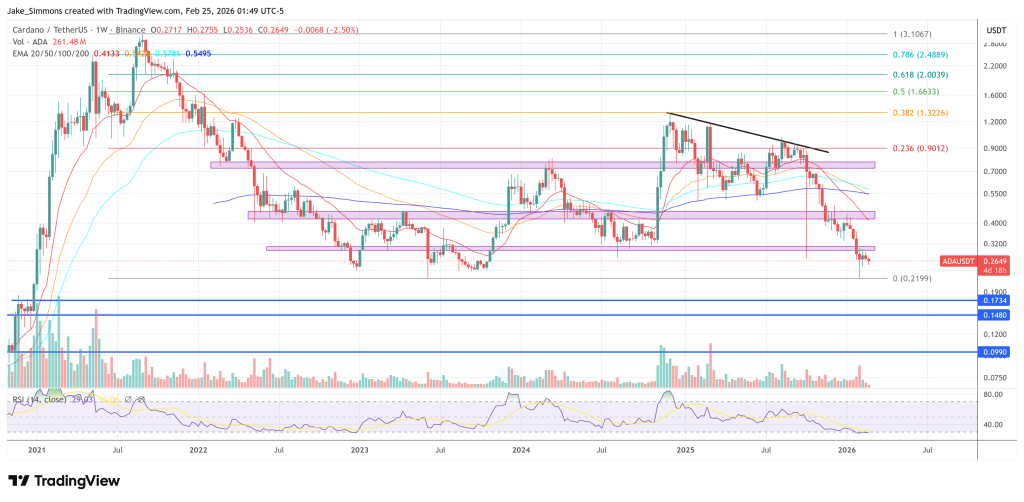
Cardano price chart
Market Opportunity
Major Logo
Major Price(MAJOR)
$0.06064
$0.06064$0.06064
+1.04%
USD
Major (MAJOR) Live Price Chart
Disclaimer: The articles reposted on this site are sourced from public platforms and are provided for informational purposes only. They do not necessarily reflect the views of MEXC. All rights remain with the original authors. If you believe any content infringes on third-party rights, please contact crypto.news@mexc.com for removal. MEXC makes no guarantees regarding the accuracy, completeness, or timeliness of the content and is not responsible for any actions taken based on the information provided. The content does not constitute financial, legal, or other professional advice, nor should it be considered a recommendation or endorsement by MEXC.

You May Also Like

Vitalik Buterin to Ethereum Developers: Build It Like It Has to Last Without You

Vitalik Buterin to Ethereum Developers: Build It Like It Has to Last Without You

Key Takeaways Vitalik Buterin wants Ethereum apps built to survive without developers, corporate servers, or trusted third parties Two major […] The post Vitalik
Share
Coindoo2026/03/07 15:49
Non-Opioid Painkillers Have Struggled–Cannabis Drugs Might Be The Solution

Non-Opioid Painkillers Have Struggled–Cannabis Drugs Might Be The Solution

The post Non-Opioid Painkillers Have Struggled–Cannabis Drugs Might Be The Solution appeared on BitcoinEthereumNews.com. In this week’s edition of InnovationRx, we look at possible pain treatments from cannabis, risks of new vaccine restrictions, virtual clinical trials at the Mayo Clinic, GSK’s $30 billion U.S. manufacturing commitment, and more. To get it in your inbox, subscribe here. Despite their addictive nature, opioids continue to be a major treatment for pain due to a lack of effective alternatives. In an effort to boost new drugs, the FDA released new guidelines for non-opioid painkillers last week. But making these drugs hasn’t been easy. Vertex Pharmaceuticals received FDA approval for its non-opioid Journavx in January, then abandoned a next generation drug after a failed clinical trial earlier this summer. Acadia similarly abandoned a promising candidate after a failed trial in 2022. One possible basis for non-opioids might be cannabis. Earlier this year, researchers at Washington University at St. Louis and Stanford published a study showing that a cannabis-derived compound successfully eased pain in mice with minimal side effects. Munich-based pharmaceutical company Vertanical is perhaps the furthest along in this quest. It is developing a cannabinoid-based extract to treat chronic pain it hopes will soon become an approved medicine, first in the European Union and eventually in the United States. The drug, currently called Ver-01, packs enough low levels of cannabinoids (including THC) to relieve pain, but not so much that patients get high. Founder Clemens Fischer, a 50-year-old medical doctor and serial pharmaceutical and supplement entrepreneur, hopes it will become the first cannabis-based painkiller prescribed by physicians and covered by insurance. Fischer founded Vertanical, with his business partner Madlena Hohlefelder, in 2017, and has invested more than $250 million of his own money in it. With a cannabis cultivation site and drug manufacturing plant in Denmark, Vertanical has successfully passed phase III clinical trials in Germany and expects…
Share
BitcoinEthereumNews2025/09/18 05:26
Short-term profit-taking pushes Bitcoin back below key $70K level – What next?

Short-term profit-taking pushes Bitcoin back below key $70K level – What next?

The post Short-term profit-taking pushes Bitcoin back below key $70K level – What next? appeared on BitcoinEthereumNews.com. Bitcoin [BTC] rallied as high as $74
Share
BitcoinEthereumNews2026/03/07 16:09