PENGU price is down 35% from its July peak, with rising volume and oversold signals hinting at a possible rebound as analyst eyes September upswing.PENGU price is down 35% from its July peak, with rising volume and oversold signals hinting at a possible rebound as analyst eyes September upswing.

PENGU price slides 35% from local top, analyst eyes next leg higher in September

PENGU price has fallen sharply from its late-July peak, yet analysts suggest the decline could set the stage for a stronger rebound in September.

Summary
  • PENGU trades at $0.027, down 35% from July’s local high.
  • NFT market slump and ETH pullback drove selling pressure.
  • Analysts see September catalysts as setup for a rebound.

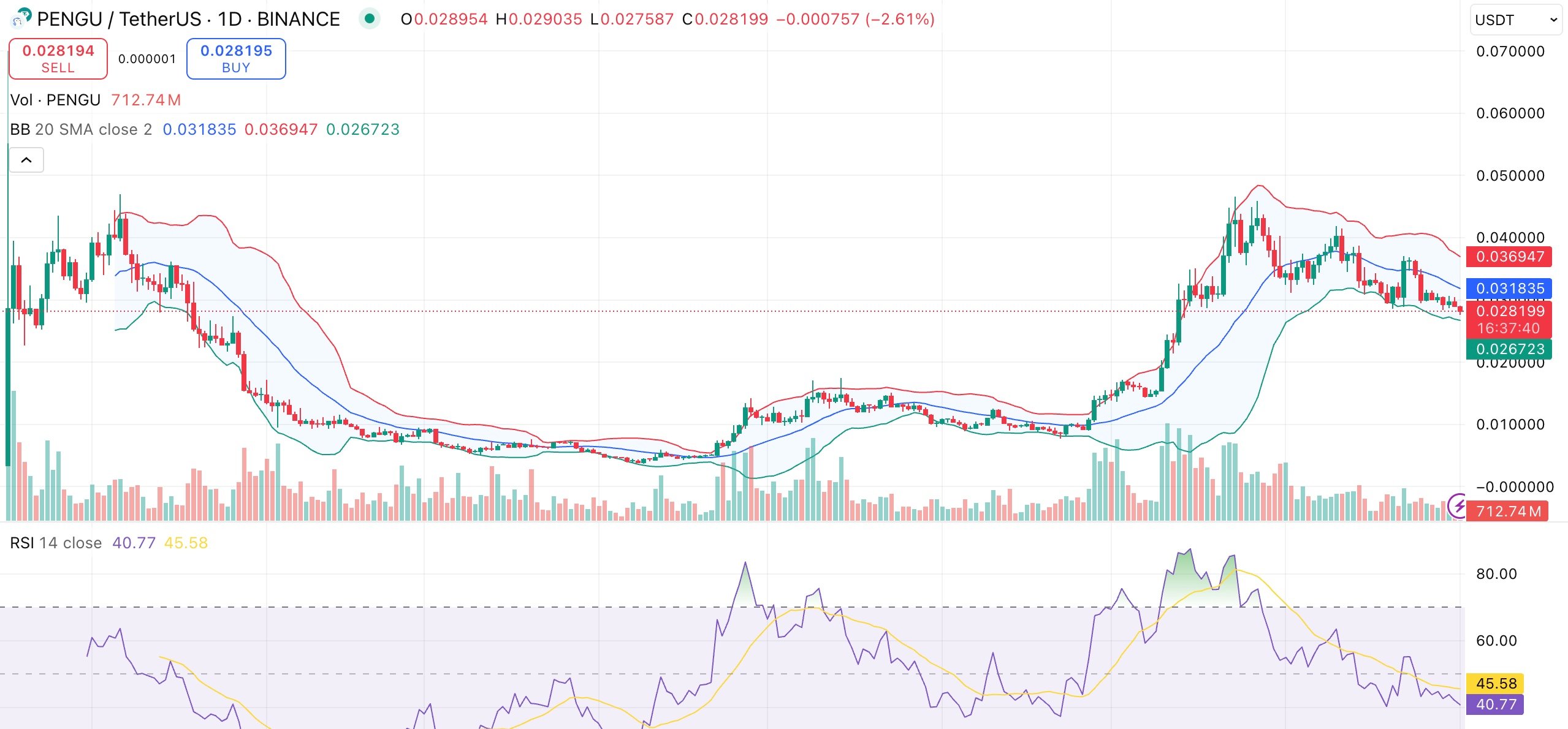
The Pudgy Penguins (PENGU) token is trading at $0.027 as of press time, down roughly 35% from its July 28 local high of $0.043. After declining 13% over the past week and 20% over the past 30 days, the token is nearly 60% below its peak of $0.068 set in December 2024. 

Despite the price decline, trading activity is still strong. PENGU recorded $214.8 million in spot volume over the past 24 hours, up 15% from the day before. Derivatives data from Coinglass show futures turnover rising 24% to $586 million, while open interest dropped 5.3% to $275 million.

During a pullback, rising volume combined with declining open interest often shows that traders are closing positions rather than building new leverage, indicating cautious sentiment.

PENGU price market drivers and sentiment shift

PENGU’s drop is a reflection of the overall cooling of the NFT market, whose monthly volume dropped from a peak of $8.2 billion on Aug. 14 to $6 billion as of press time. Ethereum’s (ETH) price retreat also weighed on valuations despite positive ecosystem developments.

The transition of PENGU from an NFT-linked token to a utility-driven brand has been taking place. The launch of Pudgy Party, a Web3 mobile game on Aug. 29 that quickly surpassed 50,000 downloads and ranked in the top 10 of the App Store, introduced direct utility for the token through in-game purchases and staking rewards.

Short-term on-chain demand, including activity tied to Pudgy Penguins’ mobile game downloads, has not offset profit-taking and portfolio rebalancing by holders.

Still, analyst Ali Martinez suggested in a Sept. 1 post on X that the correction looks like a healthy pause before the next leg higher, pointing to September as a potential turning point for momentum.

PENGU price technical analysis

Chart indicators point to consolidation at current levels. The relative strength index, which is presently trading at about 41, a neutral zone just above oversold territory, suggests that there may be room for growth if buyers step in. The Williams %R has already entered deep oversold conditions, historically a reversal zone for PENGU.
PENGU price slides 35% from local top, analyst eyes next leg higher in September  - 1

Momentum and MACD levels remain negative, and most short- and mid-term moving averages are skewed downward, suggesting short-term bearish pressure. However, the 100-day and 200-day averages continue to be supportive and could sustain the longer-term trend.

If $0.027 continues to be a support base, the next upward target is near $0.032, which is consistent with the 20-day moving average. If current levels are not defended, there may be a retest of the $0.025 region.

Given that Q4 usually signifies periods of peak momentum and September is believed to be a historically active month for cryptocurrency markets, the token’s position around significant support levels may determine its next move.


Market Opportunity
TOP Network Logo
TOP Network Price(TOP)
$0,000096
$0,000096$0,000096
%0,00
USD
TOP Network (TOP) Live Price Chart
Disclaimer: The articles reposted on this site are sourced from public platforms and are provided for informational purposes only. They do not necessarily reflect the views of MEXC. All rights remain with the original authors. If you believe any content infringes on third-party rights, please contact service@support.mexc.com for removal. MEXC makes no guarantees regarding the accuracy, completeness, or timeliness of the content and is not responsible for any actions taken based on the information provided. The content does not constitute financial, legal, or other professional advice, nor should it be considered a recommendation or endorsement by MEXC.

You May Also Like

The Channel Factories We’ve Been Waiting For

The Channel Factories We’ve Been Waiting For

The post The Channel Factories We’ve Been Waiting For appeared on BitcoinEthereumNews.com. Visions of future technology are often prescient about the broad strokes while flubbing the details. The tablets in “2001: A Space Odyssey” do indeed look like iPads, but you never see the astronauts paying for subscriptions or wasting hours on Candy Crush.  Channel factories are one vision that arose early in the history of the Lightning Network to address some challenges that Lightning has faced from the beginning. Despite having grown to become Bitcoin’s most successful layer-2 scaling solution, with instant and low-fee payments, Lightning’s scale is limited by its reliance on payment channels. Although Lightning shifts most transactions off-chain, each payment channel still requires an on-chain transaction to open and (usually) another to close. As adoption grows, pressure on the blockchain grows with it. The need for a more scalable approach to managing channels is clear. Channel factories were supposed to meet this need, but where are they? In 2025, subnetworks are emerging that revive the impetus of channel factories with some new details that vastly increase their potential. They are natively interoperable with Lightning and achieve greater scale by allowing a group of participants to open a shared multisig UTXO and create multiple bilateral channels, which reduces the number of on-chain transactions and improves capital efficiency. Achieving greater scale by reducing complexity, Ark and Spark perform the same function as traditional channel factories with new designs and additional capabilities based on shared UTXOs.  Channel Factories 101 Channel factories have been around since the inception of Lightning. A factory is a multiparty contract where multiple users (not just two, as in a Dryja-Poon channel) cooperatively lock funds in a single multisig UTXO. They can open, close and update channels off-chain without updating the blockchain for each operation. Only when participants leave or the factory dissolves is an on-chain transaction…
Share
BitcoinEthereumNews2025/09/18 00:09
How ZKP’s Daily Presale Auction Is Creating a New Standard for 1,000x Returns

How ZKP’s Daily Presale Auction Is Creating a New Standard for 1,000x Returns

The post How ZKP’s Daily Presale Auction Is Creating a New Standard for 1,000x Returns appeared on BitcoinEthereumNews.com. Disclaimer: This article is a sponsored
Share
BitcoinEthereumNews2026/01/16 09:02
Lighter drops 14% after losing $2 support – More pain ahead for LIT?

Lighter drops 14% after losing $2 support – More pain ahead for LIT?

The post Lighter drops 14% after losing $2 support – More pain ahead for LIT? appeared on BitcoinEthereumNews.com. Since it touched a high of $4.5, Lighter has
Share
BitcoinEthereumNews2026/01/16 08:46



