Finance Industry Statistics 2026: Powerful Insights
The finance industry stands as a cornerstone of the global economy, driven by rapid technological advancement, changing consumer expectations, and evolving regulations. From the resilience of global financial markets to the influence of FinTech innovations, this industry is constantly adapting to meet new demands.
This article will dive into the key statistics defining finance this year, exploring how shifts in consumer behavior, corporate finance, and employment trends reshape the landscape. For investors, policymakers, and industry professionals, staying informed on these data points is crucial to navigating the complex world of finance.
Editor’s Choice
- Cybersecurity spending for the financial sector is projected to reach about $240 billion globally in 2026.
- The average cost of a data breach for financial institutions is now $6.08 million.
- Around 90% of large financial institutions are actively exploring or piloting DeFi‑linked products and tokenised assets in 2026.
- Over 85% of financial firms now embed AI across core front‑, middle‑, and back‑office functions.
- Global assets in ESG‑aligned mutual funds and ETFs have surpassed $700 billion by early 2026.
Recent Developments
- Over 80% of central banks worldwide have active CBDC pilots or legislated roadmaps in 2026.
- India’s e‑rupee circulation has expanded to over ₹12,000 crore of on‑chain digital currency in circulation by early 2026.
- The Reserve Bank of Australia is testing 24 use cases across stablecoins, tokenised assets, and a wholesale CBDC in its 2026 trials.
- Global sustainable finance assets now exceed $15 trillion, up from about $13.4 trillion in 2025.
- Banking‑sector average fee increases are running at roughly 3.2% year‑on‑year in 2026 as legacy costs and compliance pressures rise.
- Nearly 75% of banks now deploy AI‑driven systems for real‑time fraud and AML monitoring in 2026.
- Cross‑border CBDC‑linked payment corridors, including platforms like mBridge, now handle over $18 billion in annual transaction volume.
Financial Services Market Growth Outlook
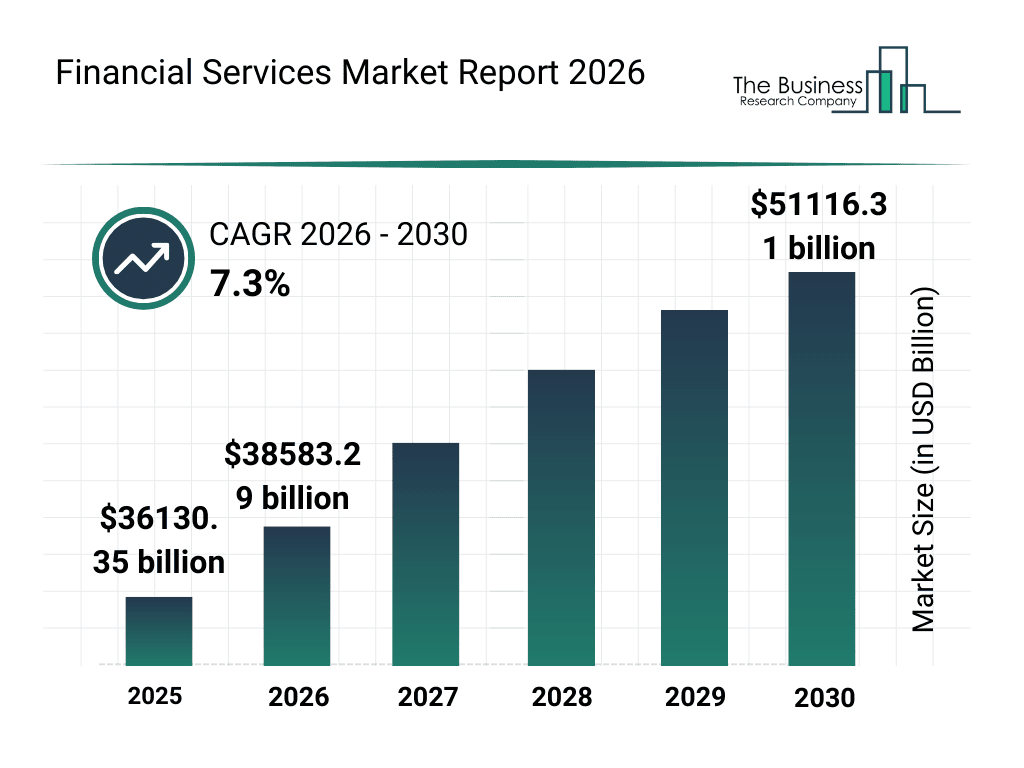
- The global financial services market was worth about $36,130.35 billion in 2025.
- The market is expected to grow to around $38,583.29 billion in 2026.
- Experts forecast a strong growth trend with a 7.3% CAGR from 2026 to 2030.
- At this pace, the market could reach roughly $51,116.31 billion by 2030.
- This means the industry may add nearly $15 trillion in value within five years.
- Rising demand for digital banking, fintech, and investment services drives this growth.
- The steady increase shows strong confidence in the global financial system.
 (Reference: The Business Research Company)
Top Areas of AI Deployment in the Banking Sector
- 82% of banks now use AI for external communications, including marketing, social media, and public relations.
- 78% have deployed AI in marketing and sales operations to optimize outreach and conversion strategies.
- 75% of institutions apply AI to enhance customer interaction via chatbots and automated service systems.
- 70% use AI for security and fraud detection, strengthening real‑time threat monitoring.
- 68% leverage AI for HR and workforce management, supporting recruitment, scheduling, and performance analytics.
- 63% report AI‑led operational improvements that streamline workflows and backend systems.
- 51% deploy AI for monitoring through external devices or systems to support smarter infrastructure and data gathering.
- 35% have integrated AI in production‑floor facilities, signaling the gradual automation of core processing areas.
- 29% use AI for fleet or mobile facility management to improve asset tracking and logistics.
- 22% apply AI to expedite transactions, highlighting ongoing gaps in speed‑optimization adoption.
- 19% deploy AI in logistics and support chains, reflecting emerging potential in backend operations.
How Cost Management Leaders Use Technology to Cut Expenses
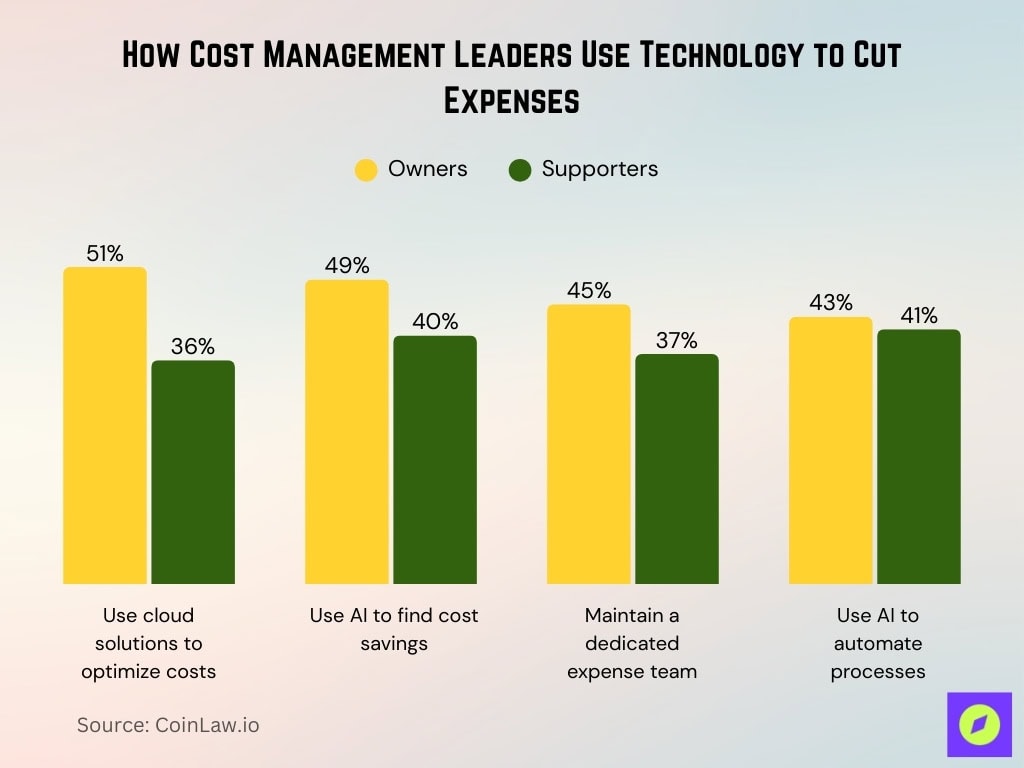
- 51% of cost management owners use cloud solutions to optimize costs, compared with 36% of supporters.
- Nearly 49% of owners use AI to find cost-saving opportunities, while 40% of supporters follow this approach.
- About 45% of owners maintain a dedicated expense management team, versus 37% of supporters.
- Around 43% of owners use AI to automate processes and reduce costs, slightly higher than 41% of supporters.
- In every category, owners adopt cost-control tools more often than those in supporting roles.
- The biggest gap appears in cloud adoption, where owners lead by 15 percentage points.
- The smallest gap occurs in AI automation, with only a 2-point difference between the two groups.
- The findings come from a survey of 1,326 respondents, including 477 owners and 849 supporters.
 (Reference: WSJ)
Consumer Finance
- Credit card debt rose to $1.32 trillion, hitting a new all-time high.
- The U.S. personal saving rate averaged 4.1%, reflecting weaker household reserves.
- Mortgage debt climbed to $13.28 trillion, maintaining dominance in total liabilities.
- Student loan debt reached $1.69 trillion, with delinquency rates nearing 9%.
- Auto loan balances totaled $1.68 trillion, up 5.4% year over year.
- About 19% of Americans aged 50+ still have no retirement savings.
- Average household credit utilization hit 31%, up from last year’s 29%.
- Consumer loan delinquencies increased to 3.2%, signaling rising financial strain.
Corporate Finance
- U.S. corporations will face $680 billion in maturing debt, creating significant refinancing pressure.
- Investors have pushed average U.S. corporate bond yields to around 4.8%, reflecting strong demand.
- Roughly 60% of large companies now allocate over 2% of revenue to sustainability-linked initiatives.
- Global M&A activity will remain above $3.0 trillion for the year, driven by large cross-sector transactions.
- Private equity firms will complete more than $1.2 trillion in deals in 2026, signaling a rebound in sponsor-driven activity.
Where Finance Professionals Work: Company Size Breakdown
- 27% of finance professionals work at enterprises with more than 10,000 employees.
- 25% work for companies with 1,000 to 10,000 employees.
- 21% work at firms with 100 to 500 employees.
- 14% work for companies with 50 to 100 employees.
- 7% work at firms with fewer than 50 employees.
- 6% work for companies with 500 to 1,000 employees.
Financial Services Industry Regulations
- Over 85% of financial institutions report that financial‑crime compliance and AML/CFT controls are top‑priority regulatory drivers.
- More than 96% of financial firms allocate over 5% of their total budget to IT, cybersecurity, and compliance functions.
- Regulatory‑driven cybersecurity and compliance budgets have risen by roughly 10–20% year‑on‑year at many large institutions.
- ESG and climate‑related disclosure rules now cover over 100 countries, with binding frameworks applying to most large listed firms.
- Compliance‑related fines and penalties in major markets have climbed by about 15% compared with the prior year.
- Around 45% of FinTech firms globally now operate under bank‑like capital, conduct, and consumer‑protection rules.
Stock Market and Securities Data
- Global stock market capitalization is projected to reach about $154 trillion, reflecting continued equity‑market expansion.
- U.S.‑listed ETFs have already drawn around $156 billion in net inflows in January alone, signaling strong demand at the start of the year.
- Long‑term U.S. mutual fund and ETF assets now exceed $19.2 trillion, with indexed products making up the majority.
- Retail investors are on track to contribute roughly $600 billion in equity purchases over the full year.
- Individual investors account for about 40% of daily trading volume in major U.S. equity markets.
- Around 42% of U.S. individual investors report a bullish view on equities heading into the year.
- Global equity index returns are expected to average around 8–10% annually through the year across developed markets.
Top Financial Challenges Faced by Businesses
- Around 34% of businesses now report rising operational costs and expenses as a primary constraint.
- Roughly 33% face irregular or unpredictable income streams, complicating cash‑flow planning.
- About 32% struggle with managing day‑to‑day financial operations, including bookkeeping and reporting.
- Nearly 30% indicate that a lack of dependable funding sources undermines financial stability.
- Approximately 28% cite restricted access to credit, loans, or other financing tools.
- Roughly 22% of firms highlight currency or interest‑rate volatility as a growing financial risk.
- About 18% point to tax‑compliance complexity and regulatory changes as a top‑tier financial challenge.
Employment in the Financial Services Industry
- Roughly 6.8 million people are now employed in the U.S. financial services sector, reflecting continued labor‑market strength.
- The finance and insurance segment has added about 9,200 new roles year‑to‑date, surpassing last year’s hiring levels.
- Financial activities employment is expanding at an estimated 3.9% annual rate.
- The average annual salary for finance professionals is now around $98,000.
- FinTech roles command an average annual pay of approximately $127,000.
- The median salary for financial analysts has risen to about $104,000.
- Technology‑related positions within finance now account for roughly 24% of new hires in the sector.
Frequently Asked Questions (FAQs)
The top 10 U.S. stocks represent nearly 25% of the global equity market cap, worth close to $25 trillion.
The global hedge fund market is projected to reach about $5,252 billion in 2026, growing at a 4.2% CAGR thereafter.
Operating spending on compliance has risen by over 60% for large banks compared with pre‑financial‑crisis levels.
The global factoring market is expected to be worth around $4,723 billion in 2026, growing at a 6.4% CAGR.
Conclusion
Today, the finance industry reveals a sector deeply influenced by technology, regulatory shifts, and evolving consumer behaviors. From FinTech innovations reshaping banking to corporate finance trends driving new growth metrics, each segment adapts to global economic conditions and market demands.
The rise of digital and decentralized solutions is poised to disrupt traditional financial models further, offering both challenges and unprecedented opportunities. For stakeholders in finance, staying abreast of these developments is essential for informed decision-making and long-term success in an increasingly complex environment.
The post Finance Industry Statistics 2026: Powerful Insights appeared first on CoinLaw.
You May Also Like

Comcast’s Versant reports declining annual profit as it prepares to go public

Time Traveler: Those Who Bought XRP Early Will Become the New Rich