

Ethereum Outlines 2026 Glamsterdam Hardfork, ETH Still Below $2K
The post Ethereum Outlines 2026 Glamsterdam Hardfork, ETH Still Below $2K appeared first on Coinpedia Fintech News
Ethereum creator and co-founder Vitalik Buterin has outlined 8 Ethereum Improvement Proposals (EIPs) that comprise the upcoming Glamsterdam hardfork scheduled for the first half of 2026.
Ethereum: 2026 Glamsterdam hardfork
The proposals follow Ethereum’s three-track roadmap enshrined in its 2025 “predictable engineering delivery model” and comprising:
- Scalability.
- Improved user experience.
- Heightened security, censorship-resistance, and quantum-resistance.
More specifically, block building will now take place directly on Ethereum rather than external relays. This increases decentralization and transaction verification time for validators.
Additionally, the upgrade will pave the way for parallel block verification, effectively increasing the network’s transaction processing speed. Users will also enjoy a 78.6% reduction in gas fees for both simple and complex smart contracts, and the ability to run nodes at a lower bandwidth.
Developers, on the other hand, would be financially incentivized to write leaner code on the network’s database, aka “The State.” They would also experience fewer memory-related errors during code compilation and fewer smart contract security risks.
Recent ETH developments and price action
Soon after the Glamsterdam hardfork, the Ethereum community will begin work on the Hegotá hardfork, with motivation coming from the timely completion of last year’s Pectra and Fusaka hardforks. So far, the Ethereum Foundation’s DevOps has already tested 3 EIPS on Devnet-4, with a transition to Devnet-5 being the current focus.
Before today’s announcement, Ethereum released a roadmap that would make it scalable and quantum-proof. The network also recently increased decentralization through the DeFipunk initiative, which seeks to reinstate DeFi’s original purpose.
Institutionally, spot Ethereum ETFs saw $157.14 million in inflows on February 25, breaking a five-week streak of outflows.
Several publicly traded companies have also incorporated Ethereum as their primary treasury reserve asset. BitMine Immersion Technologies (BMNR) is currently the largest holder with a record 4.42 million ETH in its treasury.
To support institutional adoption, the Enterprise Ethereum Alliance (EEA) is exploring enterprise-grade financial confidentiality while maintaining regulatory compliance.
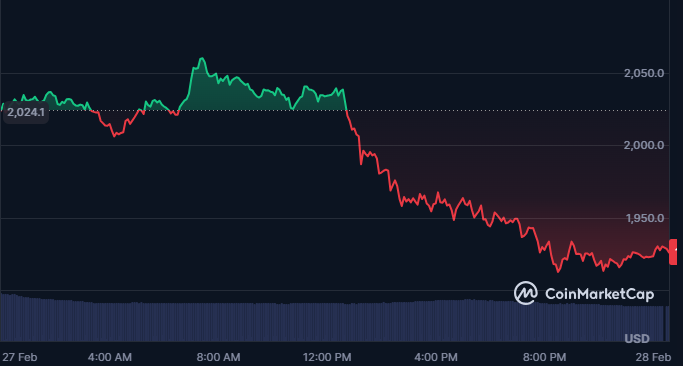
At press time, ETH was trading at $1,919 after failing to remain above the $2K mark, with macroeconomic and technical indicators showing bearish momentum.
Source: CoinMarketCap
You May Also Like

BitGo wins BaFIN nod to offer regulated crypto trading in Europe
BitGo’s move creates further competition in a burgeoning European crypto market that is expected to generate $26 billion revenue this year, according to one estimate. BitGo, a digital asset infrastructure company with more than $100 billion in assets under custody, has received an extension of its license from Germany’s Federal Financial Supervisory Authority (BaFin), enabling it to offer crypto services to European investors. The company said its local subsidiary, BitGo Europe, can now provide custody, staking, transfer, and trading services. Institutional clients will also have access to an over-the-counter (OTC) trading desk and multiple liquidity venues.The extension builds on BitGo’s previous Markets-in-Crypto-Assets (MiCA) license, also issued by BaFIN, and adds trading to the existing custody, transfer and staking services. BitGo acquired its initial MiCA license in May 2025, which allowed it to offer certain services to traditional institutions and crypto native companies in the European Union.Read more
Pepeto After Market Correction: 10,000% Forecast Dwarfs Solana, Cardano, and Ripple Potential
