Key Takeaways: Holešky, Ethereum’s biggest testnet, will be decommissioned two weeks after the Fusaka upgrade finalizes in September 2025. Hoodi will fully replace Holešky as the new validator-focused testnet, designed The post Ethereum to Shut Down Holešky, Its Largest Testnet Ever appeared first on CryptoNinjas.Key Takeaways: Holešky, Ethereum’s biggest testnet, will be decommissioned two weeks after the Fusaka upgrade finalizes in September 2025. Hoodi will fully replace Holešky as the new validator-focused testnet, designed The post Ethereum to Shut Down Holešky, Its Largest Testnet Ever appeared first on CryptoNinjas.

Ethereum to Shut Down Holešky, Its Largest Testnet Ever

Key Takeaways:

  • Holešky, Ethereum’s biggest testnet, will be decommissioned two weeks after the Fusaka upgrade finalizes in September 2025.
  • Hoodi will fully replace Holešky as the new validator-focused testnet, designed to avoid the technical issues that plagued its predecessor.
  • Ethereum now runs 3 specialized testnets: Sepolia (for dApps), Hoodi (for staking), and Ephemery (for short validator cycles).

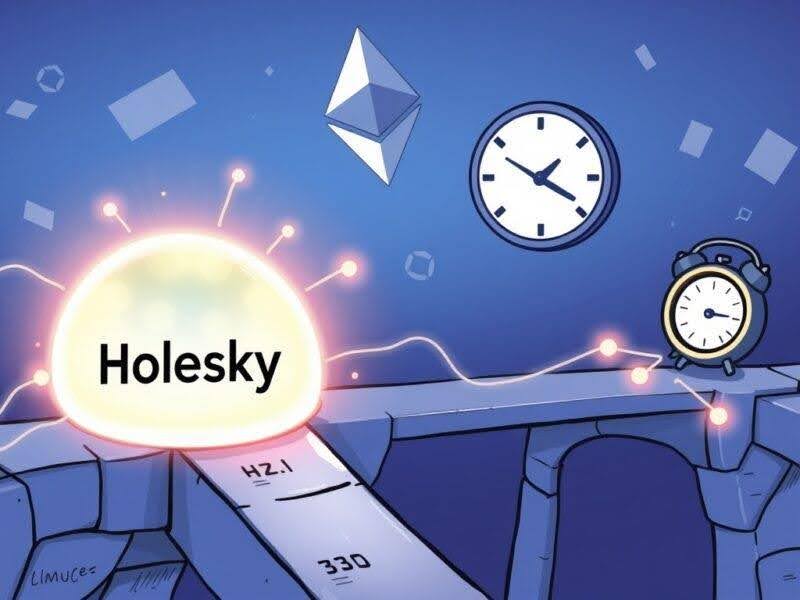
Ethereum is officially sunsetting its most ambitious Testnet, Holešky, marking a pivotal transition in its testing infrastructure. After nearly two years of enabling critical upgrades and scaling experiments, Holešky is being phased out in favor of more modular and specialized networks.
holesky-testnet

Holešky Was a Giant but Its Time Is Over

The End of a Critical Era

Launched in September 2023, Holešky was Ethereum’s largest public Testnet ever, purpose-built to simulate real-world staking conditions at massive scale. At its peak, it hosted over 1.6 million validators, dwarfing previous testnets like Goerli and Ropsten.

Holešky was particularly involved in testing upgrades including:

  • Dencun: Aimed at reducing transaction costs via EIP-4844 (Proto-Danksharding)
  • Pectra: Optimized validator performance and introduced partial withdrawal mechanisms

The same scale which had made Holešky so impressive turned, however, also against it.

Read More: Ethereum Rally Extends, With Solana and Emerging Projects Following

Why Holešky Had to Be Retired

Inactivity Leaks and Validator Exit Bottlenecks

In early 2025, Holešky began showing signs of stress. After the activation of the Pectra upgrade, a wave of inactivity leaks hit the network. Thousands of validators went offline, creating a massive exit queue that took weeks to process.

This resulted in:

  • Slow validator churn, making it unviable to test full validator lifecycle within any practical timeline.
  • Infrastructure fatigue, as developers struggled to simulate dynamic network behavior.

Even after technical recovery, the network had turned into an operating bottleneck. It was no longer able to deliver the testing agility necessary to support the fast-paced Ethereum roadmap.

Enter Hoodi: The Next-Gen Validator Testnet

Born from Holešky’s Shortcomings

Ethereum published Hoodi in March 2025 as an effort to correct the deficiencies of Holešky. It features:

  • A fresh validator set, solving the legacy exit queue issue
  • Built-in support for Pectra and upcoming upgrades, including the Fusaka fork
  • A more resilient architecture for long-term staking simulations

Hoodi is created on a merged-from-genesis model that has a more maintainable infrastructure and fewer historical bugs.

Chainstack and Infura, and other large infra providers, already moved their tooling to use Hoodi.

Ethereum’s New Testnet Landscape

Ethereum is now running a smaller set of three testnets that are optimized to fulfill specific functions:

TestnetPurpose
SepoliaSmart contract & dApp development
HoodiValidator & staking infrastructure testing
EphemeryLightweight, reset-every-28-days validator lifecycle testing

This segmentation improves reliability and ensures that testnets align with developer needs, instead of trying to serve all purposes with a single network.

Fusaka Fork Sets the Final Deadline

The Fusaka upgrade, Ethereum’s next major hard fork is slated to activate on Holešky in mid-to-late September 2025. Two weeks after it finalizes, all remaining validator nodes on Holešky will be shut down.

After this, “Holešky will no longer be supported by client, testing or infrastructure teams,” said the Ethereum Foundation in a blog post.

Fusaka introduces several enhancements including:

  • Improved data availability for rollups
  • Distributed validator load
  • Lower transaction latency and better scalability

It comprises 11 Ethereum Improvement Proposals (EIPs) and is the catalyst to the next stage of Ethereum growth.

ethereum-image

What’s Next for Ethereum Testnets?

Holešky closure is not only a closure, but it represents the overall Ethereum strategy of evolution. In 2025 and further, it becomes clear:

  • Streamlined, modular Testnets
  • Faster iteration cycles
  • Cleaner infrastructure

Looking forward Ethereum is targeting the Glamsterdam upgrade in 2026 which proposes to:

  • Halve block time from 12s → 6s
  • Separate block validation from execution
  • Improve support for ZK-EVM systems

These moves are aimed squarely at improving user experience and scalability, especially for rollups – a critical component of Ethereum’s layer-2 ecosystem.

Read More: $291 Million Pulled from Bitcoin, Ethereum ETFs as Inflation Spikes Under Trump Tariffs

Ethereum Rallies Amid Infra Shakeup

At the point of writing, ETH trades at approximately $4,395 and continues its recent streak, occasioned by ETF enthusiasm and growth in institutional buying.

  • Multiple publicly traded firms have added ETH to their treasuries
  • The crypto community views Ethereum’s infrastructure shakeup as a maturity signal, rather than a risk

With Holešky’s chapter closing, Ethereum is entering a phase of precision engineering, replacing “big and bulky” with lean and purpose-built.

The post Ethereum to Shut Down Holešky, Its Largest Testnet Ever appeared first on CryptoNinjas.

Market Opportunity
Everscale Logo
Everscale Price(EVER)
$0.00977
$0.00977$0.00977
+2.95%
USD
Everscale (EVER) Live Price Chart
Disclaimer: The articles reposted on this site are sourced from public platforms and are provided for informational purposes only. They do not necessarily reflect the views of MEXC. All rights remain with the original authors. If you believe any content infringes on third-party rights, please contact service@support.mexc.com for removal. MEXC makes no guarantees regarding the accuracy, completeness, or timeliness of the content and is not responsible for any actions taken based on the information provided. The content does not constitute financial, legal, or other professional advice, nor should it be considered a recommendation or endorsement by MEXC.

You May Also Like

A Netflix ‘KPop Demon Hunters’ Short Film Has Been Rated For Release

A Netflix ‘KPop Demon Hunters’ Short Film Has Been Rated For Release

The post A Netflix ‘KPop Demon Hunters’ Short Film Has Been Rated For Release appeared on BitcoinEthereumNews.com. KPop Demon Hunters Netflix Everyone has wondered what may be the next step for KPop Demon Hunters as an IP, given its record-breaking success on Netflix. Now, the answer may be something exactly no one predicted. According to a new filing with the MPA, something called Debut: A KPop Demon Hunters Story has been rated PG by the ratings body. It’s listed alongside some other films, and this is obviously something that has not been publicly announced. A short film could be well, very short, a few minutes, and likely no more than ten. Even that might be pushing it. Using say, Pixar shorts as a reference, most are between 4 and 8 minutes. The original movie is an hour and 36 minutes. The “Debut” in the title indicates some sort of flashback, perhaps to when HUNTR/X first arrived on the scene before they blew up. Previously, director Maggie Kang has commented about how there were more backstory components that were supposed to be in the film that were cut, but hinted those could be explored in a sequel. But perhaps some may be put into a short here. I very much doubt those scenes were fully produced and simply cut, but perhaps they were finished up for this short film here. When would Debut: KPop Demon Hunters theoretically arrive? I’m not sure the other films on the list are much help. Dead of Winter is out in less than two weeks. Mother Mary does not have a release date. Ne Zha 2 came out earlier this year. I’ve only seen news stories saying The Perfect Gamble was supposed to come out in Q1 2025, but I’ve seen no evidence that it actually has. KPop Demon Hunters Netflix It could be sooner rather than later as Netflix looks to capitalize…
Share
BitcoinEthereumNews2025/09/18 02:23
Bitmine Immersion Technologies (BMNR) stock :soars 5% as $13.4B Crypto Treasury Propels Ethereum Supercycle Vision

Bitmine Immersion Technologies (BMNR) stock :soars 5% as $13.4B Crypto Treasury Propels Ethereum Supercycle Vision

TLDR Bitmine surges 5.18% as $13.4B ETH treasury cements crypto dominance. Bitmine’s $12.6B Ethereum trove fuels bold 5% market ownership goal. Bitmine rebounds strong—ETH hoard drives record treasury valuation. Bitmine’s ETH empire grows to 3M coins, powering stock’s sharp rally. With record ETH and cash reserves, Bitmine solidifies crypto supremacy. Bitmine Immersion Technologies closed 5.18% [...] The post Bitmine Immersion Technologies (BMNR) stock :soars 5% as $13.4B Crypto Treasury Propels Ethereum Supercycle Vision appeared first on CoinCentral.
Share
Coincentral2025/10/14 02:40
Headwind Helps Best Wallet Token

Headwind Helps Best Wallet Token

The post Headwind Helps Best Wallet Token appeared on BitcoinEthereumNews.com. Google has announced the launch of a new open-source protocol called Agent Payments Protocol (AP2) in partnership with Coinbase, the Ethereum Foundation, and 60 other organizations. This allows AI agents to make payments on behalf of users using various methods such as real-time bank transfers, credit and debit cards, and, most importantly, stablecoins. Let’s explore in detail what this could mean for the broader cryptocurrency markets, and also highlight a presale crypto (Best Wallet Token) that could explode as a result of this development. Google’s Push for Stablecoins Agent Payments Protocol (AP2) uses digital contracts known as ‘Intent Mandates’ and ‘Verifiable Credentials’ to ensure that AI agents undertake only those payments authorized by the user. Mandates, by the way, are cryptographically signed, tamper-proof digital contracts that act as verifiable proof of a user’s instruction. For example, let’s say you instruct an AI agent to never spend more than $200 in a single transaction. This instruction is written into an Intent Mandate, which serves as a digital contract. Now, whenever the AI agent tries to make a payment, it must present this mandate as proof of authorization, which will then be verified via the AP2 protocol. Alongside this, Google has also launched the A2A x402 extension to accelerate support for the Web3 ecosystem. This production-ready solution enables agent-based crypto payments and will help reshape the growth of cryptocurrency integration within the AP2 protocol. Google’s inclusion of stablecoins in AP2 is a massive vote of confidence in dollar-pegged cryptocurrencies and a huge step toward making them a mainstream payment option. This widens stablecoin usage beyond trading and speculation, positioning them at the center of the consumption economy. The recent enactment of the GENIUS Act in the U.S. gives stablecoins more structure and legal support. Imagine paying for things like data crawls, per-task…
Share
BitcoinEthereumNews2025/09/18 01:27