

Vitalik Buterin Says AI Could Supercharge Ethereum Development Toward 2030

Key Insights:
- Vitalik Buterin says AI drafted Ethereum’s 2030 roadmap in two weeks, cutting years from planning.
- Hegota upgrade targets account abstraction via EIP-8141, separating approval and execution frames.
- Ethereum price trades near $1,988 as volatile spot flows show $3B inflows and $6B outflows.
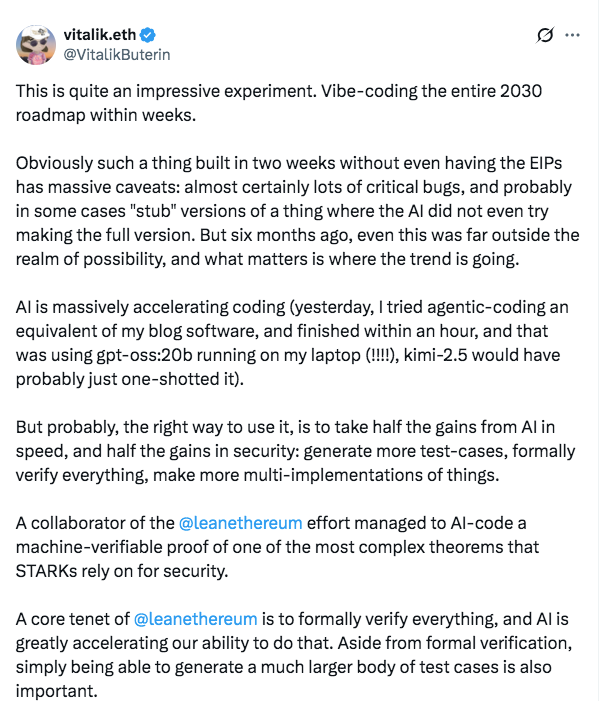
Vitalik Buterin disclosed that artificial intelligence helped draft Ethereum’s 2030 roadmap in just two weeks. He described the experiment as “impressive” in a post on X. According to him, the same process would normally take years without AI assistance.
He explained that AI greatly accelerates coding. However, he cautioned that sudden development can introduce weaknesses if not reviewed through Ethereum Improvement Proposals.
Some features, he noted, may remain incomplete stubs without proper evaluation.
Vitalik Buterin on AI-Driven Ethereum Development
Vitalik Buterin said he tested agentic coding on his blog software and completed the task within an hour.
He used the example to show how AI compresses development timelines. At the same time, he stressed that speed must not replace security.
 Vitalik Buterin on AI & Ethereum Development | Source: X
He stated that AI can assist with formal verification and generate far more test cases. That process strengthens code review and testing standards. Nevertheless, developers must still address bugs and inconsistencies manually.
He wrote that observers should remain open to the possibility that Ethereum’s roadmap could conclude faster than expected. He added that it might also reach a higher security standard. Still, he emphasized that possibility does not guarantee certainty.
Vitalik Buterin also discussed the concept of error-free software. He said such software remains essential for trustless systems. Yet he clarified that total security cannot exist because code cannot perfectly reflect every detail in a developer’s mind.
His comments came as Ethereum price remains below its 2025 high. The asset trades 60% lower than that peak. Some analysts have warned that Ethereum price could fall below the $2,000 support level this month.
Vitalik Buterin on Account Abstraction
In addition, Vitalik Buterin confirmed plans to introduce account abstraction in the Hegota upgrade within a year. He recalled that discussions around the idea began in 2016. He said EIP-8141 aims to resolve the remaining technical issues.
According to Vitalik Buterin, deployment is scheduled for this year. He noted that developers have worked on the concept for more than a decade. He described the core framework as simple and broadly functional.
The upgrade will rely on frame transactions. Smart accounts will separate signature approval from transaction execution into two frames. Furthermore, users may pay gas fees in alternative tokens through paymaster contracts or automated decentralized exchanges.
Buterin reiterated that minimizing intermediaries remains a guiding principle. He said privacy platforms such as Railgun and Tornado Cash could replace public broadcasters. He described broadcasters as a source of user experience friction.
He added that the new framework can apply to existing Ethereum accounts. As a result, users could execute batch transactions and enable sponsored fees under the same structure.
In a separate post, Vitalik Buterin outlined a roadmap to strengthen Ethereum against quantum threats. He identified validator signatures, data storage, account signatures, and zero-knowledge proofs as key focus areas. Over time, he expects gradual reductions in slot and finality times.
Ethereum Price and Market Activity
At the time of writing, the Ethereum (ETH) price had declined by 5.82% to $1,987.56. The market capitalization reached approximately $239.88 billion, up 5.81% from the previous day.
 Ethereum Price Action | Source: CoinMarketCap
However, the trading volume increased to $23.15 billion, an increase of 8.76% in the same period. The volume-to-market cap ratio was 9.68%, indicating stable liquidity amid the Vitalik Buterin update.
Meanwhile, volatile spot market flows occurred. Inflows were often in excess of $3 billion at peak times, and outflows were at times near $6 billion in negative territory. Most recently, there were outflows again as the Ethereum price was around $2,000.
The post Vitalik Buterin Says AI Could Supercharge Ethereum Development Toward 2030 appeared first on The Coin Republic.


You May Also Like
![[OPINION] US Pax Silica initiative: Good or bad?](https://www.rappler.com/tachyon/2024/10/tech-stocks-october-31-2024.jpg?resize=75%2C75&crop=408px%2C0px%2C1080px%2C1080px)
[OPINION] US Pax Silica initiative: Good or bad?

ChainAware and MelosClaw Advance AI in Web3 Growth




