

Price vs. Plumbing: Why Ethereum’s February Crash Collided With A Record Surge In Cold-Storage Migration
Ethereum is attempting to regain the $2,000 level as the broader crypto market shows early signs of relief after weeks of persistent volatility. The recent stabilization in price action has helped ease short-term selling pressure, allowing ETH to approach a key psychological and technical threshold that could influence market sentiment in the coming weeks. While the recovery remains tentative, on-chain data suggests that structural changes in supply dynamics may be developing beneath the surface.
According to data from CryptoQuant, the total amount of Ethereum withdrawn from exchanges in February reached approximately 31.6 million ETH. This represents the highest level of exchange outflows recorded since last November and marks a notable shift in how investors are positioning their holdings.
Large-scale withdrawals from centralized exchanges often indicate that market participants are moving assets into cold storage or alternative custody solutions, typically associated with longer-term holding strategies. When coins leave exchange reserves, the immediately available supply for trading declines, which can gradually tighten liquidity conditions across the market.
The magnitude of February’s withdrawals, therefore, suggests a broader behavioral shift among investors. Rather than maintaining readily tradable balances on exchanges, a growing portion of the ETH supply appears to be moving off-platform, potentially reducing short-term selling pressure as Ethereum attempts to reclaim the $2,000 level.
Binance Leads Massive Outflows as Exchange Supply Tightens
The report further highlights that the majority of February’s exchange withdrawals were concentrated on the largest trading platforms. Binance recorded the most significant outflow, with approximately 14.45 million ETH leaving the exchange during the month. This represents nearly half of the total withdrawals and confirms that activity is heavily centered on the platform that holds the deepest liquidity in the Ethereum market. Such concentration is common during periods of structural shifts, as large investors typically move assets through the exchanges that can handle substantial transaction volumes.

OKX ranked second in terms of withdrawals, with around 3.83 million ETH leaving the platform. This indicates that the trend was not isolated to a single venue but reflected broader investor activity across major exchanges. Kraken followed in third place, recording approximately 1.04 million ETH in withdrawals and securing a position among the top platforms by outflow volume during this period.
The aggregate figure—exceeding 31 million ETH—represents a notable signal within Ethereum’s supply dynamics. Rising exchange outflows are often interpreted as coins being transferred into cold storage or private custody solutions, which reduces the amount of ETH immediately available for trading.
When such movements occur near sensitive price levels, they can signal strengthening holding conviction or strategic portfolio repositioning. If withdrawals persist, exchange liquidity could tighten further in the months ahead.
Ethereum Tests Key Resistance
Ethereum’s 4-hour chart shows the asset attempting to regain upward momentum after a prolonged period of consolidation and volatile price swings. At the time of the chart, ETH is trading around $2,050, pushing slightly above the $2,000 psychological level that has acted as a key pivot throughout recent market activity.
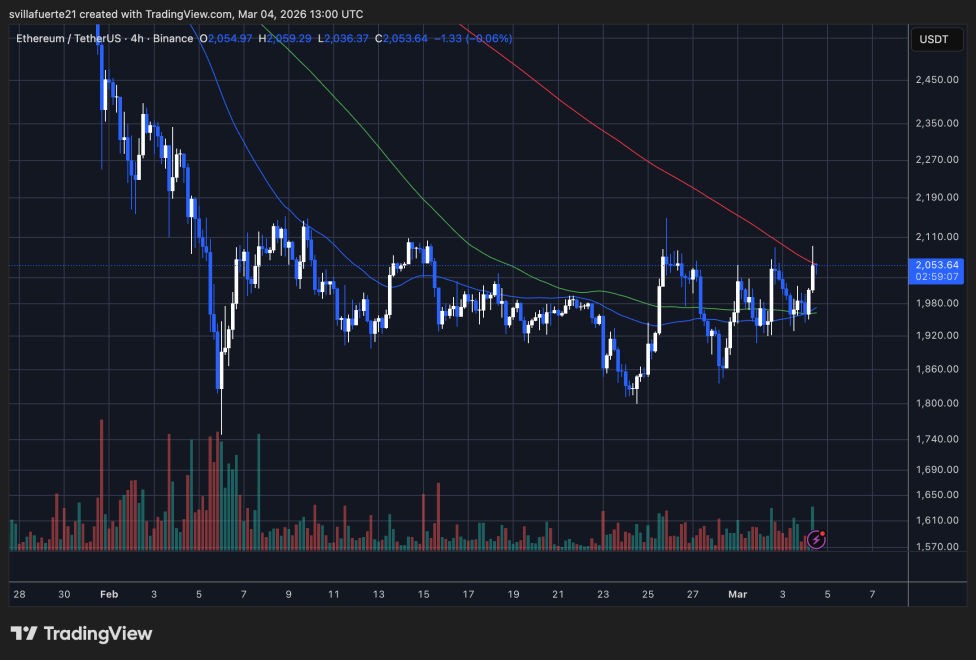
Price structure suggests that Ethereum has been forming a broad range between roughly $1,850 and $2,100 since mid-February. Within this range, multiple rebounds from the $1,850–$1,900 zone highlight the presence of buyers defending lower levels, while repeated rejections near the $2,100 region confirm that sellers remain active at higher prices.
From a technical perspective, ETH has recently reclaimed the short-term moving averages, including the 50-period and 100-period lines, which now sit just below the current price. This development indicates that short-term momentum has begun to shift in favor of buyers after several weeks of downward pressure.
However, the 200-period moving average remains above the market, acting as a dynamic resistance level near the current price zone. For Ethereum to confirm a stronger recovery phase, bulls would likely need to secure a decisive break and consolidation above this level.
If ETH can maintain support above $2,000, the next technical target could emerge near $2,150. Conversely, losing the level may reopen downside toward the $1,900 support area.
Featured image from ChatGPT, chart from TradingView.com


You May Also Like

WLFI co-founder Zach Witkoff under spotlight after 2022 drug arrest video surfaces

TSAM London: Clearwater Analytics on Why a Clear Data Strategy is the Foundation for Financial Firms




