The treacherous road to The Hague for the victims, their lawyers, and advocates
THE HAGUE, Netherlands – “What if this immigration officer is a Duterte supporter?” Sheerah Escudero thought to herself while passing through a security check at the Ninoy Aquino International Airport (NAIA) in Manila.
It was her first time to visit The Hague, specifically to attend the confirmation of charges hearing against former Philippine president Rodrigo Duterte. Escudero’s brother Ephraim was killed in 2017 in the name of the war on drugs. He was found with his head wrapped in packaging tape, and his hands bound. He was 18.
Escudero’s group Rise Up had raised funds for the non-refundable Schengen visa fee worth around 130 euros each, add to that the flight tickets and other expenses. She could not afford to stumble at this part. Philippine immigration officers are not known for being accommodating to first-time travelers.
“Are you attending the hearing as an observer?” asked the officer. “Yes, as a victim,” Escudero said.
“Dun po medyo nakaka-anxious siya in a sense na what if this immigration officer is a Duterte supporter and he’s just testing me. After I answered, he stamped my passport,” Escudero said.
(That’s the anxious part in a sense that what if this immigration officer is a Duterte supporter and he’s just testing me? After I answered, he stamped my passport.)
 (L-R) Kristina Conti, lawyer; Rubilyn Litao, coordinator; Sheerah Escudero, victim; and Llore Pasco, victim, during their group Rise Up’s mini press conference outside the ICC on Day 3 of the confirmation of charges hearing. Photo by Lian Buan/Rappler
‘We were just doing the work’
Joel Butuyan, the victims’ court-appointed legal representative, referred to this in his opening statement on Day 1 of the hearings. He said he and other lawyers were walking “like fugitives” in The Hague, out of fear of the “mini-Dutertes.”
I saw that anxiety first-hand. Nicolene Arcaina, the court-appointed case manager, was visibly nervous every time a Filipino greeted us. It’s common abroad that when you hear someone speaking your language, you greet. In The Hague this time, that greeting could be loaded.
Arcaina told me my question was difficult to answer, and so we walked around until she figured it out. My question was, “What does this mean to you?” While she thought over it, we talked about the past ten years. She didn’t have difficulty speaking about that.
She spoke about one case where a prosecutor signed, without much reading, the inquest papers of her client, although the client had been in custody longer than the prescribed 36 hours. She pleaded the prosecutor, who in turn explained that they did not want to get in the crosshairs of the police.
“That’s an example of someone who did not do their job,” Arcaina said. Prosecutors being submissive to the police was an open secret during Duterte’s war on drugs. Lawyers knew it, even journalists covering human rights knew it. Jesus Crispin “Boying” Remulla finally said it on record last year when he was justice secretary. “Hindi ho talaga maimbestigahan nang maayos kasi pati piskal tinatakot ng pulis ‘nung mga panahong ‘yun,” he said at a Senate hearing March last year. (Those cases really could be investigated because even fiscals were threatened by the cops back then.)
So, for Arcaina, reaching this stage at the ICC was unimaginable for someone whose only goal was do her job.
“At that point, what we just wanted to do was to do the work. And it didn’t matter where that work will, at least at that time, where that will bring us because all the odds were against us. And all that was within our control was the work that we can do,” said Arcaina.
 (L-R) Gilbert Andres, counsel; Nicolene Arcaina, case manager; and Joel Butuyan, counsel’ of the Common Legal Representatives for Victims (CLRVs) team. Photo courtesy of the Center for International Law
10 years’ worth
Arcaina’s first case was Efren Murillo, the survivor of a police operation in a dumpsite. Murillo played dead as cops killed four of his friends, and he took his injured body down a ravine to a road. Arcaina was fresh out of law school, but Butuyan needed all hands on deck. (Arcaina worked in Butuyan’s Center for International Law before becoming executive director of the Ateneo Human Rights Center, her current role.)
Arcaina then remembered that while Murillo was her first case, her first assignment was to sing and pray at a funeral in San Andres Bukid, a dense community in the Philippine capital Manila which had 35 of their residents killed in only 13 months.
A pattern emerged, according to CenterLaw – killings happened from 10 pm to 3 am, CCTVs suddenly not working on those time frames. While the victims were killed by masked vigilantes, uniformed police were always in the vicinity pointing their flashlights in homes and telling them not to look.
Those cases are attached to the two petitions still pending before the Supreme Court (SC) asking to declare the drug war unconstitutional.
Arcaina now has to transform her lawyering, from singing at funerals with drug war victims, to the plain walls and corporate-like vibe of the ICC. As case manager, Arcaina had to quickly learn the ICC’s software in organizing evidence. When lead defense counsel Nicholas Kaufman mentioned that SC case, trying to use it in Duterte’s favor, Arcaina said she knew where to look in the files for the rebuttal the next day of CenterLaw’s Gilbert Andres.
Kaufman said that if the Supreme Court has not decided on those petitions, and therefore has not answered whether “neutralize” really meant to kill, then “the Supreme Court’s treatment of the issue is particularly instructive.”
Andres’ rebuttal: “The same Supreme Court… referenced by the defense… said in a notice of resolution dated April 3, 2018 that ‘the government’s inclusion of these deaths among its other accomplishments may lead to the inference that these are state-sponsored killings.”
Kaufman is still trying to disqualify Butuyan, Andres and Arcaina for alleged impediment to representation, particularly to the rule prohibiting people to be legal counsels if they can also be potentially interviewed as a witness. Kaufman also earlier told Rappler it was better for Paolina Massidda, the foreign lawyer of ICC’s Office of the Public Counsel for Victims (OPCV), to take on the role because the Filipino lawyers have only been exposed to the evidence recently.
“Compared to him, we’ve been handling these victims since 2016. So, it’s now 10 years. We experienced the whole drug war period. So, between the two of us, I think there’s no contest that I know better,” said Butuyan.
Only ICC accredited lawyers are allowed to be counsels before the court. Butuyan and Andres were accredited long before. Former presidential spokesperson of Duterte, Harry Roque, is also accredited, but he has so far failed to be on the Duterte defense team.
 Joel Butuyan and his co-counsel, and wife, Tin Antonio, during the Supreme Court oral arguments on petitions seeking to declare the drug war unconstitutional in November 2017. File photo by Lian Buan/Rappler
‘They were seriously listening’
The first known communication to the ICC was in April 2017 from Jude Sabio, who, before his change of heart after a falling out with former senator Antonio Trillanes IV, represented Edgar Matobato, a self-confessed Davao Death Squad hitman.
For Rise Up, represented by ICC-accredited assistant to counsel Kristina “Krissy” Conti, the communication from them kept coming because somebody was “seriously listening.”
“When they replied to the email, they acknowledged a few weeks or a few days after. Medyo mabilis. May seriousness, and that’s why we started filing supplemental communications kasi kumbaga, seryoso ‘yung nakikinig sa amin,” said Conti.
(It was quite fast, there was a seriousness to it, and that’s why we started filing supplemental communications because they were seriously listening.)
Conti is a pro-bono peoples’ lawyer, so funds are a challenge to her group. When it reached a point that she had to snail mail a communication to the ICC, she was so pained by the 40 euro (around P2,700) mail fee. “I was allowed 2-8 kilograms, but I was only sending a few pages of paper. I thought, ‘maybe I could include dried mango here,'” she said during an interview outside of the ICC gates on Day 2.
When Karim Khan took over as prosecutor in February 2021, there was palpable hope among the local human rights community that he would take the case as seriously as his predecessor, Fatou Bensouda. After all, the ICC works on a voluntary funding by states parties, it is dealing with sanctions, and are closely scrutinized for their work in Ukraine, and later Palestine. Would the ICC devote much of its time to a small archipelago in Asia?
It turns out Khan did take it seriously, but partly for reasons that Kaufman had managed to disqualify him on. (The Office of the Prosecutor said Khan’s disqualification from the case has no impact. The Philippine team will now be led by deputy prosecutor Mame Mandiaye Niang.)
Khan, it turns out, had interviewed a death squad witness as a private lawyer, and helped send a communication to Bensouda. The ICC ruled that was conflict of interest.
In the week she was there, Escudero was the most attacked online. She was criticized for her clothes (she had borrowed winter clothes from human rights lawyer Sol Taule), her photo was doctored to make it seem she was carrying a luxury bag, and her relations to her brother Ephraim once again denied by pro-Duterte pages.
“Ano po bang gusto nila? Death certificate, crime scene photos, childhood pictures, birth certificate, marriage certificate ng magulang. Lahat po yun. Mayroon po kami,” said Escudero. (What do they want? Death certificate, crime scene photos, childhood pictures, birth certificate, marriage certificate of our parents? We have all of that.)
Visibly worn out and tired, and nursing a cold, Escudero said she still felt happy at the end of the week.
“I’m very excited to finally go home pagkatapos po nito at ikwento sa mga nanay kung ano yung itsura ng due process na pinagkait sa amin ng mahabang panahon,” said Escudero.
(I am very excited to finally go home after this, and tell the mothers what due process looks like, something we were deprived of for a very long time.)
‘Light at the end of the tunnel’
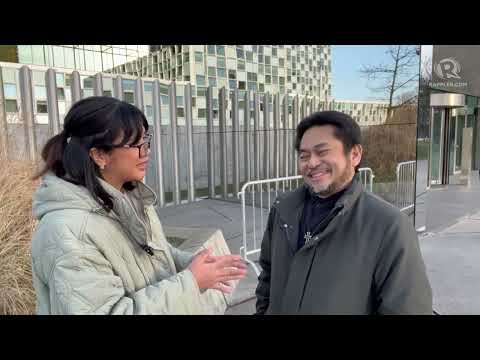
Jesuit priest Albert Alejo, who has since relocated to Rome after receiving death threats in the Philippines and being sued for sedition while advocating for justice for drug war victims, traveled to The Hague on Day 3.
Over the years, Alejo helped secure Matobato and another self-confessed hitman Arturo Lascañas as future witnesses of the ICC. “I imagine not everyone goes to priesthood thinking they’d be talking to assassins one day,” I asked Father Bert, or Paring Bert as he is most known to the human rights community. (Pari is the Filipino word for priest, but it also sounds like pare or what Filipino men call close male friends.)
“Siguro meron din akong konting mission. Yung pag-alalay. Yung walking with witnesses and whistleblowers. Para sa akin, mahalaga yun,” said Alejo.
(Maybe I also have a small mission. And that is to assist. To walk with witnesses and whistleblowers. For me, that’s important.)
Matobato and Lascañas, the priest said, have repented.
“Nakita ko, totoo ‘yung pagbabago nila Edgar Matobato. Totoo ‘yung pagbabago ni Arturo Lascañas na dalawang kapatid niya napatay nila… Itong mga taong ito mayroon ding mission. At alalay ako. Tinawag ako para umalalay sa mga taong may mission na nagbagong loob,” said Alejo.
(I saw that Edgar Matobato has truly repented. Arturo Lascañas has truly repented, two of his siblings were killed. These people have a mission. And I walk with them. I was called to walk with people who have a mission to change their ways.)
Alejo said life’s been okay in Rome, and that he feels bad for the other priests who remain in the Philippines. “But they have a different mission,” he said.
At a gathering of human rights advocates at a discreet location in The Hague after Day 1, Butuyan spoke: “We are finally seeing the light at the end of the tunnel.”
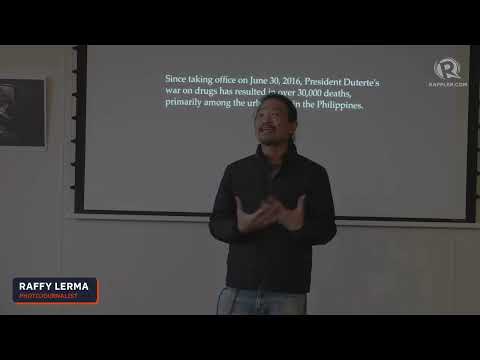
Raffy Lerma, the photojournalist behind the most recognizable photo of the drug war — of Jennilyn Olayres carrying her dead husband Michael Siaron like Mary cradled Jesus — spoke too of the “most unimaginable” scenario of Duterte being jailed in The Hague.
“I hope we focus not on our differences, but on our strengths. Because we have a long battle to go,” said Lerma.
– Rappler.com


You May Also Like

Best Free Social Media Tools for Growth & Engagement in 2026
Common Flat Roof Problems in Philadelphia Properties