Bitcoin Premium Bubble Has Burst — NYDIG Says The Signal Is Clear
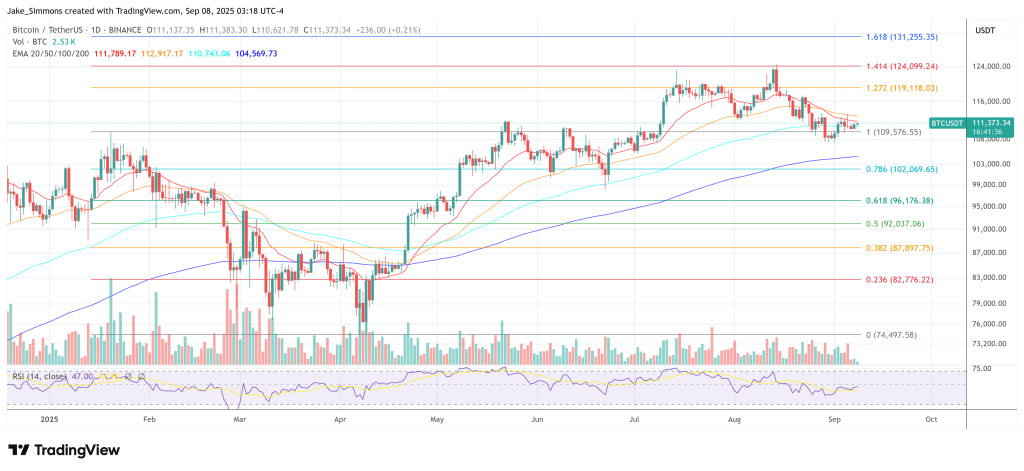
NYDIG’s latest weekly digest, published September 5, 2025 and authored by Global Head of Research Greg Cipolaro, argues that the premium investors once paid for “Digital Asset Treasury” (DAT) companies has been deflating even as bitcoin printed a fresh all-time high in mid-August.
DATs are public companies whose core strategy is to hold bitcoin on the balance sheet; the premium (or discount) reflects the gap between a firm’s share price and its underlying net asset value (NAV) per bitcoin share. NYDIG’s takeaway: the once-frothy premium has compressed across the group, and that compression itself is emerging as a macro-signal for Bitcoin’s cycle rather than a company-specific quirk.
Bitcoin Treasury Companies Feel The Heat
Cipolaro points to a confluence of drivers behind the premium squeeze: investor anxiety ahead of large supply unlocks; changing business objectives among DAT management teams; tangible increases in share issuance; profit-taking after strong runs; and limited differentiation across corporate treasury strategies. The dynamic is visible even at the largest bellwethers, where “premiums on Digital Asset Treasury companies … continue to compress,” despite bitcoin’s August record. NYDIG frames this as a structural reset rather than a blip of sentiment.
The supply calendar is front and center. NYDIG cautions that “for many DATs, conditions may deteriorate before they improve,” because numerous BTC-focused treasuries still need to complete mergers or finalize equity and debt financings to register shares for unrestricted trading. In many cases, “over 95% of the new outstanding shares are tied to these transactions,” implying a potential wave of secondary supply once registrations go effective. If prices into those unlocks weaken, the selling pressure could feed on itself.
Price references from recent fundraises underscore the risk. NYDIG notes that Twenty One’s stock is trading below its June $21 PIPE (though above an April $10 PIPE), while Nakamoto trades below a $5 additional PIPE (but above its $1.12 PIPE). ProCap/Columbus Capital sits just above its SPAC and preferred equity raise price, and Bitcoin Standard Treasury Co./Cantor Equity Partners is only marginally above its PIPE level. Slipping beneath these anchor prices would not only pressure existing investors but could also magnify post-registration selling by new holders who are near or under water.
If premiums keep compressing and discounts open up, the most direct remedy NYDIG highlights is corporate buybacks. Yet, among major bitcoin-treasury names, buyback authorizations are largely absent. Empery Digital is the exception, trading at a roughly 24% discount to NAV with a program in place. By contrast, Nakamoto is leaning into equity issuance via a $5 billion at-the-market offering—an approach that, by definition, tends to lean on the premium rather than defend it. NYDIG’s counsel is blunt: keep some cash back “to support shares via buybacks.”
Beyond near-term market mechanics, NYDIG sketches what a next phase of maturation could look like: accretive M&A and even shareholder activism among DATs. Because accretion is a function of relative premium, an acquirer trading at a higher NAV premium than a target can increase its bitcoin-per-share count through a stock deal even if the target is not at a discount. If this logic takes hold, the consolidators will likely be firms that can sustain higher premiums and operate at sufficient scale to execute meaningful transactions.
What Does This Mean For The Bitcoin Price?
Crucially for bitcoin-cycle watchers, NYDIG revisits the one historical analogue available for this emerging signal: MicroStrategy’s premium to NAV peaked in February 2021, preceding bitcoin’s April 2021 intermediate high near $64,000 and well before the ultimate November 2021 top around $69,000. In the current cycle, NYDIG observes that MicroStrategy’s premium topped out in November 2024—a timing detail that “may be telling us something about the current bitcoin cycle,” even if the firm stresses that one example does not make a rule. “There may be some cycle information being conveyed in DAT premiums, but the sample size is small.”
NYDIG’s market-tape appendix underlines the transition mood. Bitcoin declined over the past weeks, while broader US equities were largely flat. Precious metals, meanwhile, broke higher following Jackson Hole as falling nominal rates and sticky inflation expectations pushed real yields lower—macro conditions NYDIG argues should also favor BTC alongside gold and silver into September’s CPI print and the September 17 FOMC decision.
The research house stops short of making a hard-timing call. But the contours are clear: a once-buoyant premium regime for bitcoin treasuries is being wrung out by supply, issuance, and strategy convergence; management teams may need to pivot from opportunistic equity taps to defensive buybacks; and if history rhymes, the trajectory of MicroStrategy’s premium—peaking months ahead of bitcoin’s ultimate highs—may again be whispering where we are in the cycle. As NYDIG frames it, the “signal” embedded in DAT premiums is getting louder, even if the dataset is young.
At press time, bitcoin traded at $111,373.


You May Also Like

How global FinTech is using AI to detect financial crime in real time?

IMF Makes Surprise Statement on FED! Shares Expectations Regarding Interest Rate Cuts!