Swiss crypto platform SwissBorg lost $41.5 million worth of Solana (SOL) tokens after hackers compromised partner API provider Kiln, marking the latest in a devastating series of cyber attacks that struck the crypto ecosystem within hours of each other. On-chain investigator ZachXBT reported that approximately 192,600 SOL tokens were stolen from SwissBorg’s SOL Earn program, affecting less than 1% of users. The platform immediately allocated its SOL treasury to cover most user losses while engaging white-hat hackers for fund recovery efforts. SwissBorg confirmed that its SOL treasury will compensate affected users for the majority of their losses, with final figures to be determined. The company emphasized that its strong financial health remains intact, and it will continue day-to-day operations unaffected by the security incident. Quite a Day in Crypto: Cascade of Security Failures The SwissBorg incident coincided with multiple high-profile breaches across the crypto ecosystem. Earlier today, Nemo Protocol on the Sui blockchain suffered a $2.4 million exploit that crashed its total value locked from $6.3 million to $1.57 million as users fled the platform. The attack targeted Nemo’s yield-trading mechanism, which splits staked assets into Principal Tokens and Yield Tokens for speculation purposes. PeckShieldAlert detected the breach as hackers swiftly moved stolen USDC via Circle by bridging from Arbitrum to Ethereum. Following the exploit, user withdrawals exceeded $3.8 million worth of USDC and SUI tokens. Nemo halted all smart contract operations during scheduled maintenance windows to investigate the vulnerability’s root cause. Just today, the Solana project Aqua executed a $4.65 million rug pull involving 21,770 SOL tokens after promotion by teams including Meteora, Quill Audits, Helius, SYMMIO, and Dialect.Source: Telegram The funds were split four ways and transferred through intermediary addresses before reaching instant exchanges. The team disabled Twitter replies across all posts following the exit scam. These attacks contribute to 2025’s $2.37 billion in DeFi losses across 121 security incidents during the first half alone. DeFi protocols account for 76% of breach cases, though centralized exchanges recorded higher single losses. npm Supply Chain Attack Threatens Entire Ecosystem On a massive scale, hackers compromised the npm account of respected developer Josh Goldberg, publishing malicious versions of 18 popular JavaScript packages, including chalk and debug. The affected packages receive over 2 billion weekly downloads, potentially exposing the entire JavaScript ecosystem. The sophisticated crypto-clipper malware intercepts browser functions to hijack crypto transactions by replacing recipient addresses with attacker-controlled wallets. The payload targets foundational packages like strip-ansi, color-convert, and error-ex buried deep within dependency trees. Security experts warned users to verify every hardware wallet transaction and avoid web-based on-chain activity until patches are deployed. The malware uses Levenshtein distance algorithms to execute the large-scale hack. When crypto addresses are detected, the system replaces them with attacker addresses across Bitcoin, Ethereum, Solana, Tron, Litecoin, and Bitcoin Cash. Additionally, npm swiftly removed compromised packages, but transitive dependencies in tools like Babel and ESLint create persistent risks. Developers are advised to use npm ci in build pipelines and pin affected packages to the last known safe versions. Industry Grapples with Escalating Security Crisis The crypto ecosystem has been massively disrupted today, which could be regarded as one of the worst days for crypto security this year. So far this year, access control vulnerabilities, including misconfigured wallets and compromised legacy keys, represent 59% of industry losses according to Hacken’s mid-year assessment. The Sui blockchain faces particular scrutiny following the Nemo breach and May’s $223 million Cetus Protocol exploit. The earlier attack leveraged arithmetic overflow flaws in third-party code libraries, draining funds within 15 minutes. Similarly, Venus Protocol lost $13.5 million earlier this month, while Bunni Protocol suffered $8.4 million in theft. This latest hack marks the fourth major DeFi hack this month alone. The frequency of attacks has accelerated despite increased security awareness and audit practices. CertiK warns that security risks arise from multiple sources, including coding errors, blockchain network vulnerabilities, and programming language limitations. The npm attack is particularly disturbing as it represents large-scale supply chain compromises, potentially affecting millions of unaware users across thousands of websites and applicationsSwiss crypto platform SwissBorg lost $41.5 million worth of Solana (SOL) tokens after hackers compromised partner API provider Kiln, marking the latest in a devastating series of cyber attacks that struck the crypto ecosystem within hours of each other. On-chain investigator ZachXBT reported that approximately 192,600 SOL tokens were stolen from SwissBorg’s SOL Earn program, affecting less than 1% of users. The platform immediately allocated its SOL treasury to cover most user losses while engaging white-hat hackers for fund recovery efforts. SwissBorg confirmed that its SOL treasury will compensate affected users for the majority of their losses, with final figures to be determined. The company emphasized that its strong financial health remains intact, and it will continue day-to-day operations unaffected by the security incident. Quite a Day in Crypto: Cascade of Security Failures The SwissBorg incident coincided with multiple high-profile breaches across the crypto ecosystem. Earlier today, Nemo Protocol on the Sui blockchain suffered a $2.4 million exploit that crashed its total value locked from $6.3 million to $1.57 million as users fled the platform. The attack targeted Nemo’s yield-trading mechanism, which splits staked assets into Principal Tokens and Yield Tokens for speculation purposes. PeckShieldAlert detected the breach as hackers swiftly moved stolen USDC via Circle by bridging from Arbitrum to Ethereum. Following the exploit, user withdrawals exceeded $3.8 million worth of USDC and SUI tokens. Nemo halted all smart contract operations during scheduled maintenance windows to investigate the vulnerability’s root cause. Just today, the Solana project Aqua executed a $4.65 million rug pull involving 21,770 SOL tokens after promotion by teams including Meteora, Quill Audits, Helius, SYMMIO, and Dialect.Source: Telegram The funds were split four ways and transferred through intermediary addresses before reaching instant exchanges. The team disabled Twitter replies across all posts following the exit scam. These attacks contribute to 2025’s $2.37 billion in DeFi losses across 121 security incidents during the first half alone. DeFi protocols account for 76% of breach cases, though centralized exchanges recorded higher single losses. npm Supply Chain Attack Threatens Entire Ecosystem On a massive scale, hackers compromised the npm account of respected developer Josh Goldberg, publishing malicious versions of 18 popular JavaScript packages, including chalk and debug. The affected packages receive over 2 billion weekly downloads, potentially exposing the entire JavaScript ecosystem. The sophisticated crypto-clipper malware intercepts browser functions to hijack crypto transactions by replacing recipient addresses with attacker-controlled wallets. The payload targets foundational packages like strip-ansi, color-convert, and error-ex buried deep within dependency trees. Security experts warned users to verify every hardware wallet transaction and avoid web-based on-chain activity until patches are deployed. The malware uses Levenshtein distance algorithms to execute the large-scale hack. When crypto addresses are detected, the system replaces them with attacker addresses across Bitcoin, Ethereum, Solana, Tron, Litecoin, and Bitcoin Cash. Additionally, npm swiftly removed compromised packages, but transitive dependencies in tools like Babel and ESLint create persistent risks. Developers are advised to use npm ci in build pipelines and pin affected packages to the last known safe versions. Industry Grapples with Escalating Security Crisis The crypto ecosystem has been massively disrupted today, which could be regarded as one of the worst days for crypto security this year. So far this year, access control vulnerabilities, including misconfigured wallets and compromised legacy keys, represent 59% of industry losses according to Hacken’s mid-year assessment. The Sui blockchain faces particular scrutiny following the Nemo breach and May’s $223 million Cetus Protocol exploit. The earlier attack leveraged arithmetic overflow flaws in third-party code libraries, draining funds within 15 minutes. Similarly, Venus Protocol lost $13.5 million earlier this month, while Bunni Protocol suffered $8.4 million in theft. This latest hack marks the fourth major DeFi hack this month alone. The frequency of attacks has accelerated despite increased security awareness and audit practices. CertiK warns that security risks arise from multiple sources, including coding errors, blockchain network vulnerabilities, and programming language limitations. The npm attack is particularly disturbing as it represents large-scale supply chain compromises, potentially affecting millions of unaware users across thousands of websites and applications

Swiss Crypto Platform SwissBorg Hit by $41.5M SOL Hack After Partner API Compromise

2025/09/09 04:36
4 min read

Swiss crypto platform SwissBorg lost $41.5 million worth of Solana (SOL) tokens after hackers compromised partner API provider Kiln, marking the latest in a devastating series of cyber attacks that struck the crypto ecosystem within hours of each other.

On-chain investigator ZachXBT reported that approximately 192,600 SOL tokens were stolen from SwissBorg’s SOL Earn program, affecting less than 1% of users.

The platform immediately allocated its SOL treasury to cover most user losses while engaging white-hat hackers for fund recovery efforts.

SwissBorg confirmed that its SOL treasury will compensate affected users for the majority of their losses, with final figures to be determined.

The company emphasized that its strong financial health remains intact, and it will continue day-to-day operations unaffected by the security incident.

Quite a Day in Crypto: Cascade of Security Failures

The SwissBorg incident coincided with multiple high-profile breaches across the crypto ecosystem.

Earlier today, Nemo Protocol on the Sui blockchain suffered a $2.4 million exploit that crashed its total value locked from $6.3 million to $1.57 million as users fled the platform.

The attack targeted Nemo’s yield-trading mechanism, which splits staked assets into Principal Tokens and Yield Tokens for speculation purposes.

PeckShieldAlert detected the breach as hackers swiftly moved stolen USDC via Circle by bridging from Arbitrum to Ethereum.

Following the exploit, user withdrawals exceeded $3.8 million worth of USDC and SUI tokens. Nemo halted all smart contract operations during scheduled maintenance windows to investigate the vulnerability’s root cause.

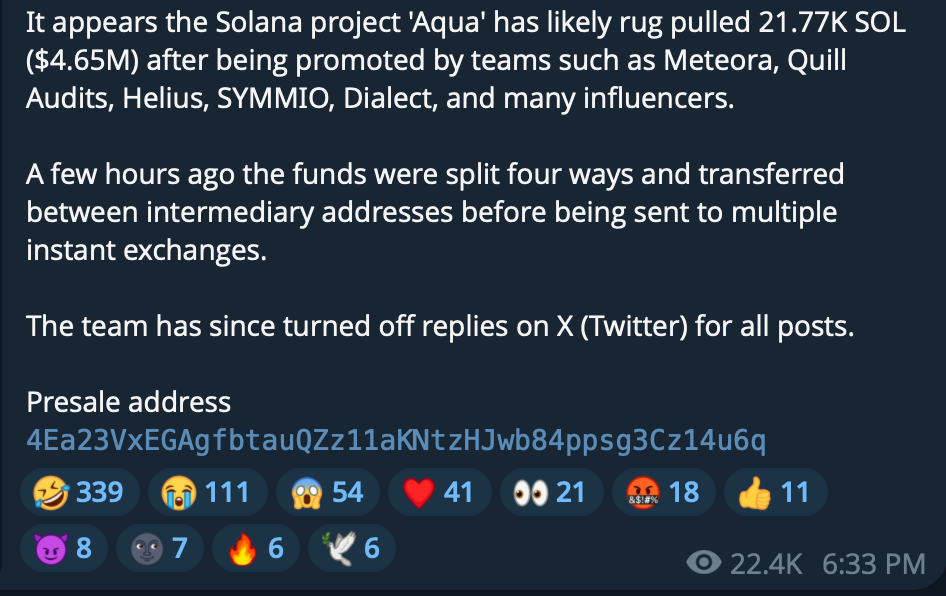
Just today, the Solana project Aqua executed a $4.65 million rug pull involving 21,770 SOL tokens after promotion by teams including Meteora, Quill Audits, Helius, SYMMIO, and Dialect.
Swiss Crypto Platform SwissBorg Hit by $41.5M SOL Hack After Partner API CompromiseSource: Telegram

The funds were split four ways and transferred through intermediary addresses before reaching instant exchanges.

The team disabled Twitter replies across all posts following the exit scam.

These attacks contribute to 2025’s $2.37 billion in DeFi losses across 121 security incidents during the first half alone.

DeFi protocols account for 76% of breach cases, though centralized exchanges recorded higher single losses.

npm Supply Chain Attack Threatens Entire Ecosystem

On a massive scale, hackers compromised the npm account of respected developer Josh Goldberg, publishing malicious versions of 18 popular JavaScript packages, including chalk and debug.

The affected packages receive over 2 billion weekly downloads, potentially exposing the entire JavaScript ecosystem.

The sophisticated crypto-clipper malware intercepts browser functions to hijack crypto transactions by replacing recipient addresses with attacker-controlled wallets.

The payload targets foundational packages like strip-ansi, color-convert, and error-ex buried deep within dependency trees.

Security experts warned users to verify every hardware wallet transaction and avoid web-based on-chain activity until patches are deployed.

The malware uses Levenshtein distance algorithms to execute the large-scale hack.

When crypto addresses are detected, the system replaces them with attacker addresses across Bitcoin, Ethereum, Solana, Tron, Litecoin, and Bitcoin Cash.

Additionally, npm swiftly removed compromised packages, but transitive dependencies in tools like Babel and ESLint create persistent risks.

Developers are advised to use npm ci in build pipelines and pin affected packages to the last known safe versions.

Industry Grapples with Escalating Security Crisis

The crypto ecosystem has been massively disrupted today, which could be regarded as one of the worst days for crypto security this year.

So far this year, access control vulnerabilities, including misconfigured wallets and compromised legacy keys, represent 59% of industry losses according to Hacken’s mid-year assessment.

The Sui blockchain faces particular scrutiny following the Nemo breach and May’s $223 million Cetus Protocol exploit.

The earlier attack leveraged arithmetic overflow flaws in third-party code libraries, draining funds within 15 minutes.

Similarly, Venus Protocol lost $13.5 million earlier this month, while Bunni Protocol suffered $8.4 million in theft. This latest hack marks the fourth major DeFi hack this month alone.

The frequency of attacks has accelerated despite increased security awareness and audit practices.

CertiK warns that security risks arise from multiple sources, including coding errors, blockchain network vulnerabilities, and programming language limitations.

The npm attack is particularly disturbing as it represents large-scale supply chain compromises, potentially affecting millions of unaware users across thousands of websites and applications.

Market Opportunity
Solana Logo
Solana Price(SOL)
$86.39
$86.39$86.39
+6.75%
USD
Solana (SOL) Live Price Chart
Disclaimer: The articles reposted on this site are sourced from public platforms and are provided for informational purposes only. They do not necessarily reflect the views of MEXC. All rights remain with the original authors. If you believe any content infringes on third-party rights, please contact crypto.news@mexc.com for removal. MEXC makes no guarantees regarding the accuracy, completeness, or timeliness of the content and is not responsible for any actions taken based on the information provided. The content does not constitute financial, legal, or other professional advice, nor should it be considered a recommendation or endorsement by MEXC.

You May Also Like

Service sector continues to dive formal employment

Service sector continues to dive formal employment

THE NUMBER of workers in formal employment — those employed by establishments with 10 or more workers — numbered 6.14 million in August 2024, the Philippine Statistics
Share
Bworldonline2026/03/01 20:17
This Trump cover-up is appalling — and may have met its match

This Trump cover-up is appalling — and may have met its match

The federal judiciary has stiffened its resolve toward the Trump administration. The Supreme Court ruled 6-3 last week against the authority that President Donald
Share
Rawstory2026/03/01 21:08
CME Group to launch Solana and XRP futures options in October

CME Group to launch Solana and XRP futures options in October

The post CME Group to launch Solana and XRP futures options in October appeared on BitcoinEthereumNews.com. CME Group is preparing to launch options on SOL and XRP futures next month, giving traders new ways to manage exposure to the two assets.  The contracts are set to go live on October 13, pending regulatory approval, and will come in both standard and micro sizes with expiries offered daily, monthly and quarterly. The new listings mark a major step for CME, which first brought bitcoin futures to market in 2017 and added ether contracts in 2021. Solana and XRP futures have quickly gained traction since their debut earlier this year. CME says more than 540,000 Solana contracts (worth about $22.3 billion), and 370,000 XRP contracts (worth $16.2 billion), have already been traded. Both products hit record trading activity and open interest in August. Market makers including Cumberland and FalconX plan to support the new contracts, arguing that institutional investors want hedging tools beyond bitcoin and ether. CME’s move also highlights the growing demand for regulated ways to access a broader set of digital assets. The launch, which still needs the green light from regulators, follows the end of XRP’s years-long legal fight with the US Securities and Exchange Commission. A federal court ruling in 2023 found that institutional sales of XRP violated securities laws, but programmatic exchange sales did not. The case officially closed in August 2025 after Ripple agreed to pay a $125 million fine, removing one of the biggest uncertainties hanging over the token. This is a developing story. This article was generated with the assistance of AI and reviewed by editor Jeffrey Albus before publication. Get the news in your inbox. Explore Blockworks newsletters: Source: https://blockworks.co/news/cme-group-solana-xrp-futures
Share
BitcoinEthereumNews2025/09/17 23:55