This article surveys parameter-efficient tuning, V&L adaptation, and multitask hypernetworks—then frames a unified hyper-embedding PELT approach.This article surveys parameter-efficient tuning, V&L adaptation, and multitask hypernetworks—then frames a unified hyper-embedding PELT approach.

One Tiny Hypernetwork to Rule All Tasks and Modalities

Abstract and 1. Introduction

  1. Related Work
  2. Preliminaries
  3. Proposed Method
  4. Experimental Setup
  5. Results and Analysis
  6. Discussion and Conclusion, and References

A. The Connection Between Prefix-tuning and Hypernetwork

B. Number of Tunable Parameters

C. Input-output formats

2. Related Work

In this section, we review recent research on parameter-efficient tuning for pure language and V&L tasks, as well as the corresponding work for multi-task learning.

2.1. Parameter-efficient tuning

As recent models grow rapidly in size, how to finetune pretrained models with a small number of trainable parameters becomes more crucial. Existing research (He et al., 2021; Lester et al., 2021; Liu et al., 2021a; Mao et al., 2021) have explored a large amount of methods on parameter-efficient tuning. These methods generally include two categories according to whether new trainable parameters are introduced. One category is that only a subset of model parameters can be updated while freezing the remain (Liu et al., 2021b; Lee et al., 2019). The other is introducing a few task-specific new parameters to different parts of pretrained models, such as before multi-head attention (Li & Liang, 2021), after feedforward layers (Houlsby et al., 2019) or Mixed-and-Match methods (MAM adapter) proposed by He et al. (2021).

2.2. Tuning towards Vision-and-Language

In addition, fine-tuning language models pretrained on pure large text corpora have led to noticeable improvements to V&L tasks. This line of research such as VL-T5 (Cho et al., 2021) and Frozen (Tsimpoukelli et al., 2021) attempts to tune large language models (e.g. T5; GPT-3) to achieve transfer learning for V&L tasks. For example, Frozen aligns the image representation into the word representation space of frozen GPT-3 model which thus is able to generate captions for those images. PICa (Yang et al., 2021) utilizes a pretrained image captioner to convert the image into captions that GPT-3 can understand, and then adapt GPT-3 to solve the VQA tasks in a few-shot manner. Sung et al. (2021) introduces a limited set of new trainable parameters to VL-T5 via a adapter-based method that can match the performance of fine-tuning the entire model.

2.3. Multi-task Learning

Learning a unified model to perform well on multiple different tasks (i.e., multi-task learning) is a challenging problem in both NLP and V&L domains. It has to address many challenges such as catastrophic forgetting, and model overfitting in low-resource tasks while underfitting in high-resource tasks (Aharoni et al., 2019). Radford et al. (2019) highlights the ability of language models to perform a wide range of multitasks in a zero-shot setting. As mentioned above, involving task-specific new parameters such as adapter (Houlsby et al., 2019), can be trained for each task separately while keeping the model fixed. von Oswald et al. (2020) propose a task-conditioned hypernetwork to generate all the weights for the targeted model, while Mahabadi et al. (2021) use a shared hypernetwork to only generate weights for a small number of parameters in adapter modules, to allow the model to adapt to each individual task efficiently.

\ Our motivation. Different from mainstream V&L models that append image tokens to the input sequence, we present a novel perspective of merging textual and visual modalities, by using image embedding and task-specific type embedding of multitasks as input to a shared hypernetwork, which generates weights for prefix-tuning and adapt-tuning modules of PLMs. At the same time, we notice a recent paper (He et al., 2022) that was publicly available days ago. This concurrent work shares the similar motivation like us on generating weights for prefix-tuning modules via a hypernetwork, but their method is only targeted at pure language tasks. Our unified framework is able to improve transfer learning in both pure text and vision-to-language multitasks, in a very parameter-efficient manner.

\

3. Preliminaries

3.1. Pretrained Language Models

All of our models are built on top of the state-of-the-art language model, T5 (Raffel et al., 2020), consisting of an encoder-decoder Transformer (Vaswani et al., 2017) with minor modifications. It frames language tasks as sequence-to-sequence generation, and is trained simultaneously on multiple task datasets. This large-scale T5 model achieves state-of-the-art performances across a diverse set of tasks. We use the T5 backbone as it enables training a universal model that interfaces with many downstream language tasks.

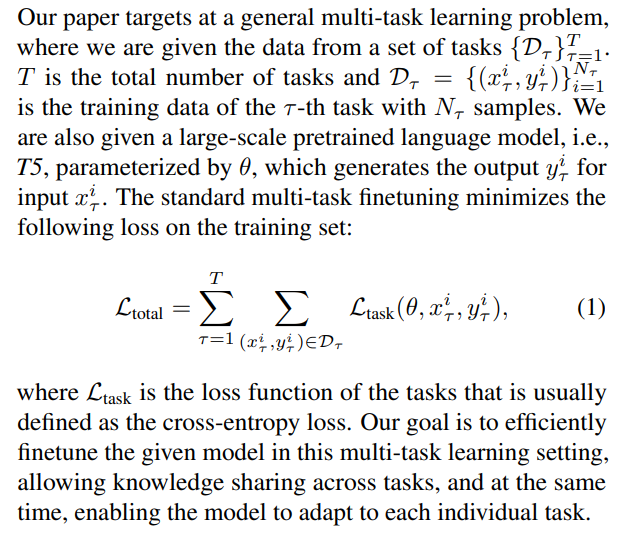
3.2. Multi-task Learning Problem formulation

\
\

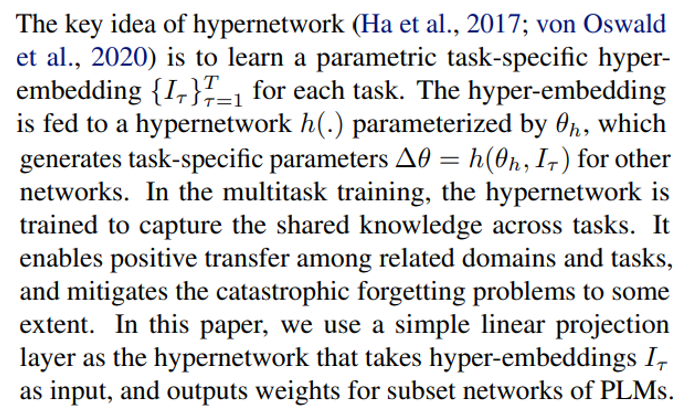
3.3. Hypernetworks

\
\

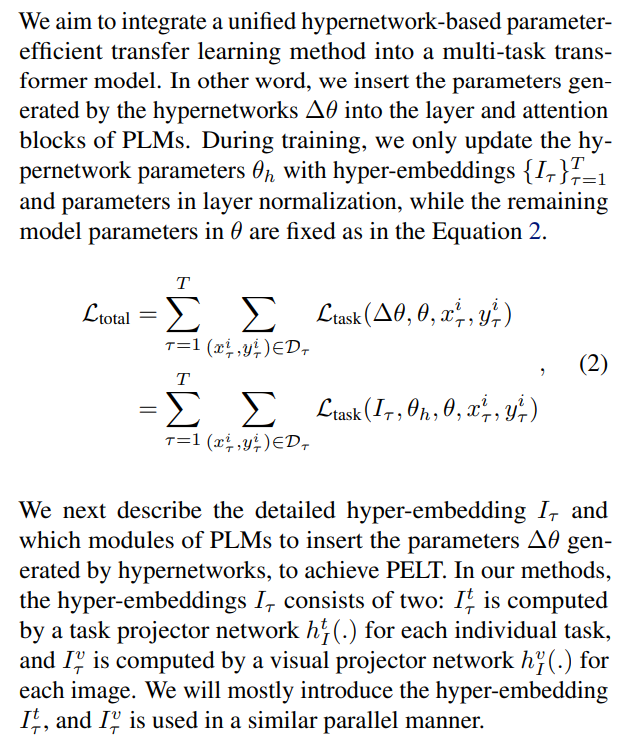
4. Proposed Method

\
\

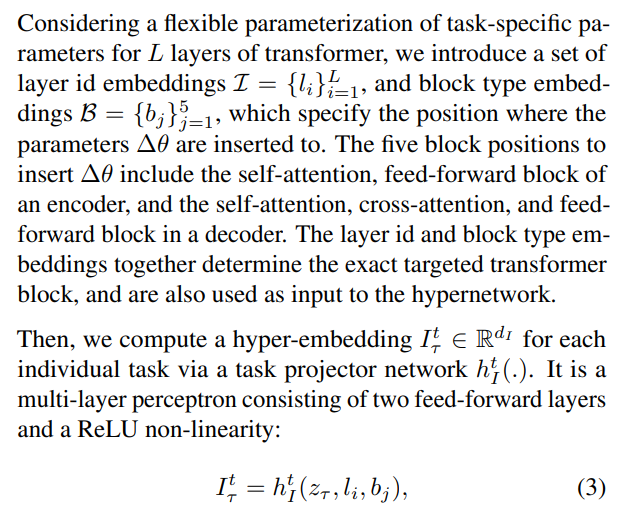
4.1. Hyper-Embeddings for PELT

\
\
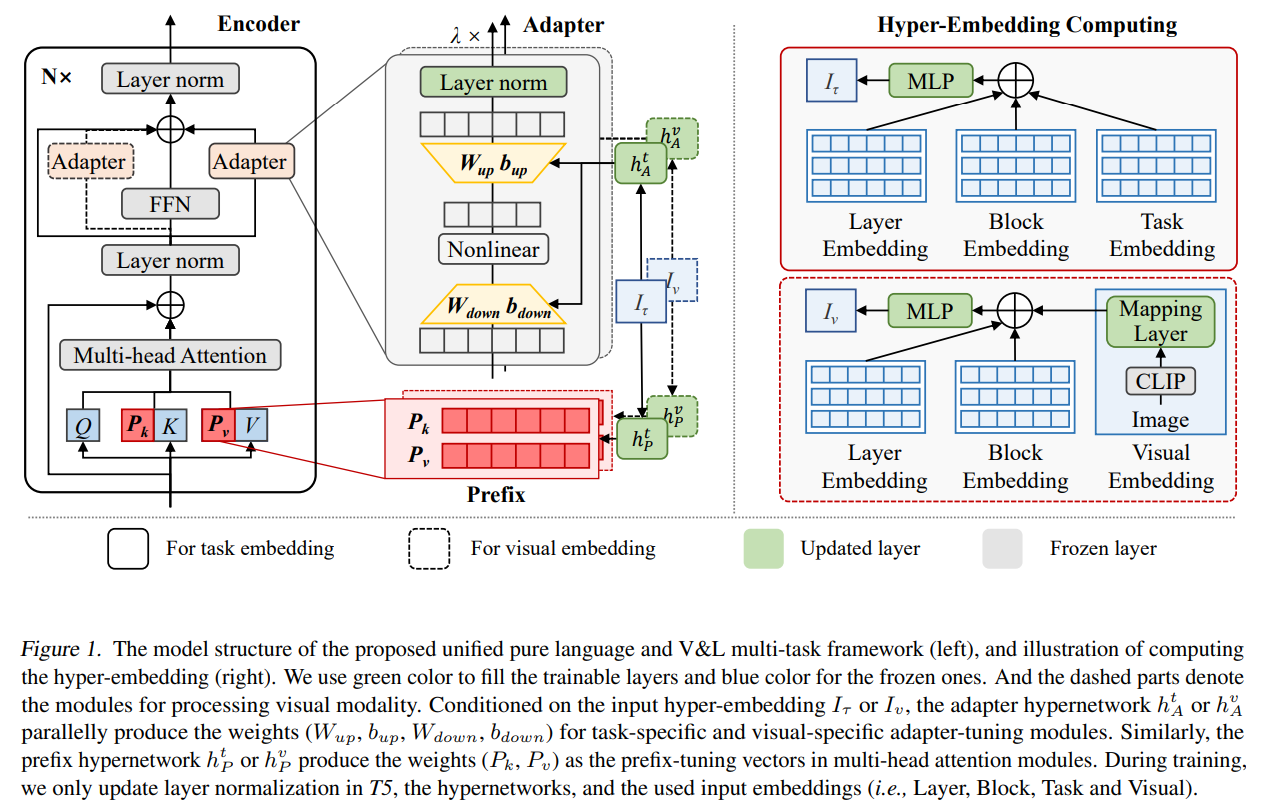
\ \ \
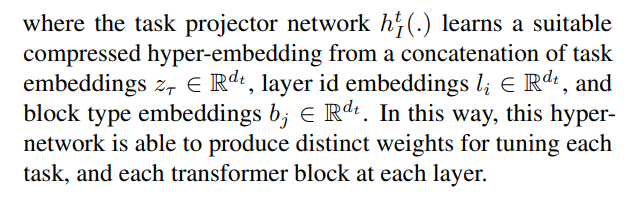
\

4.2. HyperPrefix: Incorporate with Prefix-tuning

Prefix-tuning (Li & Liang, 2021) prepends a number of taskspecific trainable prefix vectors to the parameters of multihead attention (i.e., keys and values) at each transformer layer. In the original implementation, the prefix vectors of each attention block are reparameterized by a two-layer feed-forward network:

\
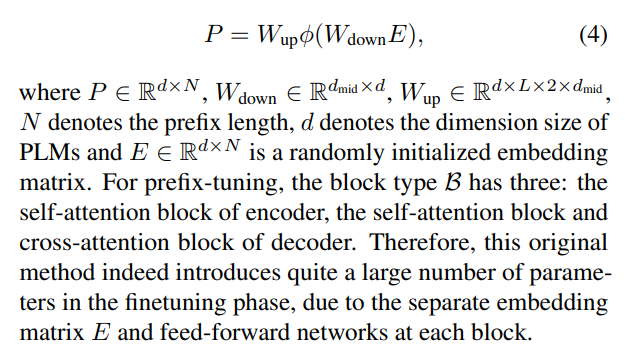
\
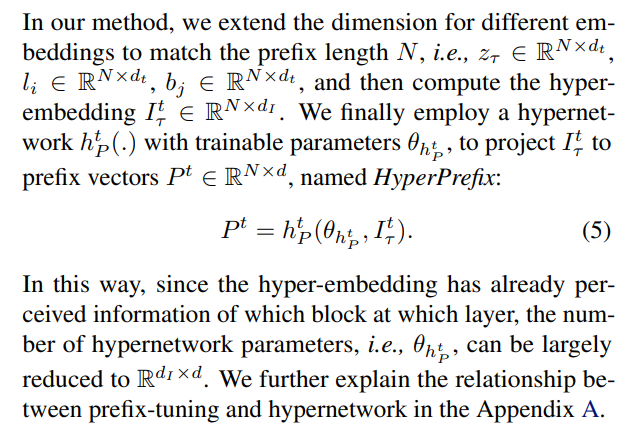
\

4.3. HyperPELT: Incorporate with Adapter

\
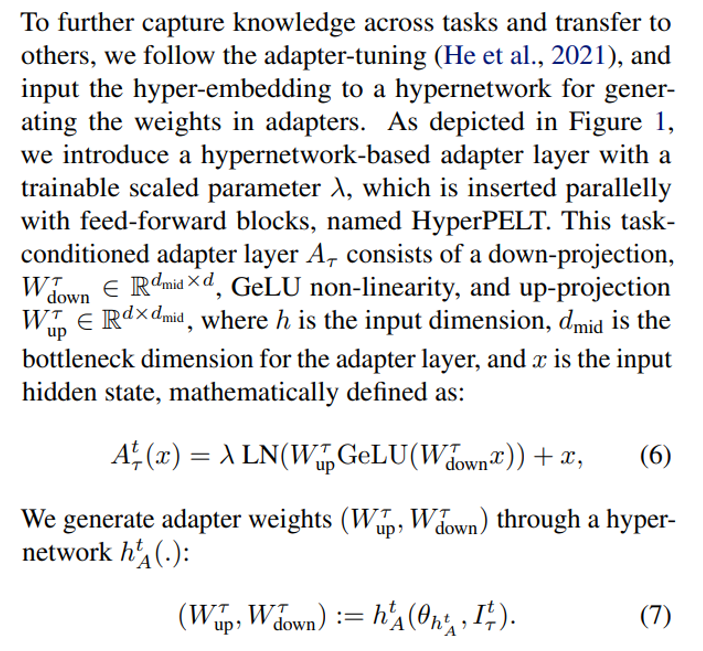
\ Note that in Section 4.2, we use the prefix length N as the dimension for hyper-embeddings. We utilize an adaptive pooling operation on hyper-embeddings to adjust the dimension for adapter hypernetwork. Note that due to we extend the dimension of the components of hyper-embeddings in the last section, we utilize an adaptive pooling operation for hyper-embeddings to adjust the dimension for adapter hypernetwork.

4.4. VL-HyperPELT: Incorporate with Visual Modality

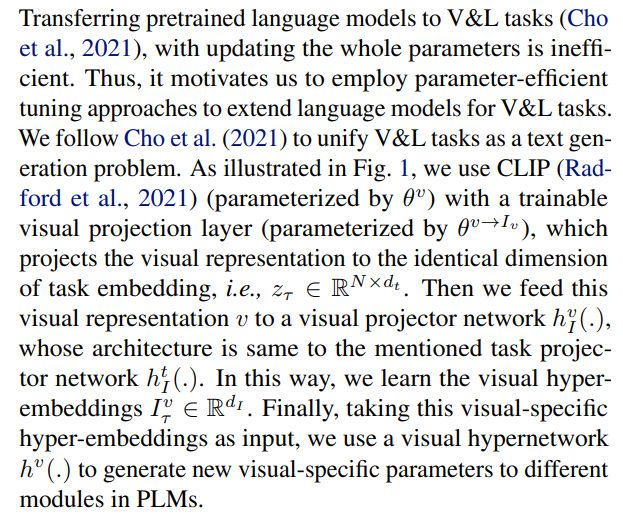
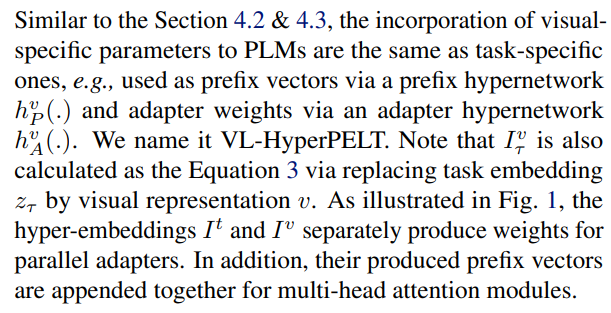
\
\
\

:::info Authors:

(1) Zhengkun Zhang, with Equal contribution from Work is done at the internship of Noah’s Ark Lab, Huawei Technologies

(2) Wenya Guo and TKLNDST, CS, Nankai University, China (yangzl@nankai.edu.cn);

(3) Xiaojun Meng, with Equal contribution from Noah’s Ark Lab, Huawei Technologies;

(4) Yasheng Wang, Noah’s Ark Lab, Huawei Technologies;

(5) Yadao Wang, Noah’s Ark Lab, Huawei Technologies;

(6) Xin Jiang, Noah’s Ark Lab, Huawei Technologies;

(7) Qun Liu, Noah’s Ark Lab, Huawei Technologies;

(8) Zhenglu Yang, TKLNDST, CS, Nankai University, China.

:::


:::info This paper is available on arxiv under CC BY 4.0 DEED license.

:::

\

Market Opportunity
Hyperlane Logo
Hyperlane Price(HYPER)
$0.13381
$0.13381$0.13381
-2.01%
USD
Hyperlane (HYPER) Live Price Chart
Disclaimer: The articles reposted on this site are sourced from public platforms and are provided for informational purposes only. They do not necessarily reflect the views of MEXC. All rights remain with the original authors. If you believe any content infringes on third-party rights, please contact service@support.mexc.com for removal. MEXC makes no guarantees regarding the accuracy, completeness, or timeliness of the content and is not responsible for any actions taken based on the information provided. The content does not constitute financial, legal, or other professional advice, nor should it be considered a recommendation or endorsement by MEXC.

You May Also Like

Mitosis Price Flashes a Massive Breakout Hope; Cup-And-Handle Pattern Signals MITO Targeting 50% Rally To $0.115305 Level

Mitosis Price Flashes a Massive Breakout Hope; Cup-And-Handle Pattern Signals MITO Targeting 50% Rally To $0.115305 Level

The analyst identified a formation of a cup-and-handle pattern on Mitosis’s chart, suggesting that MITO is preparing to see a looming price explosion.
Share
Blockchainreporter2026/01/18 09:00
Spot ETH ETFs Surge: Remarkable $48M Inflow Streak Continues

Spot ETH ETFs Surge: Remarkable $48M Inflow Streak Continues

BitcoinWorld Spot ETH ETFs Surge: Remarkable $48M Inflow Streak Continues The cryptocurrency world is buzzing with exciting news as Spot ETH ETFs continue to capture significant investor attention. For the second consecutive day, these innovative investment vehicles have seen substantial positive flows, reinforcing confidence in the Ethereum ecosystem. This consistent performance signals a growing appetite for regulated crypto exposure among traditional investors. What’s Fueling the Latest Spot ETH ETF Inflows? On September 19, U.S. Spot ETH ETFs collectively recorded a net inflow of an impressive $48 million. This marked another day of positive momentum, building on previous gains. Such figures are not just numbers; they represent tangible capital moving into the Ethereum market through accessible investment products. BlackRock’s ETHA Leads the Charge: A standout performer was BlackRock’s ETHA, which alone attracted a staggering $140 million in inflows. This substantial figure highlights the significant influence of major financial institutions in driving the adoption of crypto-backed ETFs. Institutional Confidence: The consistent inflows, particularly from prominent asset managers like BlackRock, suggest increasing institutional comfort and conviction in Ethereum’s long-term potential. Why Are Consecutive Spot ETH ETF Inflows So Significant? Two consecutive days of net inflows into Spot ETH ETFs are more than just a fleeting trend; they indicate a strengthening pattern of investor interest. This sustained positive movement suggests that initial hesitancy might be giving way to broader acceptance and strategic positioning within the digital asset space. Understanding the implications of these inflows is crucial: Market Validation: Continuous inflows serve as a strong validation for Ethereum as a legitimate and valuable asset class within traditional finance. Liquidity and Stability: Increased capital flowing into these ETFs can contribute to greater market liquidity and potentially enhance price stability for Ethereum itself, reducing volatility over time. Paving the Way: The success of Spot ETH ETFs could also pave the way for other cryptocurrency-based investment products, further integrating digital assets into mainstream financial portfolios. Are All Spot ETH ETFs Experiencing the Same Momentum? While the overall picture for Spot ETH ETFs is overwhelmingly positive, it’s important to note that individual fund performances can vary. The market is dynamic, and different funds may experience unique flow patterns based on investor preferences, fund structure, and underlying strategies. Mixed Performance: On the same day, Fidelity’s FETH saw net outflows of $53.4 million, and Grayscale’s Mini ETH recorded outflows of $11.3 million. Normal Market Fluctuations: These outflows, while notable, are a normal part of market dynamics. Investors might be rebalancing portfolios, taking profits, or shifting capital between different investment vehicles. The net positive inflow across the entire sector indicates that new money is still entering faster than it is leaving. This nuanced view helps us appreciate the complex interplay of forces shaping the market for Spot ETH ETFs. What’s Next for Spot ETH ETFs and the Ethereum Market? The sustained interest in Spot ETH ETFs suggests a potentially bright future for Ethereum’s integration into traditional financial markets. As more investors gain access to ETH through regulated products, the demand for the underlying asset could increase, influencing its price and overall market capitalization. For investors looking to navigate this evolving landscape, here are some actionable insights: Stay Informed: Keep an eye on daily inflow and outflow data, as these can provide early indicators of market sentiment. Understand Diversification: While Spot ETH ETFs offer exposure, remember the importance of a diversified investment portfolio. Monitor Regulatory Developments: The regulatory environment for cryptocurrencies is constantly evolving, which can impact the performance and availability of these investment products. Conclusion: A Promising Horizon for Ethereum The consistent positive net inflows into Spot ETH ETFs for a second straight day underscore a significant shift in how institutional and retail investors view Ethereum. This growing confidence, spearheaded by major players like BlackRock, signals a maturing market where digital assets are increasingly seen as viable components of a modern investment strategy. As the ecosystem continues to develop, these ETFs will likely play a crucial role in shaping Ethereum’s future trajectory and its broader acceptance in global finance. It’s an exciting time to watch the evolution of these groundbreaking financial instruments. Frequently Asked Questions (FAQs) Q1: What is a Spot ETH ETF? A Spot ETH ETF (Exchange-Traded Fund) is an investment product that directly holds Ethereum. It allows investors to gain exposure to Ethereum’s price movements without needing to buy, store, or manage the actual cryptocurrency themselves. Q2: Why are these recent inflows into Spot ETH ETFs important? The recent inflows signify growing institutional and retail investor confidence in Ethereum as an asset. Consistent positive flows can lead to increased market liquidity, potential price stability, and broader acceptance of cryptocurrencies in traditional financial portfolios. Q3: Which funds are leading the inflows for Spot ETH ETFs? On September 19, BlackRock’s ETHA led the group with a substantial $140 million in inflows, demonstrating strong interest from a major financial institution. Q4: Do all Spot ETH ETFs experience inflows simultaneously? No, not all Spot ETH ETFs experience inflows at the same time. While the overall sector may see net positive flows, individual funds like Fidelity’s FETH and Grayscale’s Mini ETH can experience outflows due to various factors such as rebalancing or profit-taking by investors. Q5: What does the success of Spot ETH ETFs mean for Ethereum’s price? Increased demand through Spot ETH ETFs can potentially drive up the price of Ethereum by increasing buying pressure on the underlying asset. However, numerous factors influence crypto prices, so it’s not a guaranteed outcome. If you found this article insightful, consider sharing it with your network! Your support helps us continue to provide valuable insights into the dynamic world of cryptocurrency. Spread the word and help others understand the exciting developments in Spot ETH ETFs! To learn more about the latest crypto market trends, explore our article on key developments shaping Ethereum institutional adoption. This post Spot ETH ETFs Surge: Remarkable $48M Inflow Streak Continues first appeared on BitcoinWorld.
Share
Coinstats2025/09/20 11:10
Trump imposes 10% tariffs on eight European countries over Greenland.

Trump imposes 10% tariffs on eight European countries over Greenland.

PANews reported on January 18th that, according to Jinshi News, on January 17th local time, US President Trump announced via social media that, due to the Greenland
Share
PANews2026/01/18 08:46