This article explores how low-rank approximations streamline two complex domains: portfolio optimization in financial analytics and machine learning with restricted Boltzmann machines (RBMs). By leveraging Spatial Photonic Ising Machines (SPIMs), investors can compute optimal portfolios in microseconds, crucial for high-frequency trading. Meanwhile, low-rank RBMs reduce computational complexity in AI, making training faster and more efficient compared to unrestricted Boltzmann machines. Together, these innovations highlight how optical hardware and low-rank modeling drive performance gains across finance and artificial intelligence.This article explores how low-rank approximations streamline two complex domains: portfolio optimization in financial analytics and machine learning with restricted Boltzmann machines (RBMs). By leveraging Spatial Photonic Ising Machines (SPIMs), investors can compute optimal portfolios in microseconds, crucial for high-frequency trading. Meanwhile, low-rank RBMs reduce computational complexity in AI, making training faster and more efficient compared to unrestricted Boltzmann machines. Together, these innovations highlight how optical hardware and low-rank modeling drive performance gains across finance and artificial intelligence.

What Investors and AI Researchers Can Learn from Low-Rank Optimization

I. Introduction

II. Spim Performance, Advantages and Generality

III. Inherently Low Rank Problems

A. Properties of Low Rank Graphs

B. Weakly NP-Complete Problems and Hardware Precision Limitation

C. Limitation of Low Rank Matrix Mapping

IV. Low Rank Approximation

A. Decomposition of Target Coupling Matrix

B. How Fields Influence Ran

C. Low Rank Approximation of Coupling Matrices

D. Low-Rank Approximation of Random Coupling Matrices

E. Low Rank Approximation for Portfolio Optimization

F. Low-Rank Matrices in Restricted Boltzmann Machines

V. Constrained Number Partitioning Problem

A. Definition and Characteristics of the Constrained Number Partitioning Problem

B. Computational Hardness of Random CNP Instances

VI. Translation Invariant Problems

A. “Realistic” Spin Glass

B. Circulant Graphs

VII. Conclusions, Acknowledgements, and References

E. Low Rank Approximation for Portfolio Optimization

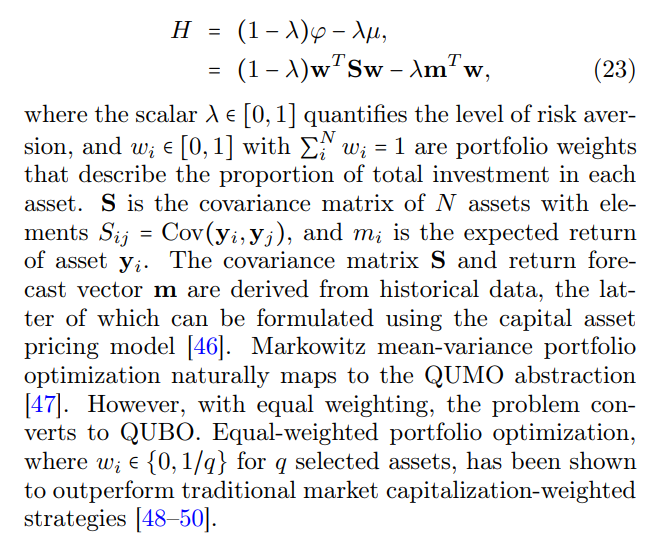
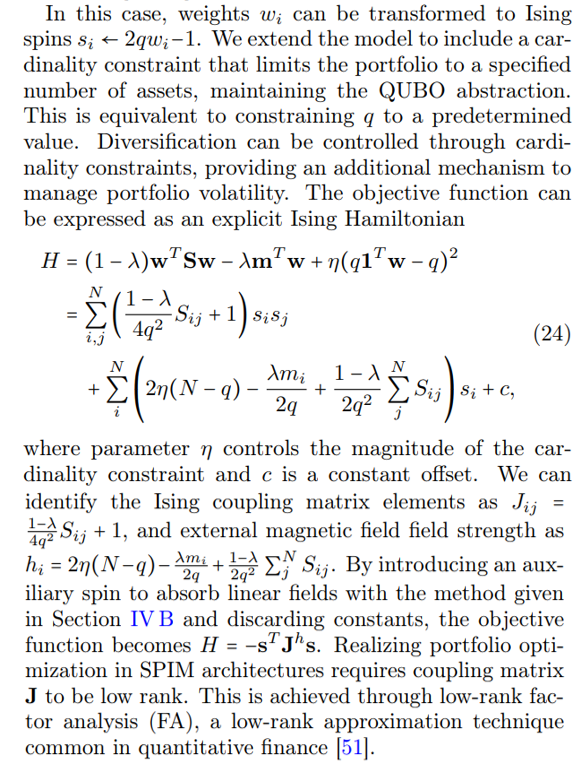
Low-rank matrices can arise during the construction of securities portfolios in financial analytics. Specifically, the optimal portfolio is the solution to a model-dependent quadratic unconstrained mixed optimization (QUMO) problem. Under an equal-weighting constraint, which we will explain below, this transforms into a quadratic unconstrained binary optimization (QUBO) problem that SPIMs can solve. Portfolio optimization involves creating an investment portfolio that balances risk and return. The objective is to allocate assets yi optimally to maximize expected returns µ while minimizing risk φ. In modern portfolio theory, this problem is formulated in the Markowitz mean-variance optimization model [43– 45] with the objective function:

\
\
\
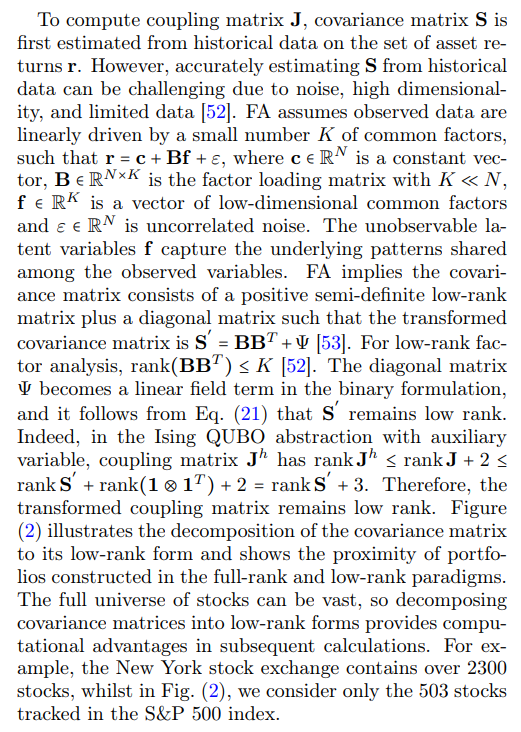
\ For a quadratic unconstrained continuous optimization problem, if the coupling matrix is positive semi-definite as the covariance matrix is, then the problem is convex for any linear field term. However, for QUBO problems, even if S and hence J is positive semi-definitive, the problem is not necessarily easy to solve. The reason is that the binary constraint makes the feasible region discrete, not convex, which is why QUBO problems are generally NP-hard. SPIMs derive a temporal advantage over classical computing due to optical hardware implementing fast and energy-efficient computation. This is particularly crucial in high-frequency trading, where optimal portfolios must be calculated over microseconds to minimize latency in placing orders [54, 55].

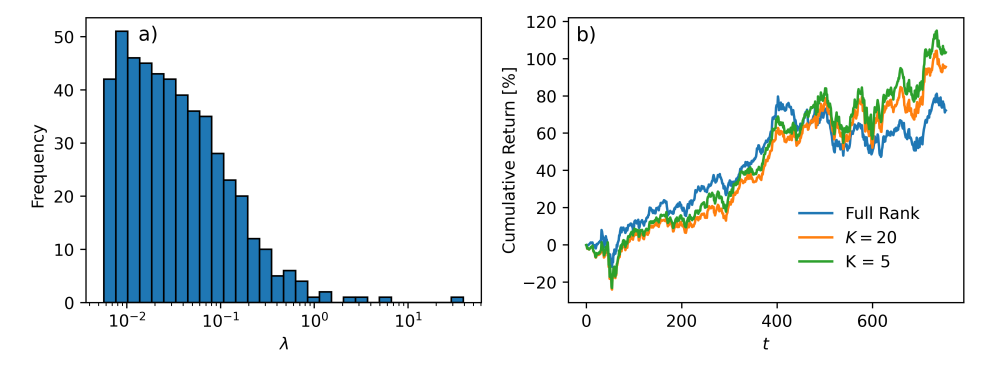
\ Figure 2. (a) Frequency histogram of eigenvalues obtained from the covariance matrix of S&P 500 stock data. There are only a few dominating eigenvalues, and most eigenvalues are orders of magnitude smaller than the dominant ones. (b) Equal-weighted cardinality-constrained portfolios constructed from the full rank covariance matrix S (blue), K = 20 low rank matrix S′ (orange), and K = 5 low rank matrix (green). Here, λ = 0.5, η = 1, and q = 20. The portfolios were built by minimizing Eq. (24) using commercial solver Gurobi.
\

F. Low-Rank Matrices in Restricted Boltzmann Machines

In Section III A, we mentioned that the minimum rank of a weighted complete bipartite graph is 2. The restricted Boltzmann machine (RBM) [56, 57] is a computational model naturally defined on complete bipartite graphs. Thus, it is sensible to consider encoding low-rank approximations of RBMs within the SPIM paradigm.

\ Previous studies have shown that RBMs can provide good results when trained with low-rank approximations for collaborative filtering [58]. Recent advancements have explored low-rank approximations in unrestricted Boltzmann machines (UBMs). Notably, UBMs trained on Spatial Photonic Ising Machine (SPIM) based optical hardware have demonstrated promising results. This novel approach leverages the computational power of optical systems for machine learning tasks, offering significant performance improvements [25].

\ Although UBMs might offer greater modeling flexibility due to their unrestricted connectivity, they suffer significant computational downsides. Each step in the UBM training algorithm involves navigating a complex energy landscape, leading to inefficient convergence. This inefficiency is particularly problematic for large-dimensional datasets, where training time and computational resources can become prohibitively high [25].

\ In contrast, RBMs can be framed as minimal rank problems. Their bipartite nature simplifies the training process and reduces computational complexity, making them more practical for SPIM applications. The training efficiency of RBMs was significantly enhanced by Hinton’s method of minimizing contrastive divergence, which simplified the optimization of these models [57]. This minimal rank framework suggests that RBMs can be trained more efficiently, so they are often preferred for collaborative filtering and feature learning tasks. The theoretical foundations of harmony theory, laid out by Smolensky in 1986 [56], underpin the information processing capabilities of both RBMs and UBMs.

\ In general, RBMs, exhibiting lower computational demands, are valuable tools in machine learning. Recent research demonstrating the efficacy of low-rank UBMs on SPIM hardware [25] indicates that low-rank RBMs could be a promising direction for future applications of SPIM devices.

\

:::info Authors:

(1) Richard Zhipeng Wang, Department of Applied Mathematics and Theoretical Physics, University of Cambridge, Wilberforce Road, Cambridge CB3 0WA, United Kingdom;

(2) James S. Cummins, Department of Applied Mathematics and Theoretical Physics, University of Cambridge, Wilberforce Road, Cambridge CB3 0WA, United Kingdom;

(3) Marvin Syed, Department of Applied Mathematics and Theoretical Physics, University of Cambridge, Wilberforce Road, Cambridge CB3 0WA, United Kingdom;

(4) Nikita Stroev, Department of Physics of Complex Systems, Weizmann Institute of Science, Rehovot 76100, Israel;

(5) George Pastras, QUBITECH, Thessalias 8, Chalandri, GR 15231 Athens, Greece;

(6) Jason Sakellariou, QUBITECH, Thessalias 8, Chalandri, GR 15231 Athens, Greece;

(7) Symeon Tsintzos, QUBITECH, Thessalias 8, Chalandri, GR 15231 Athens, Greece and UBITECH ltd, 95B Archiepiskopou Makariou, CY 3020 Limassol, Cyprus;

(8) Alexis Askitopoulos, QUBITECH, Thessalias 8, Chalandri, GR 15231 Athens, Greece and UBITECH ltd, 95B Archiepiskopou Makariou, CY 3020 Limassol, Cyprus;

(9) Daniele Veraldi, Department of Physics, University Sapienza, Piazzale Aldo Moro 5, Rome 00185, Italy;

(10) Marcello Calvanese Strinati, Research Center Enrico Fermi, Via Panisperna 89A, 00185 Rome, Italy;

(11) Silvia Gentilini, Institute for Complex Systems, National Research Council (ISC-CNR), Via dei Taurini 19, 00185 Rome, Italy;

(12) Calvanese Strinati, Research Center Enrico Fermi, Via Panisperna 89A, 00185 Rome, Italy

(13) Davide Pierangeli, Institute for Complex Systems, National Research Council (ISC-CNR), Via dei Taurini 19, 00185 Rome, Italy;

(14) Claudio Conti, Department of Physics, University Sapienza, Piazzale Aldo Moro 5, Rome 00185, Italy;

(15) Natalia G. Berlof, Department of Applied Mathematics and Theoretical Physics, University of Cambridge, Wilberforce Road, Cambridge CB3 0WA, United Kingdom (N.G.Berloff@damtp.cam.ac.uk).

:::


:::info This paper is available on arxiv under CC BY 4.0 DEED license.

:::

x

Market Opportunity
Brainedge Logo
Brainedge Price(LEARN)
$0.00924
$0.00924$0.00924
-0.32%
USD
Brainedge (LEARN) Live Price Chart
Disclaimer: The articles reposted on this site are sourced from public platforms and are provided for informational purposes only. They do not necessarily reflect the views of MEXC. All rights remain with the original authors. If you believe any content infringes on third-party rights, please contact service@support.mexc.com for removal. MEXC makes no guarantees regarding the accuracy, completeness, or timeliness of the content and is not responsible for any actions taken based on the information provided. The content does not constitute financial, legal, or other professional advice, nor should it be considered a recommendation or endorsement by MEXC.

You May Also Like

Mitosis Price Flashes a Massive Breakout Hope; Cup-And-Handle Pattern Signals MITO Targeting 50% Rally To $0.115305 Level

Mitosis Price Flashes a Massive Breakout Hope; Cup-And-Handle Pattern Signals MITO Targeting 50% Rally To $0.115305 Level

The analyst identified a formation of a cup-and-handle pattern on Mitosis’s chart, suggesting that MITO is preparing to see a looming price explosion.
Share
Blockchainreporter2026/01/18 09:00
Spot ETH ETFs Surge: Remarkable $48M Inflow Streak Continues

Spot ETH ETFs Surge: Remarkable $48M Inflow Streak Continues

BitcoinWorld Spot ETH ETFs Surge: Remarkable $48M Inflow Streak Continues The cryptocurrency world is buzzing with exciting news as Spot ETH ETFs continue to capture significant investor attention. For the second consecutive day, these innovative investment vehicles have seen substantial positive flows, reinforcing confidence in the Ethereum ecosystem. This consistent performance signals a growing appetite for regulated crypto exposure among traditional investors. What’s Fueling the Latest Spot ETH ETF Inflows? On September 19, U.S. Spot ETH ETFs collectively recorded a net inflow of an impressive $48 million. This marked another day of positive momentum, building on previous gains. Such figures are not just numbers; they represent tangible capital moving into the Ethereum market through accessible investment products. BlackRock’s ETHA Leads the Charge: A standout performer was BlackRock’s ETHA, which alone attracted a staggering $140 million in inflows. This substantial figure highlights the significant influence of major financial institutions in driving the adoption of crypto-backed ETFs. Institutional Confidence: The consistent inflows, particularly from prominent asset managers like BlackRock, suggest increasing institutional comfort and conviction in Ethereum’s long-term potential. Why Are Consecutive Spot ETH ETF Inflows So Significant? Two consecutive days of net inflows into Spot ETH ETFs are more than just a fleeting trend; they indicate a strengthening pattern of investor interest. This sustained positive movement suggests that initial hesitancy might be giving way to broader acceptance and strategic positioning within the digital asset space. Understanding the implications of these inflows is crucial: Market Validation: Continuous inflows serve as a strong validation for Ethereum as a legitimate and valuable asset class within traditional finance. Liquidity and Stability: Increased capital flowing into these ETFs can contribute to greater market liquidity and potentially enhance price stability for Ethereum itself, reducing volatility over time. Paving the Way: The success of Spot ETH ETFs could also pave the way for other cryptocurrency-based investment products, further integrating digital assets into mainstream financial portfolios. Are All Spot ETH ETFs Experiencing the Same Momentum? While the overall picture for Spot ETH ETFs is overwhelmingly positive, it’s important to note that individual fund performances can vary. The market is dynamic, and different funds may experience unique flow patterns based on investor preferences, fund structure, and underlying strategies. Mixed Performance: On the same day, Fidelity’s FETH saw net outflows of $53.4 million, and Grayscale’s Mini ETH recorded outflows of $11.3 million. Normal Market Fluctuations: These outflows, while notable, are a normal part of market dynamics. Investors might be rebalancing portfolios, taking profits, or shifting capital between different investment vehicles. The net positive inflow across the entire sector indicates that new money is still entering faster than it is leaving. This nuanced view helps us appreciate the complex interplay of forces shaping the market for Spot ETH ETFs. What’s Next for Spot ETH ETFs and the Ethereum Market? The sustained interest in Spot ETH ETFs suggests a potentially bright future for Ethereum’s integration into traditional financial markets. As more investors gain access to ETH through regulated products, the demand for the underlying asset could increase, influencing its price and overall market capitalization. For investors looking to navigate this evolving landscape, here are some actionable insights: Stay Informed: Keep an eye on daily inflow and outflow data, as these can provide early indicators of market sentiment. Understand Diversification: While Spot ETH ETFs offer exposure, remember the importance of a diversified investment portfolio. Monitor Regulatory Developments: The regulatory environment for cryptocurrencies is constantly evolving, which can impact the performance and availability of these investment products. Conclusion: A Promising Horizon for Ethereum The consistent positive net inflows into Spot ETH ETFs for a second straight day underscore a significant shift in how institutional and retail investors view Ethereum. This growing confidence, spearheaded by major players like BlackRock, signals a maturing market where digital assets are increasingly seen as viable components of a modern investment strategy. As the ecosystem continues to develop, these ETFs will likely play a crucial role in shaping Ethereum’s future trajectory and its broader acceptance in global finance. It’s an exciting time to watch the evolution of these groundbreaking financial instruments. Frequently Asked Questions (FAQs) Q1: What is a Spot ETH ETF? A Spot ETH ETF (Exchange-Traded Fund) is an investment product that directly holds Ethereum. It allows investors to gain exposure to Ethereum’s price movements without needing to buy, store, or manage the actual cryptocurrency themselves. Q2: Why are these recent inflows into Spot ETH ETFs important? The recent inflows signify growing institutional and retail investor confidence in Ethereum as an asset. Consistent positive flows can lead to increased market liquidity, potential price stability, and broader acceptance of cryptocurrencies in traditional financial portfolios. Q3: Which funds are leading the inflows for Spot ETH ETFs? On September 19, BlackRock’s ETHA led the group with a substantial $140 million in inflows, demonstrating strong interest from a major financial institution. Q4: Do all Spot ETH ETFs experience inflows simultaneously? No, not all Spot ETH ETFs experience inflows at the same time. While the overall sector may see net positive flows, individual funds like Fidelity’s FETH and Grayscale’s Mini ETH can experience outflows due to various factors such as rebalancing or profit-taking by investors. Q5: What does the success of Spot ETH ETFs mean for Ethereum’s price? Increased demand through Spot ETH ETFs can potentially drive up the price of Ethereum by increasing buying pressure on the underlying asset. However, numerous factors influence crypto prices, so it’s not a guaranteed outcome. If you found this article insightful, consider sharing it with your network! Your support helps us continue to provide valuable insights into the dynamic world of cryptocurrency. Spread the word and help others understand the exciting developments in Spot ETH ETFs! To learn more about the latest crypto market trends, explore our article on key developments shaping Ethereum institutional adoption. This post Spot ETH ETFs Surge: Remarkable $48M Inflow Streak Continues first appeared on BitcoinWorld.
Share
Coinstats2025/09/20 11:10
Trump imposes 10% tariffs on eight European countries over Greenland.

Trump imposes 10% tariffs on eight European countries over Greenland.

PANews reported on January 18th that, according to Jinshi News, on January 17th local time, US President Trump announced via social media that, due to the Greenland
Share
PANews2026/01/18 08:46