TLDR ETH price has formed lower highs and lows since reaching ATH of $4,950 on August 14 Declining spot buying and ETH ETF outflows signal weakening demand Ethereum futures open interest dropped 18% from ATH of $70 billion on August 23 Network fees and revenue decreased despite price rally, partly due to Dencun upgrade Ethereum [...] The post Ethereum (ETH) Price: Technical Analysis Points to Potential Drop to $3,550 Level appeared first on Blockonomi.TLDR ETH price has formed lower highs and lows since reaching ATH of $4,950 on August 14 Declining spot buying and ETH ETF outflows signal weakening demand Ethereum futures open interest dropped 18% from ATH of $70 billion on August 23 Network fees and revenue decreased despite price rally, partly due to Dencun upgrade Ethereum [...] The post Ethereum (ETH) Price: Technical Analysis Points to Potential Drop to $3,550 Level appeared first on Blockonomi.

Ethereum (ETH) Price: Technical Analysis Points to Potential Drop to $3,550 Level

TLDR

  • ETH price has formed lower highs and lows since reaching ATH of $4,950 on August 14
  • Declining spot buying and ETH ETF outflows signal weakening demand
  • Ethereum futures open interest dropped 18% from ATH of $70 billion on August 23
  • Network fees and revenue decreased despite price rally, partly due to Dencun upgrade
  • Ethereum dominates stablecoin market with $165 billion supply (57% market share)

Ethereum’s price has been struggling to break through the $4,500 resistance level for over 10 days, despite reaching an all-time high of $4,950 on August 14. The second-largest cryptocurrency by market cap has formed a series of lower highs and lower lows on the daily chart, suggesting a potential downward trend.

The main factor capping Ethereum at $4,500 appears to be a lack of buyers. Data shows negative net spot buying on exchanges even as ETH price consolidates. Without real demand, any breakout attempt might lack the strength required to push ETH above key levels.

Spot Ethereum ETF demand has also weakened considerably. These investment products posted outflows every day last week, with Friday alone seeing Ethereum ETFs shed $446.8 million. Total outflows for the week reached $787.6 million, indicating institutional investors may be pulling back.

The derivatives market tells a similar story. Decreased demand for leverage resulted in a sharp drop in Ethereum futures open interest, which fell by 18% to $58 billion from an all-time high of $70 billion on August 23.

Market analysis suggests ETH could potentially drop further. A descending triangle pattern has formed on the daily chart, which often signals a bearish reversal after a strong uptrend. If the price breaks below the triangle’s support line at $4,200, it could continue downward toward $3,550, representing an 18% decline from current levels.
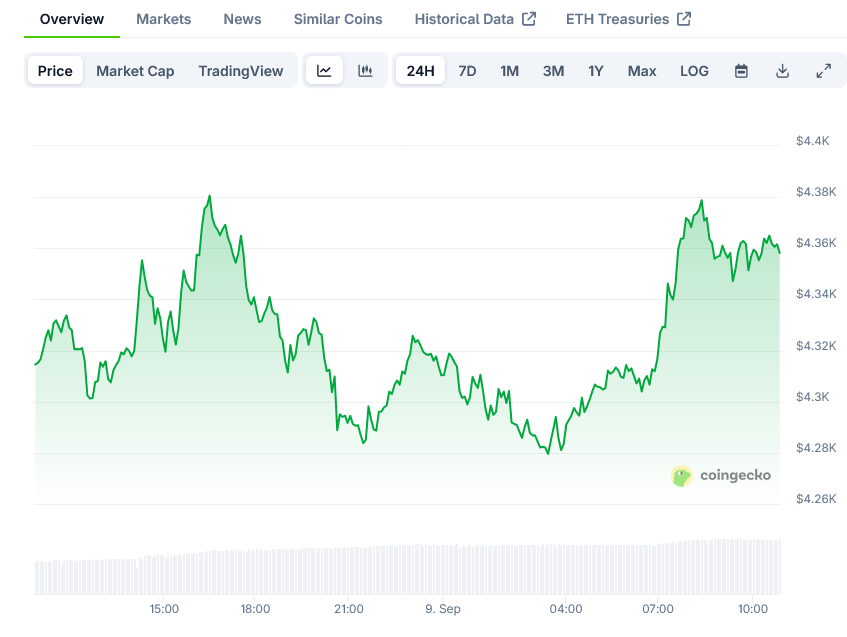
Ethereum Price on CoinGeckoEthereum Price on CoinGecko

Declining Network Activity

Ethereum’s network metrics have also shown concerning signs. Revenue from network fees dropped by about 44% in August, even as the price hit all-time highs. August revenue totaled just over $14.1 million, down from July’s $25.6 million.

This revenue decline occurred despite ETH rallying by 240% since April. Network fees have fallen approximately 10% over the last 30 days to about $43.3 million.

A large part of Ethereum’s revenue drop resulted from the Dencun upgrade in March 2024, which lowered transaction fees for layer-2 scaling networks using Ethereum as a base layer. This change has cut fee revenue and impacted ETH’s deflationary mechanism, potentially weakening its price momentum.

Some analysts remain optimistic despite these indicators. Investor and trader Ted Pillows noted that ETH price is “looking strong” above $4,200, though he added that a deeper drop to retest the $3,800-$3,900 range was possible before a reversal.

Stablecoin Dominance

Despite price struggles, Ethereum has reached a historic milestone in the stablecoin market. The network recorded a record supply of stablecoins, adding about $5 billion in new stablecoins in the past week alone.

This influx increased Ethereum’s overall stablecoin market to $165 billion, representing 57% of the total stablecoin market. Ethereum’s closest competitor, Tron, holds only 27% of the market, while Solana trails far behind with less than 4%.

Ethereum has also dominated the tokenized assets market. The network currently hosts tokenized gold valued at $2.4 billion. Since the beginning of 2024, the amount of tokenized gold has more than doubled, highlighting Ethereum’s growing role in the tokenized commodities market.

The network controls 77% of the tokenized commodities market, which grows to 97% when including the layer-2 Polygon network. Additionally, more than 70% of the market for tokenized US Treasuries runs on Ethereum.

This expansion into tokenized financial products has helped push Ethereum prices up significantly. Since April 2024, ETH has seen its price rise an impressive 200% from its previous levels.

Institutional adoption continues to grow as major financial organizations turn to Ethereum for tokenization. Fidelity, the third largest asset manager globally, recently launched an Ethereum blockchain-based asset fund that trades US Treasuries algorithmically.

Fidelity’s Digital Interest Token (FDIT), launched on September 1, has already accumulated $203.6 million in assets. This move demonstrates that institutional investors view Ethereum as neutral and dependable for financial applications.

The current price of Ethereum stands at $4,358 as it continues to consolidate below the $4,500 resistance level.

The post Ethereum (ETH) Price: Technical Analysis Points to Potential Drop to $3,550 Level appeared first on Blockonomi.


Market Opportunity
Ethereum Logo
Ethereum Price(ETH)
$3 305,03
$3 305,03$3 305,03
-0,74%
USD
Ethereum (ETH) Live Price Chart
Disclaimer: The articles reposted on this site are sourced from public platforms and are provided for informational purposes only. They do not necessarily reflect the views of MEXC. All rights remain with the original authors. If you believe any content infringes on third-party rights, please contact service@support.mexc.com for removal. MEXC makes no guarantees regarding the accuracy, completeness, or timeliness of the content and is not responsible for any actions taken based on the information provided. The content does not constitute financial, legal, or other professional advice, nor should it be considered a recommendation or endorsement by MEXC.

You May Also Like

Mitosis Price Flashes a Massive Breakout Hope; Cup-And-Handle Pattern Signals MITO Targeting 50% Rally To $0.115305 Level

Mitosis Price Flashes a Massive Breakout Hope; Cup-And-Handle Pattern Signals MITO Targeting 50% Rally To $0.115305 Level

The analyst identified a formation of a cup-and-handle pattern on Mitosis’s chart, suggesting that MITO is preparing to see a looming price explosion.
Share
Blockchainreporter2026/01/18 09:00
Spot ETH ETFs Surge: Remarkable $48M Inflow Streak Continues

Spot ETH ETFs Surge: Remarkable $48M Inflow Streak Continues

BitcoinWorld Spot ETH ETFs Surge: Remarkable $48M Inflow Streak Continues The cryptocurrency world is buzzing with exciting news as Spot ETH ETFs continue to capture significant investor attention. For the second consecutive day, these innovative investment vehicles have seen substantial positive flows, reinforcing confidence in the Ethereum ecosystem. This consistent performance signals a growing appetite for regulated crypto exposure among traditional investors. What’s Fueling the Latest Spot ETH ETF Inflows? On September 19, U.S. Spot ETH ETFs collectively recorded a net inflow of an impressive $48 million. This marked another day of positive momentum, building on previous gains. Such figures are not just numbers; they represent tangible capital moving into the Ethereum market through accessible investment products. BlackRock’s ETHA Leads the Charge: A standout performer was BlackRock’s ETHA, which alone attracted a staggering $140 million in inflows. This substantial figure highlights the significant influence of major financial institutions in driving the adoption of crypto-backed ETFs. Institutional Confidence: The consistent inflows, particularly from prominent asset managers like BlackRock, suggest increasing institutional comfort and conviction in Ethereum’s long-term potential. Why Are Consecutive Spot ETH ETF Inflows So Significant? Two consecutive days of net inflows into Spot ETH ETFs are more than just a fleeting trend; they indicate a strengthening pattern of investor interest. This sustained positive movement suggests that initial hesitancy might be giving way to broader acceptance and strategic positioning within the digital asset space. Understanding the implications of these inflows is crucial: Market Validation: Continuous inflows serve as a strong validation for Ethereum as a legitimate and valuable asset class within traditional finance. Liquidity and Stability: Increased capital flowing into these ETFs can contribute to greater market liquidity and potentially enhance price stability for Ethereum itself, reducing volatility over time. Paving the Way: The success of Spot ETH ETFs could also pave the way for other cryptocurrency-based investment products, further integrating digital assets into mainstream financial portfolios. Are All Spot ETH ETFs Experiencing the Same Momentum? While the overall picture for Spot ETH ETFs is overwhelmingly positive, it’s important to note that individual fund performances can vary. The market is dynamic, and different funds may experience unique flow patterns based on investor preferences, fund structure, and underlying strategies. Mixed Performance: On the same day, Fidelity’s FETH saw net outflows of $53.4 million, and Grayscale’s Mini ETH recorded outflows of $11.3 million. Normal Market Fluctuations: These outflows, while notable, are a normal part of market dynamics. Investors might be rebalancing portfolios, taking profits, or shifting capital between different investment vehicles. The net positive inflow across the entire sector indicates that new money is still entering faster than it is leaving. This nuanced view helps us appreciate the complex interplay of forces shaping the market for Spot ETH ETFs. What’s Next for Spot ETH ETFs and the Ethereum Market? The sustained interest in Spot ETH ETFs suggests a potentially bright future for Ethereum’s integration into traditional financial markets. As more investors gain access to ETH through regulated products, the demand for the underlying asset could increase, influencing its price and overall market capitalization. For investors looking to navigate this evolving landscape, here are some actionable insights: Stay Informed: Keep an eye on daily inflow and outflow data, as these can provide early indicators of market sentiment. Understand Diversification: While Spot ETH ETFs offer exposure, remember the importance of a diversified investment portfolio. Monitor Regulatory Developments: The regulatory environment for cryptocurrencies is constantly evolving, which can impact the performance and availability of these investment products. Conclusion: A Promising Horizon for Ethereum The consistent positive net inflows into Spot ETH ETFs for a second straight day underscore a significant shift in how institutional and retail investors view Ethereum. This growing confidence, spearheaded by major players like BlackRock, signals a maturing market where digital assets are increasingly seen as viable components of a modern investment strategy. As the ecosystem continues to develop, these ETFs will likely play a crucial role in shaping Ethereum’s future trajectory and its broader acceptance in global finance. It’s an exciting time to watch the evolution of these groundbreaking financial instruments. Frequently Asked Questions (FAQs) Q1: What is a Spot ETH ETF? A Spot ETH ETF (Exchange-Traded Fund) is an investment product that directly holds Ethereum. It allows investors to gain exposure to Ethereum’s price movements without needing to buy, store, or manage the actual cryptocurrency themselves. Q2: Why are these recent inflows into Spot ETH ETFs important? The recent inflows signify growing institutional and retail investor confidence in Ethereum as an asset. Consistent positive flows can lead to increased market liquidity, potential price stability, and broader acceptance of cryptocurrencies in traditional financial portfolios. Q3: Which funds are leading the inflows for Spot ETH ETFs? On September 19, BlackRock’s ETHA led the group with a substantial $140 million in inflows, demonstrating strong interest from a major financial institution. Q4: Do all Spot ETH ETFs experience inflows simultaneously? No, not all Spot ETH ETFs experience inflows at the same time. While the overall sector may see net positive flows, individual funds like Fidelity’s FETH and Grayscale’s Mini ETH can experience outflows due to various factors such as rebalancing or profit-taking by investors. Q5: What does the success of Spot ETH ETFs mean for Ethereum’s price? Increased demand through Spot ETH ETFs can potentially drive up the price of Ethereum by increasing buying pressure on the underlying asset. However, numerous factors influence crypto prices, so it’s not a guaranteed outcome. If you found this article insightful, consider sharing it with your network! Your support helps us continue to provide valuable insights into the dynamic world of cryptocurrency. Spread the word and help others understand the exciting developments in Spot ETH ETFs! To learn more about the latest crypto market trends, explore our article on key developments shaping Ethereum institutional adoption. This post Spot ETH ETFs Surge: Remarkable $48M Inflow Streak Continues first appeared on BitcoinWorld.
Share
Coinstats2025/09/20 11:10
Trump imposes 10% tariffs on eight European countries over Greenland.

Trump imposes 10% tariffs on eight European countries over Greenland.

PANews reported on January 18th that, according to Jinshi News, on January 17th local time, US President Trump announced via social media that, due to the Greenland
Share
PANews2026/01/18 08:46