A senior adviser to Russian President Vladimir Putin has alleged that the United States is preparing to use cryptocurrencies —specifically US dollar stablecoins—alongside gold to “devalue” and ultimately reset its towering national liabilities. Speaking at the Eastern Economic Forum in Vladivostok, Anton Kobyakov framed crypto and gold as “alternative currencies” to the dollar-centric system and […]A senior adviser to Russian President Vladimir Putin has alleged that the United States is preparing to use cryptocurrencies —specifically US dollar stablecoins—alongside gold to “devalue” and ultimately reset its towering national liabilities. Speaking at the Eastern Economic Forum in Vladivostok, Anton Kobyakov framed crypto and gold as “alternative currencies” to the dollar-centric system and […]

‘Crypto Cloud Reset’: Putin Adviser Accuses US Of Plot To Erase $35 Trillion Debt

A senior adviser to Russian President Vladimir Putin has alleged that the United States is preparing to use cryptocurrencies —specifically US dollar stablecoins—alongside gold to “devalue” and ultimately reset its towering national liabilities. Speaking at the Eastern Economic Forum in Vladivostok, Anton Kobyakov framed crypto and gold as “alternative currencies” to the dollar-centric system and argued that Washington aims to harness them to address what he called a crisis of confidence in the greenback.

“Right now, the United States is trying to change the rules on the gold and cryptocurrency markets. Just think about their debt – $35 trillion. These are two alternative currencies to the global market,” Kobyakov said. He added: “Washington’s actions in this direction clearly demonstrate one of the main American goals. They want to solve the problem of lowering the dollar’s trust. The United States, as it was in the 1930s and 1970s, will solve its financial problems at the expense of the whole world, driving everyone into the cryptocurrency cloud.”

Kobyakov’s most arresting claim was operational: “Over time, when part of the US government debt is placed in stablecoins, the US will devalue this debt. In other words, they have a $35 trillion debt, they drive it into the cryptocurrency cloud, devalue it and start from scratch.” The remarks, which were circulated by Russian state-adjacent outlets, did not include a detailed mechanism for how “placing” sovereign obligations into stablecoins would alter their real value.

Can Bitcoin And Crypto (Stablecoins) Erase The US Debt?

The accusation lands amid two relevant backdrops: a US debt load now measured in the mid-$30 trillions and a fast-expanding stablecoin and tokenized-Treasury ecosystem that nonetheless remains orders of magnitude smaller than public debt. Treasury data and Congressional dashboards put gross federal debt at roughly $37.4 trillion in early September, with about $30.1 trillion held by the public. By contrast, the entire stablecoin market stands in the high-$200 billions, and tokenized US Treasury products total about $7.4 billion—hardly a platform capable of “absorbing” sovereign liabilities at scale.

US policy developments complicate Kobyakov’s narrative in another way. In July, President Donald Trump signed the GENIUS Act, the first federal framework for payment stablecoins. The law requires 100% reserve backing in cash and short-term Treasuries and mandates regular public disclosures—design choices that, if anything, tie stablecoin growth to incremental demand for Treasury bills rather than a mechanism for extinguishing US obligations. That is, more regulated stablecoins typically mean more private-sector buying of T-bills to back those tokens, not fewer Treasuries outstanding.

Kobyakov’s historical analogy—invoking the 1930s and 1970s—references episodes when US authorities changed the monetary regime: FDR’s dollar devaluation against gold in 1933–34 and Nixon’s 1971 closure of the gold window. But translating that precedent into a “stablecoin devaluation” is tenuous.

Stablecoins are issued by private or specially licensed entities and are designed to be redeemed at par; moving government liabilities “into” them would neither novate the debt nor change its legal terms. Any genuine devaluation of dollar-denominated debt would still occur via familiar channels—higher inflation, negative real rates, buybacks at discounts, or maturity transformation—not by wrapping the debt in token form.

Beyond the stablecoin debate, Washington has already sketched an alternative pathway: a Strategic Bitcoin Reserve. On March 6, 2025, the White House issued an executive order establishing a federal bitcoin reserve alongside a US Digital Asset Stockpile to manage government-owned crypto (largely from forfeitures) on a long-term, “budget-neutral” basis; companion legislation—the BITCOIN Act introduced in both chambers—would codify governance and disclosure rules.

US President Donald Trump himself has floated the idea in blunt terms. In an Aug. 2024 Fox Business interview with Maria Bartiromo, he mused: “Who knows? Maybe we’ll pay off our $35 trillion, hand them a little crypto check, right? We’ll hand them a little Bitcoin and wipe out our $35 trillion.” The remark was rhetorical rather than an operational plan, but it prefigured the administration’s March 6, 2025 executive order establishing a Strategic Bitcoin Reserve.

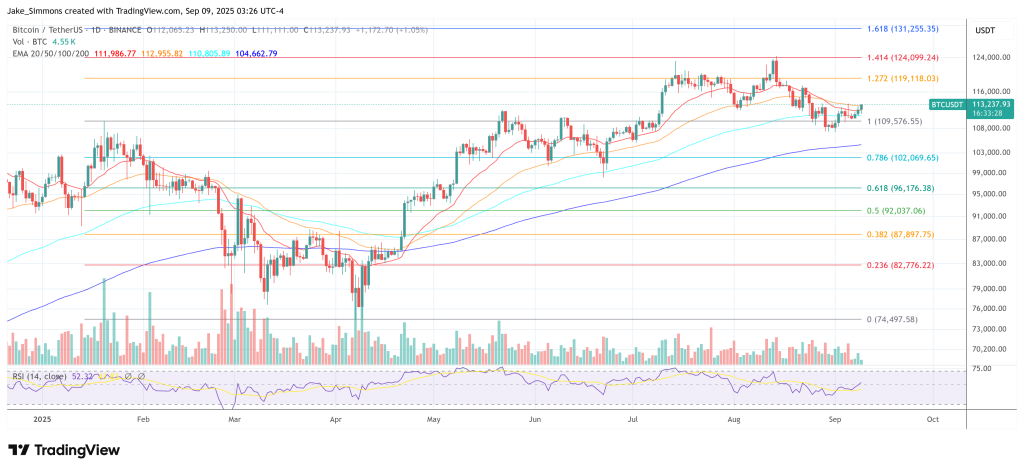
At press time, Bitcoin traded at $113,237.
Bitcoin price
Market Opportunity
Cloud Logo
Cloud Price(CLOUD)
$0.06923
$0.06923$0.06923
-0.94%
USD
Cloud (CLOUD) Live Price Chart
Disclaimer: The articles reposted on this site are sourced from public platforms and are provided for informational purposes only. They do not necessarily reflect the views of MEXC. All rights remain with the original authors. If you believe any content infringes on third-party rights, please contact service@support.mexc.com for removal. MEXC makes no guarantees regarding the accuracy, completeness, or timeliness of the content and is not responsible for any actions taken based on the information provided. The content does not constitute financial, legal, or other professional advice, nor should it be considered a recommendation or endorsement by MEXC.

You May Also Like

Mitosis Price Flashes a Massive Breakout Hope; Cup-And-Handle Pattern Signals MITO Targeting 50% Rally To $0.115305 Level

Mitosis Price Flashes a Massive Breakout Hope; Cup-And-Handle Pattern Signals MITO Targeting 50% Rally To $0.115305 Level

The analyst identified a formation of a cup-and-handle pattern on Mitosis’s chart, suggesting that MITO is preparing to see a looming price explosion.
Share
Blockchainreporter2026/01/18 09:00
Spot ETH ETFs Surge: Remarkable $48M Inflow Streak Continues

Spot ETH ETFs Surge: Remarkable $48M Inflow Streak Continues

BitcoinWorld Spot ETH ETFs Surge: Remarkable $48M Inflow Streak Continues The cryptocurrency world is buzzing with exciting news as Spot ETH ETFs continue to capture significant investor attention. For the second consecutive day, these innovative investment vehicles have seen substantial positive flows, reinforcing confidence in the Ethereum ecosystem. This consistent performance signals a growing appetite for regulated crypto exposure among traditional investors. What’s Fueling the Latest Spot ETH ETF Inflows? On September 19, U.S. Spot ETH ETFs collectively recorded a net inflow of an impressive $48 million. This marked another day of positive momentum, building on previous gains. Such figures are not just numbers; they represent tangible capital moving into the Ethereum market through accessible investment products. BlackRock’s ETHA Leads the Charge: A standout performer was BlackRock’s ETHA, which alone attracted a staggering $140 million in inflows. This substantial figure highlights the significant influence of major financial institutions in driving the adoption of crypto-backed ETFs. Institutional Confidence: The consistent inflows, particularly from prominent asset managers like BlackRock, suggest increasing institutional comfort and conviction in Ethereum’s long-term potential. Why Are Consecutive Spot ETH ETF Inflows So Significant? Two consecutive days of net inflows into Spot ETH ETFs are more than just a fleeting trend; they indicate a strengthening pattern of investor interest. This sustained positive movement suggests that initial hesitancy might be giving way to broader acceptance and strategic positioning within the digital asset space. Understanding the implications of these inflows is crucial: Market Validation: Continuous inflows serve as a strong validation for Ethereum as a legitimate and valuable asset class within traditional finance. Liquidity and Stability: Increased capital flowing into these ETFs can contribute to greater market liquidity and potentially enhance price stability for Ethereum itself, reducing volatility over time. Paving the Way: The success of Spot ETH ETFs could also pave the way for other cryptocurrency-based investment products, further integrating digital assets into mainstream financial portfolios. Are All Spot ETH ETFs Experiencing the Same Momentum? While the overall picture for Spot ETH ETFs is overwhelmingly positive, it’s important to note that individual fund performances can vary. The market is dynamic, and different funds may experience unique flow patterns based on investor preferences, fund structure, and underlying strategies. Mixed Performance: On the same day, Fidelity’s FETH saw net outflows of $53.4 million, and Grayscale’s Mini ETH recorded outflows of $11.3 million. Normal Market Fluctuations: These outflows, while notable, are a normal part of market dynamics. Investors might be rebalancing portfolios, taking profits, or shifting capital between different investment vehicles. The net positive inflow across the entire sector indicates that new money is still entering faster than it is leaving. This nuanced view helps us appreciate the complex interplay of forces shaping the market for Spot ETH ETFs. What’s Next for Spot ETH ETFs and the Ethereum Market? The sustained interest in Spot ETH ETFs suggests a potentially bright future for Ethereum’s integration into traditional financial markets. As more investors gain access to ETH through regulated products, the demand for the underlying asset could increase, influencing its price and overall market capitalization. For investors looking to navigate this evolving landscape, here are some actionable insights: Stay Informed: Keep an eye on daily inflow and outflow data, as these can provide early indicators of market sentiment. Understand Diversification: While Spot ETH ETFs offer exposure, remember the importance of a diversified investment portfolio. Monitor Regulatory Developments: The regulatory environment for cryptocurrencies is constantly evolving, which can impact the performance and availability of these investment products. Conclusion: A Promising Horizon for Ethereum The consistent positive net inflows into Spot ETH ETFs for a second straight day underscore a significant shift in how institutional and retail investors view Ethereum. This growing confidence, spearheaded by major players like BlackRock, signals a maturing market where digital assets are increasingly seen as viable components of a modern investment strategy. As the ecosystem continues to develop, these ETFs will likely play a crucial role in shaping Ethereum’s future trajectory and its broader acceptance in global finance. It’s an exciting time to watch the evolution of these groundbreaking financial instruments. Frequently Asked Questions (FAQs) Q1: What is a Spot ETH ETF? A Spot ETH ETF (Exchange-Traded Fund) is an investment product that directly holds Ethereum. It allows investors to gain exposure to Ethereum’s price movements without needing to buy, store, or manage the actual cryptocurrency themselves. Q2: Why are these recent inflows into Spot ETH ETFs important? The recent inflows signify growing institutional and retail investor confidence in Ethereum as an asset. Consistent positive flows can lead to increased market liquidity, potential price stability, and broader acceptance of cryptocurrencies in traditional financial portfolios. Q3: Which funds are leading the inflows for Spot ETH ETFs? On September 19, BlackRock’s ETHA led the group with a substantial $140 million in inflows, demonstrating strong interest from a major financial institution. Q4: Do all Spot ETH ETFs experience inflows simultaneously? No, not all Spot ETH ETFs experience inflows at the same time. While the overall sector may see net positive flows, individual funds like Fidelity’s FETH and Grayscale’s Mini ETH can experience outflows due to various factors such as rebalancing or profit-taking by investors. Q5: What does the success of Spot ETH ETFs mean for Ethereum’s price? Increased demand through Spot ETH ETFs can potentially drive up the price of Ethereum by increasing buying pressure on the underlying asset. However, numerous factors influence crypto prices, so it’s not a guaranteed outcome. If you found this article insightful, consider sharing it with your network! Your support helps us continue to provide valuable insights into the dynamic world of cryptocurrency. Spread the word and help others understand the exciting developments in Spot ETH ETFs! To learn more about the latest crypto market trends, explore our article on key developments shaping Ethereum institutional adoption. This post Spot ETH ETFs Surge: Remarkable $48M Inflow Streak Continues first appeared on BitcoinWorld.
Share
Coinstats2025/09/20 11:10
Trump imposes 10% tariffs on eight European countries over Greenland.

Trump imposes 10% tariffs on eight European countries over Greenland.

PANews reported on January 18th that, according to Jinshi News, on January 17th local time, US President Trump announced via social media that, due to the Greenland
Share
PANews2026/01/18 08:46