Polygon’s price largely recovered after the team quickly repaired a bug that caused 10-15 minute transaction delays. These issues were a side effect of planned upgrades to the blockchain’s infrastructure. CEO Sandeep Nailwal praised Polygon’s engineers for identifying the problem early and implementing a viable solution. He claimed that the firm will continue making ambitious technical upgrades despite growing pains like this. Polygon’s Delay Bugs Polygon, a major blockchain platform, has been fairly quiet for the last few months, but several important events occurred in the last few hours. Early this morning, Polygon’s team confirmed a technical issue, claiming that a node bug was causing transaction delays of 10-15 minutes. Soon after, developers released a hard fork that apparently fixed the problem: Soon after, Polygon Foundation CEO Sandeep Nailwal posted an in-depth explanation of this delay issue and the ensuing fix. Essentially, he claimed that a major upgrade was responsible for the issues. Developers recently reimplemented some of Polygon’s blockchain architecture, attempting to make transactions faster and more efficient. Although the meat of this upgrade worked well, a faulty proposal accidentally caused some short-term instability. Polygon engineers quickly identified and worked to solve this delay issue, creating hard forks to delete this faulty milestone and purge its code from the database. This speedy fix evidently left a positive impression on the community, as Polygon’s MATIC token regained much of its losses from when the bug happened: Polygon (MATIC) Price Performance. Source: CoinGecko Nailwal was very clear that these delays aren’t going to hamper Polygon’s ambitious upgrade plans. He claimed that any major upgrade will involve growing pains, but that the firm is still completely committed to improving on-chain capacity, reliability, and overall resilience. These speed modifications were just the first part of the plan. Clearly, skilled and dedicated developers can help make these dreams a reality. If Polygon has any other unexpected delays while improving its infrastructure, we can hope that the team will resolve these issues with similar urgency.Polygon’s price largely recovered after the team quickly repaired a bug that caused 10-15 minute transaction delays. These issues were a side effect of planned upgrades to the blockchain’s infrastructure. CEO Sandeep Nailwal praised Polygon’s engineers for identifying the problem early and implementing a viable solution. He claimed that the firm will continue making ambitious technical upgrades despite growing pains like this. Polygon’s Delay Bugs Polygon, a major blockchain platform, has been fairly quiet for the last few months, but several important events occurred in the last few hours. Early this morning, Polygon’s team confirmed a technical issue, claiming that a node bug was causing transaction delays of 10-15 minutes. Soon after, developers released a hard fork that apparently fixed the problem: Soon after, Polygon Foundation CEO Sandeep Nailwal posted an in-depth explanation of this delay issue and the ensuing fix. Essentially, he claimed that a major upgrade was responsible for the issues. Developers recently reimplemented some of Polygon’s blockchain architecture, attempting to make transactions faster and more efficient. Although the meat of this upgrade worked well, a faulty proposal accidentally caused some short-term instability. Polygon engineers quickly identified and worked to solve this delay issue, creating hard forks to delete this faulty milestone and purge its code from the database. This speedy fix evidently left a positive impression on the community, as Polygon’s MATIC token regained much of its losses from when the bug happened: Polygon (MATIC) Price Performance. Source: CoinGecko Nailwal was very clear that these delays aren’t going to hamper Polygon’s ambitious upgrade plans. He claimed that any major upgrade will involve growing pains, but that the firm is still completely committed to improving on-chain capacity, reliability, and overall resilience. These speed modifications were just the first part of the plan. Clearly, skilled and dedicated developers can help make these dreams a reality. If Polygon has any other unexpected delays while improving its infrastructure, we can hope that the team will resolve these issues with similar urgency.

Polygon Quickly Fixes Delay Bug Amidst Blockchain Upgrades

Polygon’s price largely recovered after the team quickly repaired a bug that caused 10-15 minute transaction delays. These issues were a side effect of planned upgrades to the blockchain’s infrastructure.

CEO Sandeep Nailwal praised Polygon’s engineers for identifying the problem early and implementing a viable solution. He claimed that the firm will continue making ambitious technical upgrades despite growing pains like this.

Polygon’s Delay Bugs

Polygon, a major blockchain platform, has been fairly quiet for the last few months, but several important events occurred in the last few hours. Early this morning, Polygon’s team confirmed a technical issue, claiming that a node bug was causing transaction delays of 10-15 minutes.

Soon after, developers released a hard fork that apparently fixed the problem:

Soon after, Polygon Foundation CEO Sandeep Nailwal posted an in-depth explanation of this delay issue and the ensuing fix. Essentially, he claimed that a major upgrade was responsible for the issues.

Developers recently reimplemented some of Polygon’s blockchain architecture, attempting to make transactions faster and more efficient. Although the meat of this upgrade worked well, a faulty proposal accidentally caused some short-term instability.

Polygon engineers quickly identified and worked to solve this delay issue, creating hard forks to delete this faulty milestone and purge its code from the database.

This speedy fix evidently left a positive impression on the community, as Polygon’s MATIC token regained much of its losses from when the bug happened:
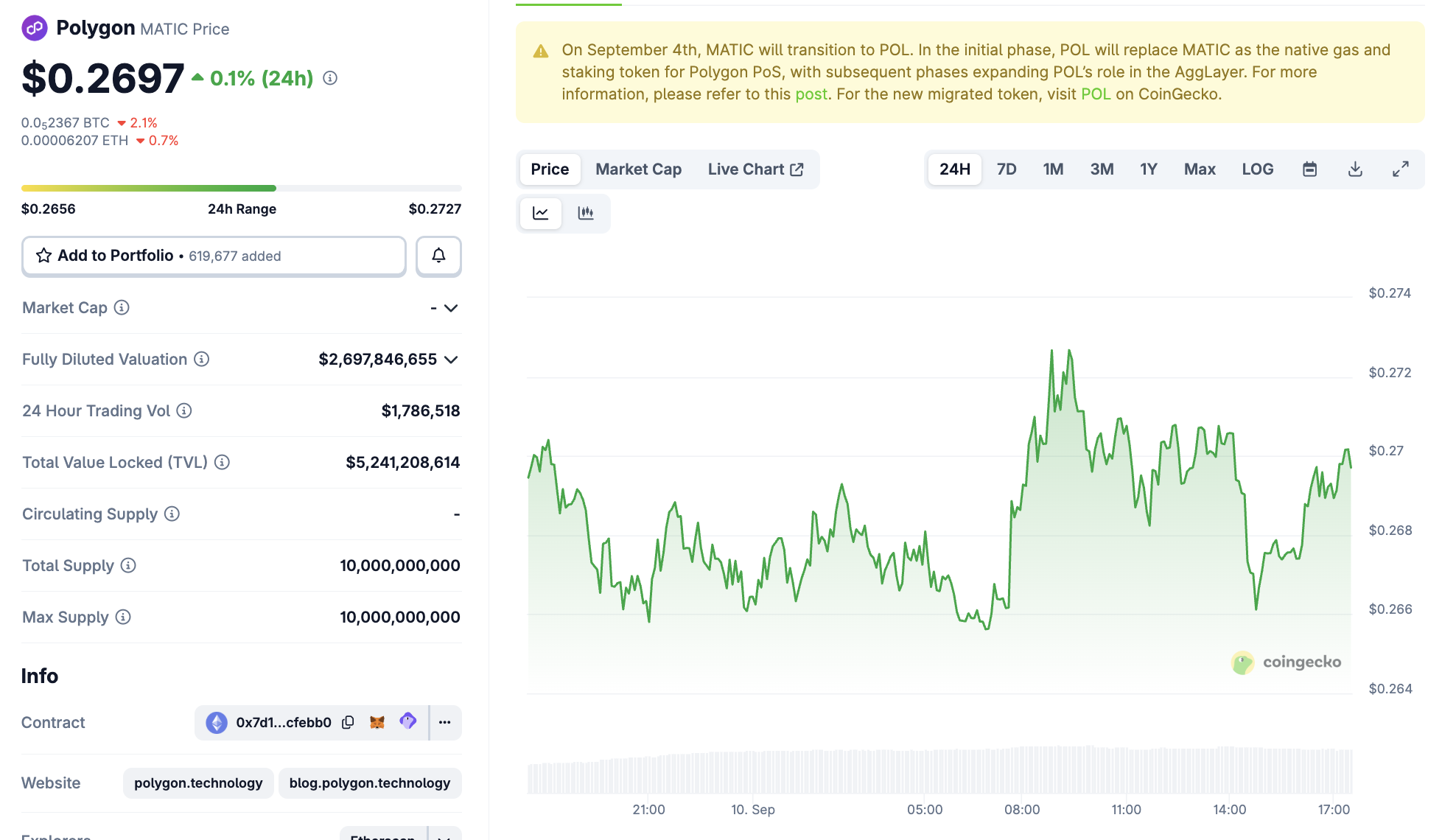
Polygon (MATIC) Price PerformancePolygon (MATIC) Price Performance. Source: CoinGecko

Nailwal was very clear that these delays aren’t going to hamper Polygon’s ambitious upgrade plans. He claimed that any major upgrade will involve growing pains, but that the firm is still completely committed to improving on-chain capacity, reliability, and overall resilience. These speed modifications were just the first part of the plan.

Clearly, skilled and dedicated developers can help make these dreams a reality. If Polygon has any other unexpected delays while improving its infrastructure, we can hope that the team will resolve these issues with similar urgency.


Disclaimer: The articles reposted on this site are sourced from public platforms and are provided for informational purposes only. They do not necessarily reflect the views of MEXC. All rights remain with the original authors. If you believe any content infringes on third-party rights, please contact service@support.mexc.com for removal. MEXC makes no guarantees regarding the accuracy, completeness, or timeliness of the content and is not responsible for any actions taken based on the information provided. The content does not constitute financial, legal, or other professional advice, nor should it be considered a recommendation or endorsement by MEXC.

You May Also Like

Digitap Raises Over $4M: A Comparison with DeepSnitch AI

Digitap Raises Over $4M: A Comparison with DeepSnitch AI

Both DeepSnitch AI and Digitap ($TAP) have been highlighted within some crypto communities for their distinct approaches. Although the two coins take a very different
Share
Crypto Ninjas2026/01/18 23:42
China Blocks Nvidia’s RTX Pro 6000D as Local Chips Rise

China Blocks Nvidia’s RTX Pro 6000D as Local Chips Rise

The post China Blocks Nvidia’s RTX Pro 6000D as Local Chips Rise appeared on BitcoinEthereumNews.com. China Blocks Nvidia’s RTX Pro 6000D as Local Chips Rise China’s internet regulator has ordered the country’s biggest technology firms, including Alibaba and ByteDance, to stop purchasing Nvidia’s RTX Pro 6000D GPUs. According to the Financial Times, the move shuts down the last major channel for mass supplies of American chips to the Chinese market. Why Beijing Halted Nvidia Purchases Chinese companies had planned to buy tens of thousands of RTX Pro 6000D accelerators and had already begun testing them in servers. But regulators intervened, halting the purchases and signaling stricter controls than earlier measures placed on Nvidia’s H20 chip. Image: Nvidia An audit compared Huawei and Cambricon processors, along with chips developed by Alibaba and Baidu, against Nvidia’s export-approved products. Regulators concluded that Chinese chips had reached performance levels comparable to the restricted U.S. models. This assessment pushed authorities to advise firms to rely more heavily on domestic processors, further tightening Nvidia’s already limited position in China. China’s Drive Toward Tech Independence The decision highlights Beijing’s focus on import substitution — developing self-sufficient chip production to reduce reliance on U.S. supplies. “The signal is now clear: all attention is focused on building a domestic ecosystem,” said a representative of a leading Chinese tech company. Nvidia had unveiled the RTX Pro 6000D in July 2025 during CEO Jensen Huang’s visit to Beijing, in an attempt to keep a foothold in China after Washington restricted exports of its most advanced chips. But momentum is shifting. Industry sources told the Financial Times that Chinese manufacturers plan to triple AI chip production next year to meet growing demand. They believe “domestic supply will now be sufficient without Nvidia.” What It Means for the Future With Huawei, Cambricon, Alibaba, and Baidu stepping up, China is positioning itself for long-term technological independence. Nvidia, meanwhile, faces…
Share
BitcoinEthereumNews2025/09/18 01:37
The Economics of Self-Isolation: A Game-Theoretic Analysis of Contagion in a Free Economy

The Economics of Self-Isolation: A Game-Theoretic Analysis of Contagion in a Free Economy

Exploring how the costs of a pandemic can lead to a self-enforcing lockdown in a networked economy, analyzing the resulting changes in network structure and the existence of stable equilibria.
Share
Hackernoon2025/09/17 23:00