

When the Dollar Rallies, Safe Havens Break: Bitcoin vs. Gold in the Iran Shock
The current US-Iran conflict has resulted in significant geopolitical upheaval, leading to increased market volatility worldwide. It has also prompted individual traders to reevaluate conventional safe assets like gold and new options, such as Bitcoin.
Gold initially experienced a boost due to safe-haven interest; however, it later faced a downturn as the US dollar gained strength and bond yields increased.
This demonstrated that broader economic factors can take precedence over purchasing behavior influenced by crises.
The rapid recovery from Bitcoin's volatility is indicative of its expanding significance as an alternative asset. Market mood and liquidity levels, however, had a far larger role in the price changes.
Cryptocurrencies have emerged as notable performers among various asset categories since the onset of the Iran conflict, yet the strength of these assets could be influenced by timing factors.
Bitcoin, the leading cryptocurrency, along with a selection of smaller market cap digital assets, has provided a stable refuge amidst the fluctuations seen in equities, gold, and oil markets.
With crude oil experiencing a remarkable increase of over 40%, bullion has seen a decline of approximately 5% for the month, while the MSCI World Index has dropped by 4%.
On the other hand, during Tuesday's Asian trading, Bitcoin rose beyond the $75,000 psychological barrier, marking an almost 14% rise from when the conflict started at the end of February.
With rising demand for dollar liquidity guiding global asset movements, the strength of the dollar had a substantial influence on the performance of both Bitcoin and gold.
The financial markets have always been a reliable predictor of political instability and geopolitical crises.
Investors seeking to hedge their bets against growing geopolitical tensions often put their money into "safe haven" assets, those whose value is expected to stay stable or even rise in this uncertain market.
Due to its limited availability and history of protecting wealth, gold has always been considered the benchmark for secure investments.
The rise of Bitcoin in the last several years has been the subject of much debate. Would this decentralized digital money be able to serve the same purpose as a modern, borderless alternative?
The Iran War offered a good chance to study Bitcoin's performance as a possible safe-haven asset in real-time.
Global financial markets have felt the effects of the upheaval. Anxieties over possible Strait of Hormuz closure and escalating military tensions have prompted worries about major disruptions to energy supply.
International energy markets place a premium on this crucial canal since it is expected to carry over 20% of the world's oil. Financial markets were more volatile as a result of the sharp spike in oil prices caused by the escalating tensions. As investors reevaluated the dangers of inflation, supply chain disruptions, and expected economic growth, global stock indices fell.
When times are tough, people like to put their money into things they know they can trust: safe havens. This time around, the response across different types of assets was much more complex than usual.
Gold's Mixed Response
In the early stages of a global crisis, gold's reaction was predictable. People sought stability in the face of uncertainty, which stoked a fire of interest.
Due to investors shifting their money away from unconventional safe-haven solutions, the value of gold skyrocketed as the crisis intensified.
However, the increase in gold prices was temporary.
Due to rising US Treasury rates and a stronger US currency, gold's value fell sharply. Because it does not provide any income, these factors often make the precious metal less attractive.
Even as tensions were continuing to rise, gold fell by more than 1% at one point.
This highlighted the reality that long-term economic considerations, such as changes in interest rates or currency strength, might at times be more important than short-term investments in safe-haven assets.
These swings show that even a popular hedge, like gold, may experience temporary adjustments when people react to shifts in the economy as a whole or prioritize their liquidity needs.
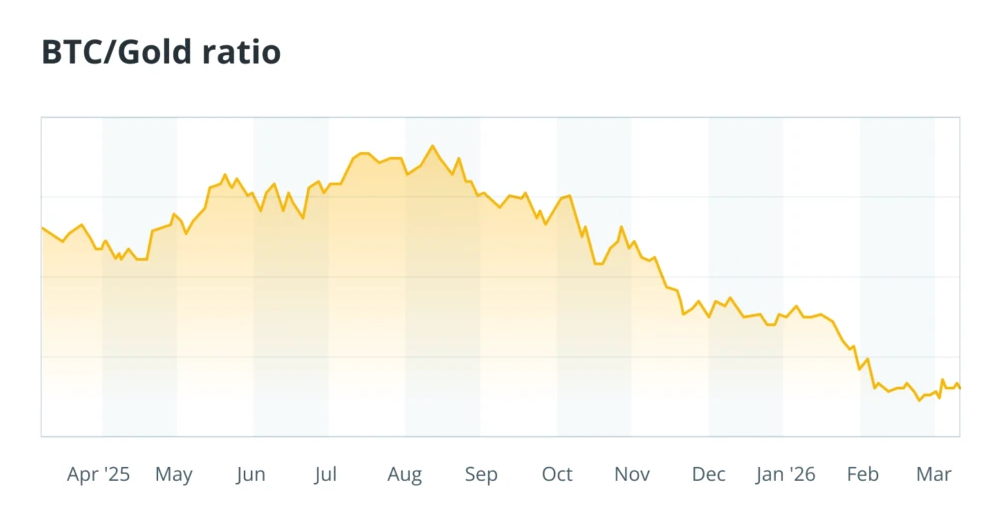 Source: cbonds
Market players momentarily sold gold and other assets as a result of the recent shock caused by the war in Iran.
When people are afraid of losing money due to extreme market volatility, they may sell their assets fast rather than hold onto commodities or securities.
At the outset of the war, the allure of gold as a safe haven was temporarily overshadowed by the increased demand for US dollars and general liquidity. In addition, bond rates rose as inflation fears intensified due to rising oil costs, further dragging gold prices down.
An essential trend is shown by this tendency. When economies and world governments are in turmoil, many people go to gold as a safe haven.
Prioritizing quick cash and liquidity to handle margin calls, make portfolio modifications, or navigate risks is common in the early stages of a crisis.
Volatile Yet Resilient Bitcoin
During the war, Bitcoin's reaction was different from gold's. As market players mostly reduced their risk and redirected their investment plans during the early stage of the geopolitical tensions, digital currencies saw considerable swings.
Bitcoin recovered significantly despite the initial volatility. The price of Bitcoin dropped to $63,106 on February 28, 2026, just before the conflict broke out.
It bounced back to $73,156 on March 5, 2026, and has marched forward since.
The current trajectory of Bitcoin's price suggests that individuals are once again seeking alternative safeguards against economic and geopolitical uncertainty. The fluctuations in Bitcoin's price are predominantly shaped by overall market sentiment and liquidity conditions, rather than solely by geopolitical factors.
Dollar Plays a Key Part
The value of these assets was greatly affected by how the dollar performed throughout the battle.
The dollar's value surged as people flocked to it for safety and liquidity.
Gold prices tend to fall as the value of the dollar rises on global markets because people holding other currencies find it more expensive to buy gold.
The value of Bitcoin is also affected by changes in the dollar. The demand for cryptocurrencies can momentarily decrease, causing prices to fall, during periods of uncertainty when capital flows towards traditional safe assets such as cash and reserve currencies.
Gold and Bitcoin's performance in this setting may be understood by examining the interplay of many components, such as dollar strength, liquidity preferences, and cautious market attitude.
Despite their obvious long-term characteristics, they also clarify why neither gold nor Bitcoin offered a unique, persistent safe-haven rise in the early phases of the war.
Inflation Play
During the conflict, energy markets played a crucial role in shaping investor behavior. Concerns regarding potential disruptions to trade through the Strait of Hormuz have led to an increase in oil prices, subsequently fueling the escalation.
Should this crucial juncture face substantial disruption, the expenses associated with energy and transportation worldwide will increase, thereby exacerbating inflationary pressures on a global level.
Inflation forecasts over the long run tend to support gold as a classic inflation hedge, but these assumptions may have the opposite impact in the near run.
Interest rates and bond yields tend to rise when market participants anticipate tighter monetary policies from governments or markets in response to growing inflation concerns.
Gold prices might be temporarily pushed down if interest-bearing assets become more attractive due to higher yields, rather than non-yielding commodities.
Noticeably contradictory is the link between inflation expectations and Bitcoin. Bitcoin is more often seen as an asset with a high degree of volatility than as a developed defense against inflation.
As a result, its response to inflation indicators seems to be more erratic and affected by the prevailing risk sentiment.
Will the Real Safe Haven Please Stand Up
The Iranian crisis highlighted an important difference between established and emerging safe-haven assets.
Within the context of the international monetary and financial system, gold is crucial. A large amount of trust and credibility may be placed in it during periods of economic or geopolitical unrest because of its long history, large holdings by central banks, and enduring role as a reserve asset.
On the other hand, Bitcoin functions inside a digital financial ecosystem that is still in its early stages and is constantly evolving.
Geopolitical events, network adoption, legislative changes, technical improvements, and the risk tolerance of investors in both traditional and cryptocurrency markets are some of the factors that drive its price variations.
'Digital' Gold Finally?
Proponents of Bitcoin have used the term "digital gold" to describe it for a long time, drawing attention to its status as a modern, decentralized alternative to the traditional safe-haven commodity.
An example from Iran's condition allowed us to test this claim in the real world.
Despite its strength, Bitcoin's behavior during the turmoil was not characteristic of a conventional safe haven asset.
However, the typical macroeconomic elements, including the dollar's strength, inflation expectations, and fluctuations in bond yields, remained favorable for the gold price.
Shifts in how investors feel, their willingness to take risks, and the prevailing liquidity trends in other markets have significantly influenced Bitcoin's fluctuations and its rebound.
The latest moves show that Bitcoin is becoming more and more of a reliable store of value during tough times, but it is still far from being a continuously secure asset.
Instead, it keeps evolving into a hybrid asset on the global financial scene.
Be at the heart of TradFi–DeFi collaboration at Money20/20 Asia 2026.

Are you looking to forge partnerships with banks and fintechs? To expand into new markets across Asia, or to secure funding from top-tier investors? This April, the world of digital assets, blockchain, and Web3 converges with the biggest players in APAC’s financial ecosystem at Money20/20 Asia 2026 and its brand new ‘Intersection’ zone, complete with a dedicated content stage, TradFi-Defi innovator showcase, and curated networking spaces. From traditional banking giants to decentralised innovators, private equity leaders, and cutting-edge fintech disruptors, this is where they meet to forge partnerships, spark dialogue, and shape the future of finance.


You May Also Like

The changing face of elder care in Malaysia — Sayed Mohammad Reza Yamani Sayed Umar

Not a loophole: Singapore AI export controls let China tap US AI legally

Exclusive interview with Smokey The Bera, co-founder of Berachain: How the innovative PoL public chain solves the liquidity problem and may be launched in a few months



