Monero suffered its most severe blockchain reorganization on Sunday, September 14, when 19 blocks were replaced by a competing chain. The incident, which unfolded between block heights 3,499,659 and 3,499,678, lasted roughly 43 minutes and rewrote 36 minutes of chain history, according to blockchain explorer data. The reorg forced the network to discard 118 previously confirmed transactions, unsettling users and exchanges. Analysts described the event as unprecedented in Monero’s history and noted it followed recent reports that Qubic had seized control of more than 51% of the network’s hashrate, a position that could allow chain rewrites or double-spending at a cost of around $100,000 per day. Despite the disruption, Monero’s native coin, XMR, saw a price uptick. XMR rose 7% in the past day before retracing to the current price. As of this press time, XMR trades at $305, extending its weekly and monthly gains to 12% and 29%, respectively.XRM Weekly Price Chart Source: CoinMarketCap 118 Transactions Invalidated After Monero’s Deepest Chain Reorg Monero’s largest blockchain reorganization to date wiped out 118 previously confirmed transactions, creating visible disruption for users and exchanges. Blockchain researcher Andy Fitche confirmed that the competing chain invalidated confirmed payments, noting that wallets displayed alerts showing transactions marked in red as “invalid.” Avdiu Sazan, another community analyst, said the competing blocks were linked to the mining pool Qubic. He described the event as “a casual 18 blocks reorg.” Providing possible reasons for the recent event, crypto podcaster Xenu suggested Qubic aimed to “stop the bleeding” of XMR’s price, sparking debate on the chain’s future. Reorganizations occur when two versions of a blockchain compete, and miners extend different ledgers. The longest valid chain ultimately becomes the accepted history, discarding blocks on shorter chains. While one- or two-block reorgs occasionally occur on proof-of-work chains due to latency or simultaneous block discovery, Monero’s 19-block reorg is highly unusual and points to concentrated mining power or instability. The episode has reignited discussion around Monero’s network security. The community has floated potential safeguards, including localized mining, merge mining, or Dash-style ChainLocks, to reduce the risk of deep reorgs and 51% attacks. None, however, have been adopted, leaving mining pools like Qubic with disproportionate influence. Notably, the latest reorg exceeded Monero’s built-in 10-block protection, underscoring ongoing vulnerabilities in the protocol. Monero Supporters Double Down on the Network Despite Security and Privacy Concerns Monero supporters rallied behind the privacy-focused cryptocurrency this week despite mounting scrutiny after its deepest blockchain reorganization to date. Advocates took to X, insisting that Monero remains the only asset offering “true freedom,” contrasting its privacy guarantees with Bitcoin’s traceability under know-your-customer (KYC) regimes. “Monero is the only safe haven,” one supporter posted, while another, Meta Ryuk, said the asset poses unique challenges for regulators. “Bitcoin is a haven for them. Monero is a challenge.” Ryuk dismissed claims of traceability, calling them “unfounded.” Critics, however, questioned the network’s reliability following the 43-minute chain rewrite that invalidated 118 confirmed transactions. Dash DAO’s Joel Valenzuela likened the disruption to “Visa going down for 40 minutes,” warning that such instability would be unacceptable for mainstream systems. A crypto analyst said he would stop accepting XMR payments until the issue is resolved, calling the network “unreliable.” Meanwhile, Monero has been previously implicated in the criminal economy, particularly for laundering funds from CSAM sales, according to Chainalysis’s 2024 Crypto Crime Report. Vendors often convert Bitcoin into Monero via instant exchangers, taking advantage of its privacy features and lack of KYC to obscure transactions. Similarly, Finnish authorities traced Monero in the Julius Kivimäki case, where the hacker allegedly converted Bitcoin ransom payments into Monero via a non-KYC exchange to obscure the funds before transferring them to a dedicated walletMonero suffered its most severe blockchain reorganization on Sunday, September 14, when 19 blocks were replaced by a competing chain. The incident, which unfolded between block heights 3,499,659 and 3,499,678, lasted roughly 43 minutes and rewrote 36 minutes of chain history, according to blockchain explorer data. The reorg forced the network to discard 118 previously confirmed transactions, unsettling users and exchanges. Analysts described the event as unprecedented in Monero’s history and noted it followed recent reports that Qubic had seized control of more than 51% of the network’s hashrate, a position that could allow chain rewrites or double-spending at a cost of around $100,000 per day. Despite the disruption, Monero’s native coin, XMR, saw a price uptick. XMR rose 7% in the past day before retracing to the current price. As of this press time, XMR trades at $305, extending its weekly and monthly gains to 12% and 29%, respectively.XRM Weekly Price Chart Source: CoinMarketCap 118 Transactions Invalidated After Monero’s Deepest Chain Reorg Monero’s largest blockchain reorganization to date wiped out 118 previously confirmed transactions, creating visible disruption for users and exchanges. Blockchain researcher Andy Fitche confirmed that the competing chain invalidated confirmed payments, noting that wallets displayed alerts showing transactions marked in red as “invalid.” Avdiu Sazan, another community analyst, said the competing blocks were linked to the mining pool Qubic. He described the event as “a casual 18 blocks reorg.” Providing possible reasons for the recent event, crypto podcaster Xenu suggested Qubic aimed to “stop the bleeding” of XMR’s price, sparking debate on the chain’s future. Reorganizations occur when two versions of a blockchain compete, and miners extend different ledgers. The longest valid chain ultimately becomes the accepted history, discarding blocks on shorter chains. While one- or two-block reorgs occasionally occur on proof-of-work chains due to latency or simultaneous block discovery, Monero’s 19-block reorg is highly unusual and points to concentrated mining power or instability. The episode has reignited discussion around Monero’s network security. The community has floated potential safeguards, including localized mining, merge mining, or Dash-style ChainLocks, to reduce the risk of deep reorgs and 51% attacks. None, however, have been adopted, leaving mining pools like Qubic with disproportionate influence. Notably, the latest reorg exceeded Monero’s built-in 10-block protection, underscoring ongoing vulnerabilities in the protocol. Monero Supporters Double Down on the Network Despite Security and Privacy Concerns Monero supporters rallied behind the privacy-focused cryptocurrency this week despite mounting scrutiny after its deepest blockchain reorganization to date. Advocates took to X, insisting that Monero remains the only asset offering “true freedom,” contrasting its privacy guarantees with Bitcoin’s traceability under know-your-customer (KYC) regimes. “Monero is the only safe haven,” one supporter posted, while another, Meta Ryuk, said the asset poses unique challenges for regulators. “Bitcoin is a haven for them. Monero is a challenge.” Ryuk dismissed claims of traceability, calling them “unfounded.” Critics, however, questioned the network’s reliability following the 43-minute chain rewrite that invalidated 118 confirmed transactions. Dash DAO’s Joel Valenzuela likened the disruption to “Visa going down for 40 minutes,” warning that such instability would be unacceptable for mainstream systems. A crypto analyst said he would stop accepting XMR payments until the issue is resolved, calling the network “unreliable.” Meanwhile, Monero has been previously implicated in the criminal economy, particularly for laundering funds from CSAM sales, according to Chainalysis’s 2024 Crypto Crime Report. Vendors often convert Bitcoin into Monero via instant exchangers, taking advantage of its privacy features and lack of KYC to obscure transactions. Similarly, Finnish authorities traced Monero in the Julius Kivimäki case, where the hacker allegedly converted Bitcoin ransom payments into Monero via a non-KYC exchange to obscure the funds before transferring them to a dedicated wallet

Monero Jumps 7% Despite Largest-Ever Reorg Wiping 117 Transactions

2025/09/15 19:48
4 min read
For feedback or concerns regarding this content, please contact us at crypto.news@mexc.com

Monero suffered its most severe blockchain reorganization on Sunday, September 14, when 19 blocks were replaced by a competing chain. The incident, which unfolded between block heights 3,499,659 and 3,499,678, lasted roughly 43 minutes and rewrote 36 minutes of chain history, according to blockchain explorer data.

The reorg forced the network to discard 118 previously confirmed transactions, unsettling users and exchanges. Analysts described the event as unprecedented in Monero’s history and noted it followed recent reports that Qubic had seized control of more than 51% of the network’s hashrate, a position that could allow chain rewrites or double-spending at a cost of around $100,000 per day.

Despite the disruption, Monero’s native coin, XMR, saw a price uptick. XMR rose 7% in the past day before retracing to the current price. As of this press time, XMR trades at $305, extending its weekly and monthly gains to 12% and 29%, respectively.
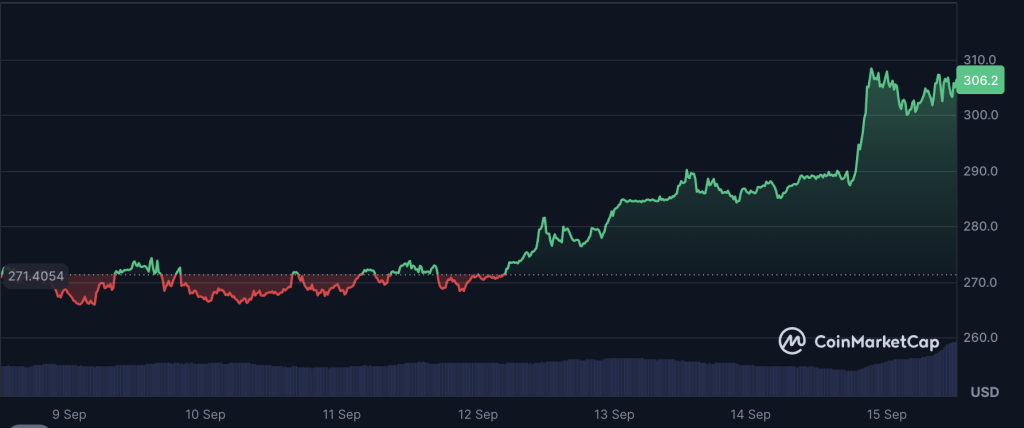
XRM Weekly Price Chart Source: CoinMarketCap

118 Transactions Invalidated After Monero’s Deepest Chain Reorg

Monero’s largest blockchain reorganization to date wiped out 118 previously confirmed transactions, creating visible disruption for users and exchanges. Blockchain researcher Andy Fitche confirmed that the competing chain invalidated confirmed payments, noting that wallets displayed alerts showing transactions marked in red as “invalid.”

Avdiu Sazan, another community analyst, said the competing blocks were linked to the mining pool Qubic. He described the event as “a casual 18 blocks reorg.” Providing possible reasons for the recent event, crypto podcaster Xenu suggested Qubic aimed to “stop the bleeding” of XMR’s price, sparking debate on the chain’s future.

Reorganizations occur when two versions of a blockchain compete, and miners extend different ledgers. The longest valid chain ultimately becomes the accepted history, discarding blocks on shorter chains.

While one- or two-block reorgs occasionally occur on proof-of-work chains due to latency or simultaneous block discovery, Monero’s 19-block reorg is highly unusual and points to concentrated mining power or instability.

The episode has reignited discussion around Monero’s network security. The community has floated potential safeguards, including localized mining, merge mining, or Dash-style ChainLocks, to reduce the risk of deep reorgs and 51% attacks.

None, however, have been adopted, leaving mining pools like Qubic with disproportionate influence. Notably, the latest reorg exceeded Monero’s built-in 10-block protection, underscoring ongoing vulnerabilities in the protocol.

Monero Supporters Double Down on the Network Despite Security and Privacy Concerns

Monero supporters rallied behind the privacy-focused cryptocurrency this week despite mounting scrutiny after its deepest blockchain reorganization to date. Advocates took to X, insisting that Monero remains the only asset offering “true freedom,” contrasting its privacy guarantees with Bitcoin’s traceability under know-your-customer (KYC) regimes.

“Monero is the only safe haven,” one supporter posted, while another, Meta Ryuk, said the asset poses unique challenges for regulators. “Bitcoin is a haven for them. Monero is a challenge.” Ryuk dismissed claims of traceability, calling them “unfounded.”

Critics, however, questioned the network’s reliability following the 43-minute chain rewrite that invalidated 118 confirmed transactions.

Dash DAO’s Joel Valenzuela likened the disruption to “Visa going down for 40 minutes,” warning that such instability would be unacceptable for mainstream systems.

A crypto analyst said he would stop accepting XMR payments until the issue is resolved, calling the network “unreliable.”

Meanwhile, Monero has been previously implicated in the criminal economy, particularly for laundering funds from CSAM sales, according to Chainalysis’s 2024 Crypto Crime Report. Vendors often convert Bitcoin into Monero via instant exchangers, taking advantage of its privacy features and lack of KYC to obscure transactions.

Similarly, Finnish authorities traced Monero in the Julius Kivimäki case, where the hacker allegedly converted Bitcoin ransom payments into Monero via a non-KYC exchange to obscure the funds before transferring them to a dedicated wallet.

Market Opportunity
Everscale Logo
Everscale Price(EVER)
$0.00304
$0.00304$0.00304
-1.61%
USD
Everscale (EVER) Live Price Chart
Disclaimer: The articles reposted on this site are sourced from public platforms and are provided for informational purposes only. They do not necessarily reflect the views of MEXC. All rights remain with the original authors. If you believe any content infringes on third-party rights, please contact crypto.news@mexc.com for removal. MEXC makes no guarantees regarding the accuracy, completeness, or timeliness of the content and is not responsible for any actions taken based on the information provided. The content does not constitute financial, legal, or other professional advice, nor should it be considered a recommendation or endorsement by MEXC.

You May Also Like

The Channel Factories We’ve Been Waiting For

The Channel Factories We’ve Been Waiting For

The post The Channel Factories We’ve Been Waiting For appeared on BitcoinEthereumNews.com. Visions of future technology are often prescient about the broad strokes while flubbing the details. The tablets in “2001: A Space Odyssey” do indeed look like iPads, but you never see the astronauts paying for subscriptions or wasting hours on Candy Crush.  Channel factories are one vision that arose early in the history of the Lightning Network to address some challenges that Lightning has faced from the beginning. Despite having grown to become Bitcoin’s most successful layer-2 scaling solution, with instant and low-fee payments, Lightning’s scale is limited by its reliance on payment channels. Although Lightning shifts most transactions off-chain, each payment channel still requires an on-chain transaction to open and (usually) another to close. As adoption grows, pressure on the blockchain grows with it. The need for a more scalable approach to managing channels is clear. Channel factories were supposed to meet this need, but where are they? In 2025, subnetworks are emerging that revive the impetus of channel factories with some new details that vastly increase their potential. They are natively interoperable with Lightning and achieve greater scale by allowing a group of participants to open a shared multisig UTXO and create multiple bilateral channels, which reduces the number of on-chain transactions and improves capital efficiency. Achieving greater scale by reducing complexity, Ark and Spark perform the same function as traditional channel factories with new designs and additional capabilities based on shared UTXOs.  Channel Factories 101 Channel factories have been around since the inception of Lightning. A factory is a multiparty contract where multiple users (not just two, as in a Dryja-Poon channel) cooperatively lock funds in a single multisig UTXO. They can open, close and update channels off-chain without updating the blockchain for each operation. Only when participants leave or the factory dissolves is an on-chain transaction…
Share
BitcoinEthereumNews2025/09/18 00:09
US Prosecutors Seek $327K Crypto Forfeiture Over Romance Scam

US Prosecutors Seek $327K Crypto Forfeiture Over Romance Scam

The post US Prosecutors Seek $327K Crypto Forfeiture Over Romance Scam appeared on BitcoinEthereumNews.com. In brief The Massachusetts District of the U.S. Attorney
Share
BitcoinEthereumNews2026/03/03 06:20
Pump.fun: Can $1.8mln whale buying help PUMP target $0.0022?

Pump.fun: Can $1.8mln whale buying help PUMP target $0.0022?

The post Pump.fun: Can $1.8mln whale buying help PUMP target $0.0022? appeared on BitcoinEthereumNews.com. Since reaching $0.0016, Pump.fun has shown upward momentum
Share
BitcoinEthereumNews2026/03/03 06:01