

Rapidise: The Rise of Vision-Driven Intelligence
Rapidise expands into Vision AI platforms reflecting a broader shift toward edge-based intelligence. As organizations embed AI into physical environments, real-time responsiveness, compliance, and scalability are becoming critical to delivering seamless customer experiences across industries.
Edge AI and Vision Systems Move to the Center of CX Infrastructure
Rapidise Technology Pvt. Ltd., an India-based original design manufacturer (ODM), has expanded its Vision AI and intelligent camera platform capabilities, reflecting a broader shift in how enterprises design and deploy AI-driven systems at the edge. The development underscores the increasing importance of integrated platforms that combine hardware engineering, embedded intelligence, and compliant manufacturing to support real-time, vision-enabled applications.
As organizations across transportation, public safety, and industrial sectors accelerate their digital transformation efforts, computer vision is emerging as a foundational layer of operational intelligence. The ability to capture, process, and act on visual data in real time is no longer experimental—it is becoming integral to how businesses deliver efficiency, safety, and responsiveness at scale.
The Expanding Role of Vision AI in Customer Experience
Customer experience is evolving beyond traditional digital touchpoints into physical environments. Whether in mobility ecosystems, smart cities, or industrial operations, user interactions are increasingly shaped by intelligent systems that interpret and respond to real-world conditions.
This shift is driven by rising expectations for immediacy and reliability. End users expect faster resolutions, safer interactions, and seamless service continuity. As a result, enterprises are investing in technologies that can deliver contextual insights without delays associated with centralized processing.
Edge computing plays a critical role in enabling this transformation. By processing data closer to its source, edge AI reduces latency and supports real-time decision-making. However, implementing such systems at scale introduces complexity—ranging from integration challenges to cybersecurity risks and regulatory compliance requirements.
For CX leaders, the challenge lies in aligning these technologies with business outcomes—ensuring that investments in AI and infrastructure translate into measurable improvements in customer journeys and operational performance.
Strategic Shift Toward Integrated Platform Models
Rapidise expands signalling a strategic shift toward providing vertically integrated solutions that span the full product lifecycle—from design and prototyping to manufacturing and deployment. This model addresses a key pain point for enterprises: the fragmentation of hardware, software, and production workflows.
By consolidating these capabilities, the company aims to simplify the development of AI-enabled camera systems while enabling faster time-to-market. This approach is particularly relevant as organizations seek to scale deployments across geographies and use cases.
Brijesh Kamani, CEO and Managing Director, Rapidise, indicated that vision AI is becoming a critical layer for connected devices, enabling systems to interpret physical environments in real time. This perspective aligns with broader industry trends, where context-aware systems are redefining how businesses interact with customers and manage operations.
The emphasis on modular platform architectures further supports adaptability. Enterprises can customize solutions for specific applications—such as fleet management or industrial monitoring—while maintaining consistency in performance and scalability.
Technology Architecture: From Imaging to Intelligence
At the core of Rapidise offer is the integration of advanced imaging hardware. Alongwith embedded computing and AI-driven computer vision software. These systems are designed to process video data locally, enabling real-time analytics and automated decision-making.
The platforms incorporate embedded firmware and edge AI processing capabilities, allowing them to function independently of centralized cloud systems. This reduces latency and enhances reliability, particularly in environments where immediate responses are critical.
An additional layer of functionality is provided through Human Machine Interface (HMI) capabilities. These interfaces translate visual data into actionable insights, enabling operators to interact with systems more intuitively. In industrial and operational contexts, this can significantly improve decision-making efficiency.
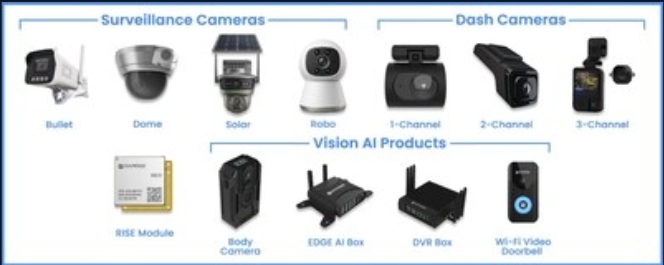
The company’s product ecosystem includes surveillance cameras, dash cameras, body cameras, edge AI processing units, and video management systems. These solutions are built on modular frameworks, enabling rapid customization while supporting large-scale deployment.
In transportation use cases, AI-powered driver monitoring systems analyze behavioral patterns to detect fatigue, distraction, or unsafe driving practices. Such capabilities not only enhance safety but also contribute to operational efficiency and regulatory compliance.
Regulatory Compliance as a Design Imperative
As vision-enabled systems become more pervasive, regulatory compliance is emerging as a critical factor in technology adoption. Governments are introducing stricter standards for cybersecurity, device integrity, and system reliability.
In India, compliance with frameworks such as Standardization Testing and Quality Certification (STQC) and AIS-184 is essential for deploying camera-based systems, particularly in transportation and public safety applications.
Rapidise integrating with engineering and manufacturing approach enables compliance requirements to be embedded into product design from the outset. According to Mohit Aggarwal, Chief Technology Officer, meeting such standards requires close coordination across hardware, firmware, and security layers.
For enterprises, this integration reduces the risk of deployment delays and ensures that systems can be scaled without compromising on regulatory adherence. From a CX perspective, compliance also plays a role in building trust—particularly in applications involving surveillance and data collection.
Implications for Customer Experience
The expansion of Vision AI capabilities has direct implications for how organizations design and deliver customer experiences. By enabling real-time monitoring and analysis, these systems allow businesses to move from reactive to proactive service models.
In transportation, for example, driver monitoring systems can identify risks before they lead to incidents, improving safety outcomes and enhancing user confidence. In smart infrastructure, vision-enabled analytics can optimize traffic flows, reduce congestion, and improve service efficiency.
From an operational standpoint, edge AI reduces reliance on centralized systems, enabling faster response times and greater resilience. This is particularly valuable in environments where delays can impact safety, service continuity, or customer satisfaction.
The integration of intelligent camera systems also enhances transparency. Real-time visibility into operations allows organizations to provide more accurate information to customers, improving communication and trust.
Additionally, modular platform architectures support personalization at scale. Enterprises can tailor solutions to specific contexts and customer needs while maintaining operational efficiency.
Industry Implications: Toward Scalable AI Infrastructure
Announcement by Rapidise reflects a broader industry transition from isolated AI deployments to scalable, production-ready systems. As organizations seek to operationalize AI across multiple use cases, the demand for integrated platforms is expected to grow.
This shift is likely to intensify competition among ODMs and technology providers. Companies that can offer end-to-end capabilities—combining engineering expertise with manufacturing scale—will be better positioned to support enterprise requirements.
At the same time, the convergence of hardware, software, and AI is reshaping how digital infrastructure is built. Vision-enabled systems are becoming a core component of this infrastructure, supporting applications ranging from smart cities to industrial automation.
The growing emphasis on regulatory compliance, in fact, further reinforces the need for integrated approaches. As standards evolve, organizations must ensure that their systems are both technologically advanced and compliant with local and global requirements.
The Future of CX in an Edge-Driven World
The evolution of customer experience is, in fact, increasingly tied to the intelligence embedded in physical environments. Vision AI and edge computing are enabling organizations to deliver faster, safer, and more context-aware interactions.
For CX leaders, the focus, in fact, is shifting from isolated digital touchpoints to holistic ecosystems that integrate data, analytics, and operational execution. This requires a rethinking of technology strategies, with greater emphasis on scalability, interoperability, and compliance.
Investments in integrated platforms that combine hardware and AI capabilities will play a critical role in this transformation. As enterprises continue to embed intelligence into their operations, the ability to process and act on real-time data will become a defining factor in competitive differentiation.
Rapidise expanding into Vision AI platforms offers a view into this evolving landscape—one where the boundaries between digital and physical experiences are increasingly blurred, and where real-time intelligence becomes central to delivering consistent, high-quality customer experiences.
Key Takeaways
- Edge AI is becoming foundational to CX delivery
Real-time data processing at the edge enables faster, context-aware interactions, making it a critical component of modern customer experience infrastructure. - Vision AI is shifting CX into physical environments
Customer experience is no longer limited to digital channels—intelligent camera systems are enabling proactive, real-world interaction management across industries. - Integrated platforms reduce complexity and accelerate deployment
Combining hardware engineering, embedded AI, and manufacturing into a unified model simplifies implementation and shortens time-to-market for CX-driven solutions. - Regulatory compliance is now integral to experience design
Adherence to standards such as STQC and AIS-184 is not just operational—it directly impacts trust, reliability, and customer perception. - Proactive CX is enabled through real-time intelligence
Vision-enabled systems allow organizations to anticipate issues, improve safety, and optimize operations before disruptions occur. - Modular architectures enable scalable personalization
Flexible platform design supports customization across use cases while maintaining consistency and efficiency at scale. - Operational visibility is becoming a competitive differentiator
Real-time monitoring and analytics enhance transparency. Thus, enabling better decision-making and improved communication with customers. - End-to-end ecosystem control strengthens CX outcomes
Vertical integration across design, development, and manufacturing ensures consistency, quality, and reliability. Especially, in delivering customer-facing technologies.
The post Rapidise: The Rise of Vision-Driven Intelligence appeared first on CX Quest.


You May Also Like

Why Bitcoin Just Faced Resistance After Recent Support

Crypto Market Drops as Fear Grows and Major Assets Decline

Trump's media company craters to record low as losses keep stacking up



