The Clarity Act Banned Stablecoin Yield to Protect Banks: It May Have Just Made Tether and DeFi the Winners
Regulation toward cryptocurrencies, specifically in the U.S., have largely been progressive to the industry since President Trump took office. The CLARITY Act, a proposed legislation that would clarify oversight and legitimize stablecoins was supposed to be crypto’s big moment. However, on March 23 we got an updated version of the market structure bill from congress that highlighted a ban on yield payments for simply holding a stablecoin.
This news has triggered a massive sell off in Circle (the issuer of USDC) stock, falling over 20% yesterday, making it the largest decline in a single day since its IPO on June 5 last year. Coinbase, which had built a revenue sharing arrangement around USDC saw a drop of over 9%. Meanwhile, the irony in this story is hard to ignore. Tether, which never passed yield to users in the first place, walked away from this news unscathed. What was framed as regulatory clarity has actually changed the competitive environment, with the regulated US stablecoins not being the winners here, while pushing the real yield opportunity elsewhere.
What the Clarity Act Actually Bans and What It Doesn’t
The updated draft of the CLARITY Act released on March 23 highlighted a clear stance on passive rewards on stables. Any sort of interest paid out for simply holding a stablecoin is banned, according to CoinDesk’s analysis of the draft. That means passive reward, the kind Circle was distributing to USDC holders through its Coinbase revenue sharing arrangement, is off the table. While a passive yield is banned, Disruption Banking analysis shows that rewards tied to activity such as payments, transfers or platform activity remain in the updated bill. This compromise was negotiated by Senators Thom Tillis and Angela Alsobrooks, with White House backing confirmed on March 20.
The task of reaching a conclusion on what can be seen as a permissible reward and to draft anti-evasion rules now are in the hands of the SEC, CFTC and the U.S. Treasury. The fact is that the bill still has to traverse through many steps before it becomes law and this is an important point to keep in mind. The Banking Committee markup is currently set for the second half of April, after Easter recess ends on April 13. From here, the bill has to go through a set of five hurdles. Committee approval, a Senate floor vote that requires 60 votes, reconciliation with both the Agriculture Committee and House versions and finally a presidential signature. Even though the journey for the bill to be enacted seems long at the moment, the way Circle and Coinbase stock reacted so sharply is indicative of the market’s already repricing the news that has come out.
Circle’s Worst Week: How the Revenue Model Broke
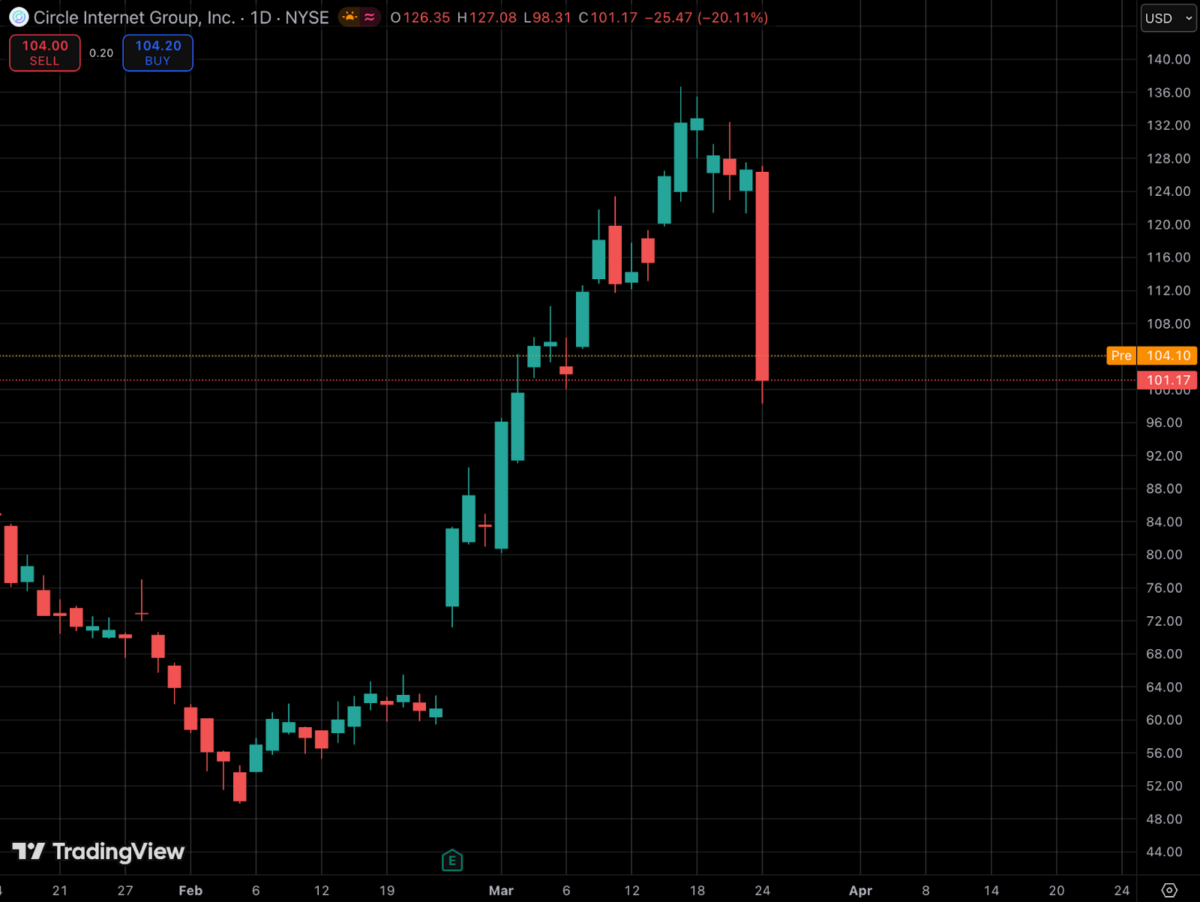
Circle posted its worst week since its IPO in June last year as its stock fell over 20% in a single day yesterday, its sharpest decline in a day as reported by CNBC, and now trading near $101. This drop has effectively wiped out the gains seen over the past two weeks. At the same time, Coinbase reacted in the same vein to the yield ban news, with its stock dropping over 9%. The drawdowns actually make sense once you understand how the two companies are connected.
Circle holds U.S. Treasury securities as the reserves backing the $75 billion worth of USDC in circulation. Those Treasuries generate yield, Circle shares a portion of that income with Coinbase, and Coinbase passes it along to users as rewards for holding USDC. This entire system is what the updated draft of the CLARITY ACT targets with its ban on passive stablecoin rewards. To add to this, Coinbase draws in roughly 20% of their total revenue via USDC related revenue, per the company’s financial disclosures, and hence starts to make sense why the drawdown was as steep as it was on the back of this news. This is where the real irony kicks in. Circle was actually the issuer that gave yield back to consumers rather than keeping it all like their competitors Tether but the new rules hurt the one that gives it away.
Tether Wins by Default, DeFi Enters Regulatory Limbo
This updated draft has actually meant that Tether comes out as the winner. The company has always kept all reserve income from USDT to itself, never passing a cent of yield to holders, which means the CLARITY Act’s ban on passive stablecoin rewards doesn’t change a single thing about how Tether operates. To add to that, on the same day Circle was in freefall, Tether announced it had hired a Big Four accounting firm for a full audit of USDT reserves, a move that, regardless of the timing being coincidental, positioned it as the steady, credible alternative while its biggest U.S. competitor was dealing with an existential question about its business model.
With USDT dominance at 58% at a marketcap of $184.84 billion compared to USDC’s $78.68 billion, this news could very well widen the gap between the two largest stablecoins on the market today.
The more complicated question is what happens to yield that doesn’t come from a company at all. Decentralized protocols, automated lending markets that run entirely on software code without any central company behind them, currently offer anywhere between 5% and 20% annual returns on stablecoins, and platforms like Aave, Ethena and Compound have been doing this at scale for years. The CLARITY Act broadly targets payment stablecoins, but its DeFi provisions are still unwritten, leaving an enormous grey area unresolved. The fundamental problem Congress faces is that these protocols have no CEO to call before a committee, no headquarters to inspect and no corporate structure to regulate. Whether legislation written for companies can meaningfully govern software running autonomously on decentralized networks is a question the bill doesn’t answer, and right now, nobody in Washington seems to have a clear answer either.
What to Watch
The next hard date on the calendar is the Banking Committee markup, currently scheduled for the second half of April once Easter recess ends on April 13. That’s the first real legislative vote on whether the yield ban survives in its current form, and prediction market analysis from Seeking Alpha currently puts the odds of passage at around 68%. For Circle and Coinbase, that number matters a lot. Both stocks are likely to remain under pressure as long as the market believes the yield ban goes through unchanged, but any signs of softened language around what qualifies as a permissible reward could quickly become a recovery catalyst.
The other thing worth watching is whether capital starts visibly rotating out of centralized stablecoin yield arrangements and into DeFi alternatives, if activity on platforms like Aave and Ethena starts picking up meaningfully in the coming weeks, that’s the market giving its clearest signal yet about where yield goes when regulation closes the door on one architecture and leaves another one untouched.
This news has dropped during a time when the broader crypto market is already grappling with a very unsettling macro setting. Bitcoin is currently in a positive trend caused by a geopolitical relief rally, hovering between the $71 to $72K mark. That said, this update on stablecoin regulation adds another entirely different but extremely consequential hurdle that the market has not fully digested. Stablecoins are the primary on-ramp into crypto, the infrastructure that connects fiat to the digital asset market, and a structural change to how they work and what they can offer doesn’t stay contained to Circle’s stock price. If the on-ramp changes, everything downstream shifts with it, and that’s a dynamic the entire market will need to reckon with as the markup date gets closer.
Get seen where it counts. Advertise in Cryptopolitan Research and reach crypto’s sharpest investors and builders.
You May Also Like

The Protocol: Ethereum faces make-or-break moment as scaling, quantum and AI pressures mount

Adoption Leads Traders to Snorter Token