

Revolut Crosses $1.2B in Onchain Transactions on Polygon as Europe’s Most Valuable Fintech Deepens Blockchain Bet

Polygon’s Open Money Stack Enables Regulated Fintechs Like Revolut to Scale Stablecoin Payments with Seamless, Low-cost Blockchain Settlement
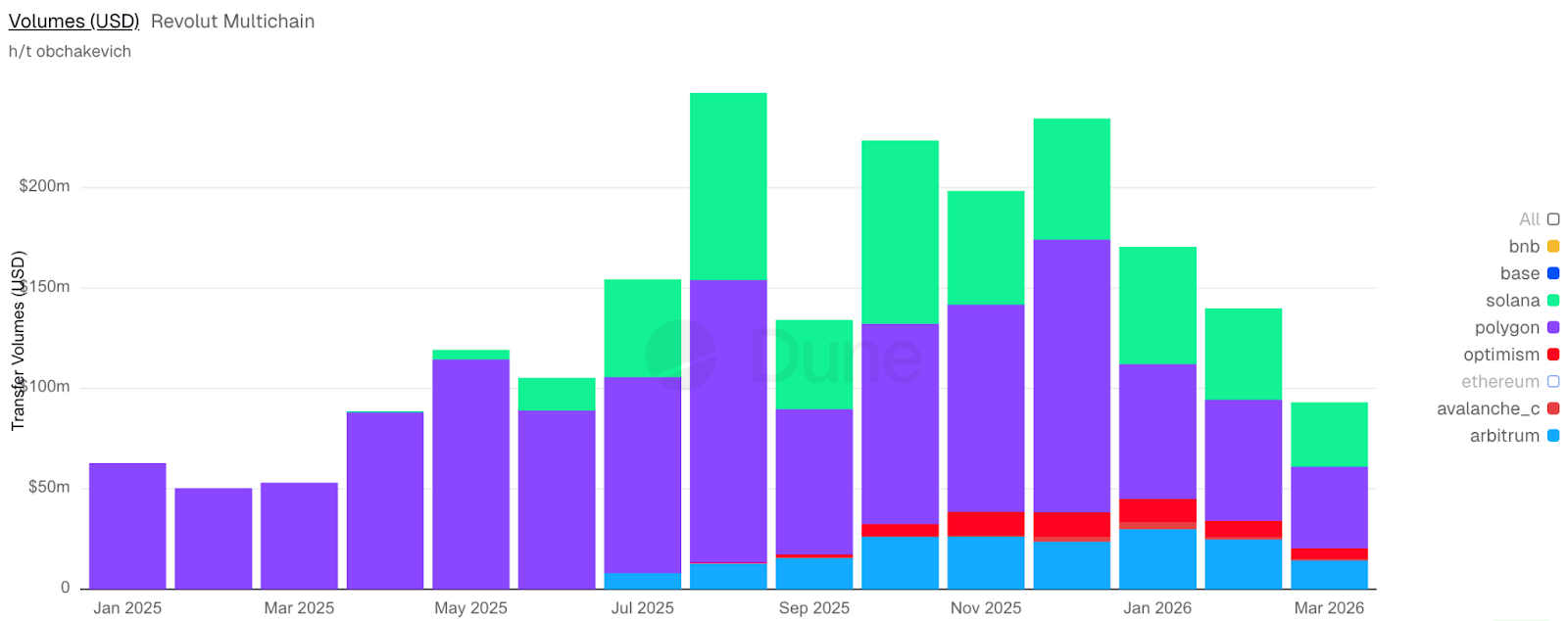
March 26th 9AM ET – Polygon Labs today announced that Revolut, Europe’s largest digital bank with more than 65 million customers worldwide, has crossed $1.2 billion in cumulative transaction volume on Polygon – a milestone that contributed to Polygon closing the month as the number one blockchain network by transaction count, underscoring the accelerating shift of everyday payments onto blockchain rails.
Despite decades of innovation, correspondent banking remains slow and costly for cross-border transfers. The global remittance market moves over $905 billion annually, yet according to the World Bank, sending money across borders still costs an average of 6.49% of the amount sent, with traditional banks charging over 14%. The UN Sustainable Development Goals call for reducing these costs to under 3% by 2030, a target the industry has so far struggled to meet.
Revolut’s Polygon integration drastically reduces these costs for users in the UK and the European Economic Area, who can now send USDC, USDT, and POL settling in seconds rather than days. Polygon leads in the lowest gas fees compared to other blockchains Revolut has integrated with: data show that a majority of the time, gas fees are 426x more expensive on Ethereum and 4x more expensive on Solana. Revolut also offers 1:1 stablecoin-to-USD conversion with no spreads, eliminating the hidden FX margins that inflate traditional transfer costs.
The milestone arrives amid a landmark period for Revolut’s digital asset ambitions. The UK’s Financial Conduct Authority selected Revolut to participate in its regulatory sandbox for stablecoin testing, where the neobank will pilot a pound-denominated stablecoin designed to maintain a 1:1 peg to sterling. The selection signals growing regulatory confidence in Revolut’s crypto infrastructure at the same time the company is reportedly in early-stage discussions for a secondary share sale that could value the firm at $100 billion or more with an eventual IPO target of up to $150 billion.
“Legacy banking infrastructure still makes international money movement slow and costly; Revolut crossing $1 billion on Polygon proves there’s a better way,” said Marc Boiron, Polygon Labs CEO. “We’re not asking people to change how they send money. We’re modernizing the settlement layer underneath it for scale, speed, and cost. Same app, same experience, radically better economics.”
Recent network data shows Polygon leading among major blockchains in stablecoin transaction activity, leading both by transaction counts and volume. This includes more than 20 million USDC transactions processed over a single weekend.
Polygon recently announced the acquisitions of Coinme and Sequence, and unveiled the Open Money Stack, an open, integrated set of blockchain-based payment and stablecoin services that enable institutions to move money globally, end-to-end, by replacing a fragmented web of vendors, contracts, and APIs they navigate today with a single integration.
The Open Money Stack enables institutions to build with enterprise-grade wallets, tap compliant on/off-ramps, seamlessly integrate existing payments flows, and leverage the deep stablecoin liquidity and stability of Polygon Chain. Revolut’s volume on Polygon Chain is a direct expression of this: real users, real scale, and blockchain infrastructure operating invisibly beneath a familiar financial app.
Revolut’s FCA sandbox participation further validates the trajectory. By piloting a regulated GBP stablecoin while running more than $1.2 billion in stablecoin volume through Polygon, Revolut is building both the regulatory credibility and the production-scale infrastructure that institutional-grade money movement demands.
Revolut’s integration represents this vision in action. POL, the native token of the Polygon ecosystem, is available for trading on Revolut and Revolut X, with in-app staking offering yields of up to 4% APY. The company’s fiat-to-crypto on-ramp, Revolut Ramp, supports Polygon Chain, enabling users to transfer funds directly from bank accounts to digital wallets.
The $1.2 billion milestone comes as Revolut’s stablecoin payment volumes surged an estimated 156% year-over-year in 2025 to approximately $10.5 billion across all supported chains, affirming Polygon’s position as the preferred infrastructure for institutional-grade payments. Revolut, now projecting $9 billion in revenue and $3.5 billion in profit for 2026, making it Europe’s most valuable private fintech, is expected to pursue a share sale later this year that could value the company north of $100 billion ahead of an eventual IPO. As of January 2026, Polygon currently supports more than $3 billion in stablecoin supply, processes an average of 6 million transactions per day, and delivers settlement in approximately two seconds at an average cost of $0.008 per transaction.
Revolut joins a growing roster of enterprises building on Polygon, including Mastercard, Stripe, Robinhood, Grab, Calastone, Reliance Jio, Paxos, Flutterwave, and Standard Chartered-backed AlloyX; Paxos recently passed $1.3 billion in volume on Polygon, a 50x volume growth in 12 months. In 2025, Polygon Chain saw a 264% increase in stablecoin volume year-over-year, processing $932B total transfers.
“This milestone reflects what happens when you combine world-class fintech with infrastructure purpose-built for scale,” said Sandeep Nailwal, co-founder of Polygon and CEO of Polygon Foundation. “Revolut’s users don’t need to understand blockchain. They just experience faster, cheaper money movement. That invisible integration is exactly how mainstream adoption happens.”
For more information, please visit polygon.technology.
-end-
For more information, please contact:
CLPR | polygon@clpr.agency
About Polygon Labs
Polygon Labs is a global blockchain payments company building and operating infrastructure to move money instantly, reliably, and at internet scale, with the mission to move all money onchain. It is building the Polygon Open Money Stack, an open and integrated stack of services and technologies to instantly and reliably move money anywhere, and put it to work. Its infrastructure has facilitated trillions of dollars in onchain value transfer and supported millions of transactions daily for some of the globe’s largest banks, fintechs, enterprises, and consumer applications.


You May Also Like

'Real Housewives' star may hold key to unlocking Ghislaine Maxwell's prison secrets: Dem

EUR/GBP Exchange Rate Surges as Bank of England Rate Hike Expectations Intensify – Market Analysis




